

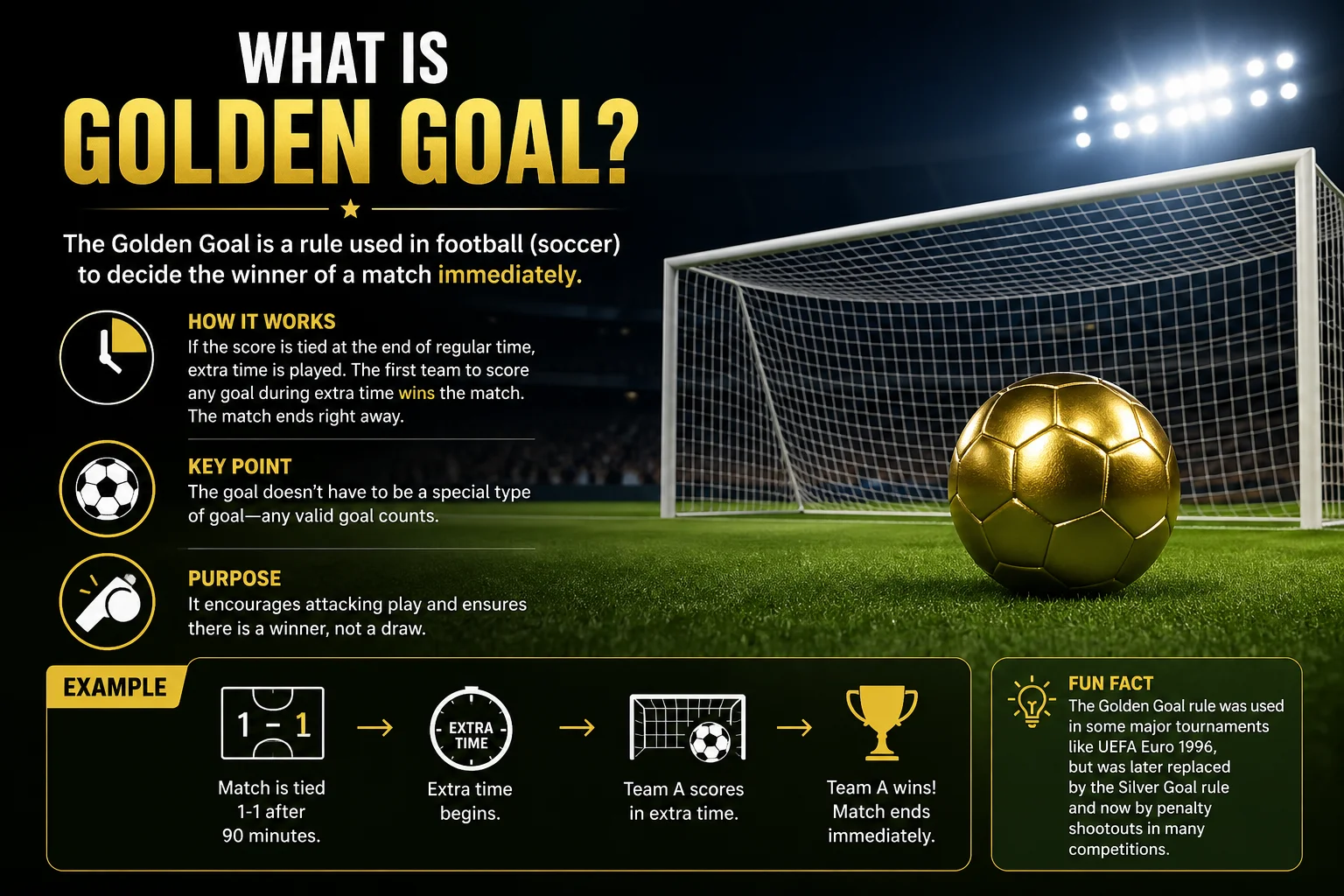
The Golden Goal
Football’s Most Dramatic Sudden-Death Rule
What Is A Golden Goal?
The Golden Goal once brought edge-of-your-seat drama to football, turning every extra-time minute into a high-stakes battle. Introduced in the 1990s, this rule meant that the very first goal scored in extra time instantly ended the match, declaring the scoring team the winner.
The Promise
It promised more attacking football and a way to reduce the frequency of unpredictable penalty shootouts.
Iconic Moments
- Oliver Bierhoff (Euro 1996): The first major international golden goal.
- David Trezeguet (Euro 2000): A stunning volley that clinched the title for France.
While its sudden-death excitement thrilled fans, it also reshaped team tactics—often making teams more defensive out of fear—and left a lasting mark on football history.
Golden Goal Explained
Definition and Simple Explanation
The Golden Goal rule was a football tiebreaker used in extra time. If a team scored during extra time, the match ended immediately, and that team was declared the winner.
Golden Goal
- Match ends immediately when a goal is scored in extra time.
- No need to play the remaining minutes.
- Creates sudden-death pressure.
Normal Extra Time (Current Rule)
- Two full 15-minute halves are played.
- Even if a team scores, the match continues.
- The opposing team still has time to respond.
- If still tied after 30 minutes, the match goes to penalties.
Normal extra time = Full 30 minutes played regardless of scoring.
Why Golden Goal Was Introduced
Origins & Intention to Encourage Attacking Play
The Golden Goal rule was officially introduced by FIFA in the early 1990s as a way to make extra time more exciting and decisive.
Before this change, many teams played very cautiously during extra time because they were afraid of conceding and losing. This often led to defensive, slow-paced football and matches that ended in penalty shootouts.
Encourage Attacking Football
Teams were motivated to push forward and score quickly rather than sit back defensively.
Reduce Penalty Shootouts
Organizers wanted more matches decided through open play instead of penalties.
Increase Excitement
The sudden-death nature created dramatic, high-pressure moments for players and fans.
Replacement of the “Sudden Death” Concept
The idea of “sudden death” already existed informally in sports, meaning the first score in extra time wins. The Golden Goal formally introduced this concept into official football competitions.
How Golden Goal Worked (Rules & Application)
Competitions That Used It
The Golden Goal rule was officially adopted by FIFA in the 1990s and used in several major international tournaments.
Notable competitions that applied the rule include:
🏆 FIFA World Cup
1998 and 2002 editions
🇪🇺 UEFA Euro
1996 and 2000 editions
🌍 FIFA Youth Cups
Various international youth levels
⚽ Domestic Cups
Select national cup competitions
Extra Time Duration and Conditions
The Golden Goal applied only during extra time — not during the normal 90 minutes.
Golden Goal vs Silver Goal — Key Differences
Comparison with the Silver Goal Rule
Both the Golden Goal and Silver Goal were extra-time rules designed to reduce penalty shootouts and make matches more decisive — but they worked differently. The Silver Goal was introduced by UEFA as a modified version of the Golden Goal.
⚡ Golden Goal
- First team to score in extra time wins immediately.
- Match ends instantly (sudden death).
- No chance for the opponent to respond.
- Used in tournaments like FIFA World Cup (1998, 2002).
🥈 Silver Goal
- If a team was leading at the end of the first 15-minute half of extra time, they won the match.
- The game did not stop immediately after a goal.
- The opposing team had the remainder of the half to equalize.
- Used in events such as UEFA Euro 2004.
⚡ Golden Goal = instant sudden death.
🥈 Silver Goal = win at halftime of extra time (if leading).
Why Both Were Later Abolished
- Defensive mindset increased – Teams became overly cautious, fearing a single mistake would end the match.
- Didn’t significantly reduce penalties – Many games still went to shootouts.
- Perceived unfairness – Matches could end abruptly without giving the other team a real chance to respond.
- Less attacking football than expected – Teams often avoided risks instead of playing boldly.
Famous Golden Goal Moments
The Golden Goal rule produced some of the most dramatic and memorable moments in football history. Here are the standout examples:
🇪🇺 Euro 1996
Oliver Bierhoff scored the first-ever Golden Goal in a major tournament during the final against the Czech Republic. His goal in extra time instantly won Germany the European Championship.
🏆 World Cup 1998
During the Round of 16, Laurent Blanc scored a Golden Goal for France against Argentina. This was the first Golden Goal in World Cup history, sending France through to the quarter-finals.
🇪🇺 Euro 2000
The final between France and Italy was decided by a Golden Goal from David Trezeguet. His strike in extra time gave France the European Championship title instantly.
⚽ Other Notable Examples
Saeed Al-Owairan scored a Golden Goal in domestic cup competitions, and several UEFA club matches in the late 1990s were decided by Golden Goals, creating unforgettable moments for fans.
Tactical Impact on Teams
How Teams Approached Extra Time Under This Rule
The Golden Goal rule significantly affected how teams played during extra time. Because a single goal could instantly end the match:
⚠️ Increased Caution
Teams became very careful in possession to avoid conceding.
🎯 Targeted Attacks
Teams looked for quick counterattacks rather than prolonged build-up play.
⏱️ Time Management Focus
Coaches often substituted defensive players to protect against sudden defeat.
🧠 Psychological Pressure
Players were under immense stress knowing that one mistake could immediately lose the game.
Criticisms and Strategic Conservative Play
- Encouraged defensive mindset – Teams often played conservatively, “parking the bus” rather than attacking.
- Reduced fairness – Matches could end abruptly, leaving little chance for the opposing team to respond.
- Less entertaining than expected – Fans and analysts observed that fear of sudden loss dominated tactics.
- Led to rule abandonment – Strategic drawbacks were a key reason authorities eventually abolished Golden Goal and Silver Goal, returning to full extra-time periods followed by penalties.
Legacy & Where the Rule Is Used Today
Football and Related Sports Experiments
The Golden Goal rule was a significant experiment in association football. Adopted in 1993, it was abolished in 2004 because it did not consistently encourage attacking play and sometimes led to overly cautious strategies.
Although no longer used in major professional football (like FIFA World Cup or UEFA tournaments), similar “sudden death” concepts continue in other sports:
🏒 Ice Hockey
The NHL uses golden point overtime in regular-season games — the first team to score in overtime wins.
🏉 Rugby League
Golden point system decides tied games by the first score in extra time.
⚽ College Soccer (NCAA)
Used up to 2021, briefly removed in 2022, reinstated for post-season play in 2024.
🥅 Field Hockey
FIH-sanctioned competitions continue to use golden-goal-style extra time.
Rule Abolition and Modern Extra Time Usage
In football today, after abolishing Golden Goal and Silver Goal in 2004:
- Knockout matches tied after 90 minutes play two full 15-minute halves of extra time.
- If still tied, matches are decided by a penalty shootout.
This system ensures both teams have the full extra time to press for a result, which is seen as fairer than instant-death sudden goals.
FAQs
Anti – OffsideAston VillaBallon d’OrBarcelonaBright Football ClubCareer Football CoachCenter-BackChampions LeagueChampions League Predictionsconcacaf champions cup 2026Cristiano Ronaldofootball bros unblockedFootball Club MenuFootball FormationFootball Netball ClubFootball's Most Talked-AboutGo Ahead EaglesInter MilanNorway national football teamOffsidePrediction of serie aPreviewRomaSerie ASoccer Rulessoccer throw in rulesStriker Soccertransfer marktYellow Card Soccer

stromi
Website: https://footballclubmenu.com/









Leave a Reply