

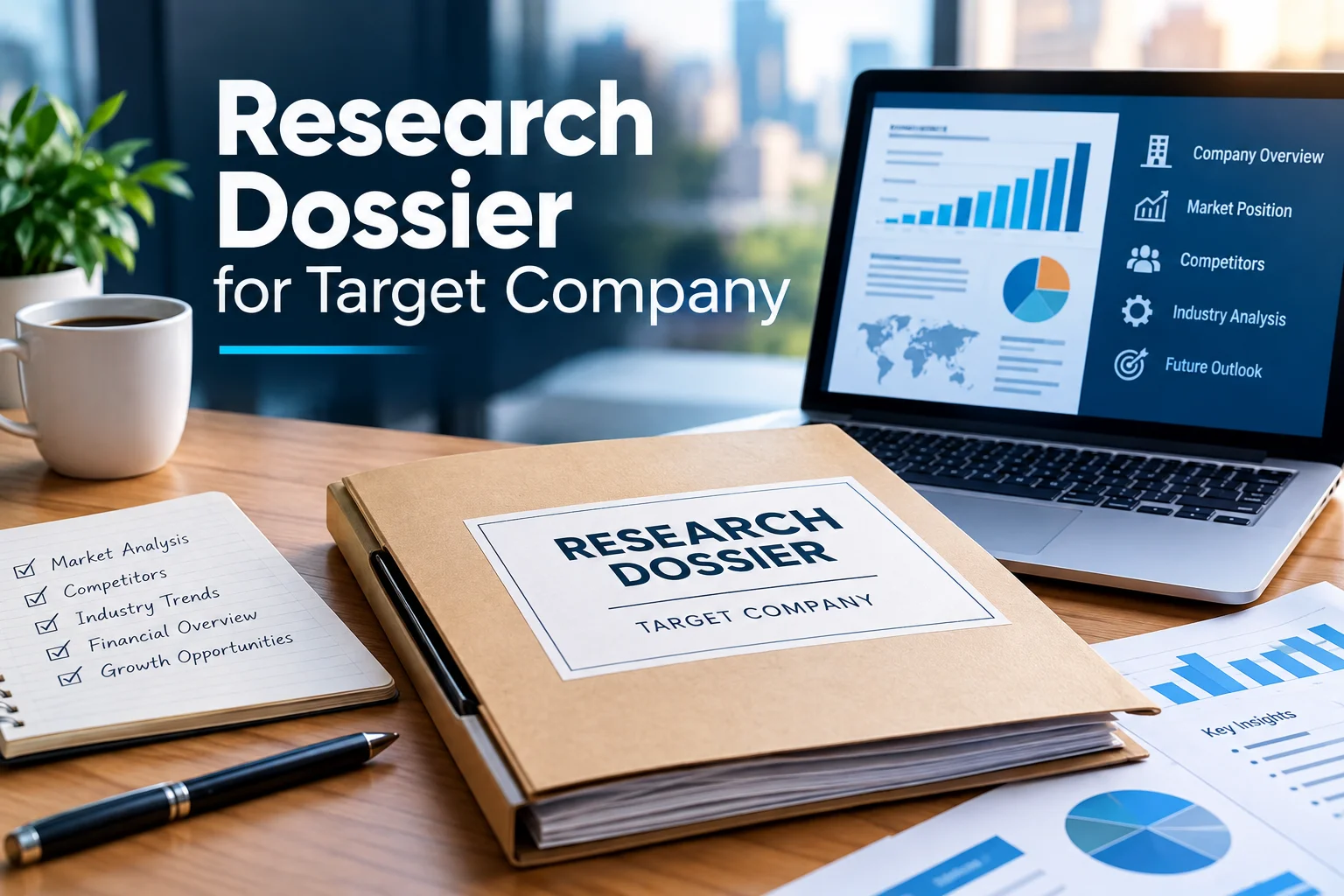
A research dossier for target company is a structured way to collect, organize, verify, and analyze important information about a specific business. Instead of keeping scattered notes from websites, reports, news articles, and public records, a well-prepared dossier brings relevant information into one clear document. It can help researchers understand a company’s background, business model, leadership, products, market position, competitors, financial information, and potential risks.
The value of company research comes from more than collecting facts. Good research connects information with reliable evidence and useful context. A company may describe its products or growth positively, but a strong dossier also checks those statements against independent and primary sources. This creates a more balanced and useful research record.
Building a Research Dossier for Target Company
A successful dossier should begin with a clear research purpose. The goal might be to understand a prospective business partner, prepare for a sales conversation, study a competitor, evaluate a supplier, or conduct general market research.
Before gathering large amounts of information, decide which questions the research needs to answer. This prevents the document from becoming overloaded with irrelevant details.
Start With Company Identification
The first section should establish the company’s basic identity. Record the official business name, website, industry, headquarters, operating regions, founding information, ownership structure, and major brands where applicable.
It is also useful to create a short timeline of important developments. Major launches, acquisitions, leadership changes, expansions, or strategic shifts can provide valuable context when reviewing the company’s current position.
Examine the Business Model
Understanding how a company operates is one of the most important parts of the research process. Look at its products or services, customers, pricing approach, distribution channels, and primary revenue sources.
Ask practical questions about how the organization creates value. Does it sell directly to consumers, serve other businesses, use subscriptions, depend on advertising, or combine several revenue streams?
This section should explain the commercial engine behind the company rather than simply listing its products.
Key Information to Include
A research dossier for target company should contain information that directly supports the research objective. While every dossier can be customized, several categories are commonly useful.
- Company background, ownership, locations, and major developments
- Products, services, customers, pricing, and business model
- Leadership, workforce, operations, technology, and resources
- Financial information, competitors, market position, and recent developments
- Legal, regulatory, reputational, operational risks, and supporting sources
The depth of each section should depend on the purpose of the research. A basic market study may need a concise company profile, while a major business evaluation can require substantially more evidence and verification.
Research Dossier for Target Company: Evidence and Sources
Reliable evidence is the foundation of a useful dossier. Information should not be treated equally simply because it appears online.
Primary sources can provide especially valuable information. These may include official company reports, regulatory filings, investor materials, government records, official announcements, and published corporate documents. Secondary sources such as established business publications and industry research can add context and independent perspectives.
Every important statistic should have a date. Revenue, employee numbers, locations, market share, leadership positions, and product information can change over time. Recording the reporting period makes the research more accurate and easier to update.
Create an Evidence Log
An evidence log can make the dossier considerably stronger. For each important finding, record the source, publication date, research date, and a short note explaining why the information matters.
This approach also helps identify conflicting information. If two sources provide different employee figures, for example, the dossier can investigate whether they refer to different dates, regions, subsidiaries, or definitions.
Financial and Market Research
Financial information can reveal important patterns, but individual figures should always be considered in context. Depending on the availability of public information, researchers may examine revenue, profitability, expenses, cash flow, debt, funding, or other relevant indicators.
The market section should examine the environment surrounding the company. Identify major competitors and consider how the company differentiates itself through products, pricing, technology, customer experience, distribution, or specialization.
A useful comparison can be organized like this:
| Research Area | Information to Examine | Why It Matters |
|---|---|---|
| Company Profile | History, ownership, locations | Establishes business identity |
| Business Model | Products, services, revenue sources | Explains how the company operates |
| Market | Customers, competitors, trends | Provides industry context |
| Financials | Revenue, expenses, funding | Shows financial direction |
| Risk | Legal, operational, market concerns | Highlights uncertainty |
| Evidence | Sources, dates, verification | Improves research reliability |
The table can serve as a simple framework when creating a new company dossier.
Leadership, Operations, and Technology
Leadership research can provide additional context about an organization. Record publicly documented executives, founders, senior managers, and significant leadership changes when they are relevant to the research objective.
Operations deserve attention as well. Consider locations, suppliers, distribution systems, technology infrastructure, production capabilities, and other resources that influence how the business delivers its products or services.
For technology-focused businesses, research may also cover software platforms, patents, intellectual property, digital infrastructure, or product development. However, claims should be supported by credible evidence rather than assumptions.
Identifying Risks and Opportunities
Every company operates within a changing environment. A useful dossier should therefore identify relevant risks without presenting speculation as fact.
Potential areas include changing customer demand, competition, regulatory requirements, supply-chain challenges, financial pressure, technology changes, cybersecurity concerns, or dependence on particular markets.
At the same time, researchers can document observable opportunities such as new markets, product expansion, partnerships, technology adoption, or increasing customer demand.
The important principle is evidence. A potential opportunity should be described as an opportunity supported by available information, not as a guaranteed outcome.
Keeping the Dossier Accurate
Company research should be treated as a living document. New financial results, leadership changes, product launches, acquisitions, and market developments can make older information less useful.
Review important sections regularly and update dates whenever information changes. Keep older findings where they provide historical context, but clearly distinguish current information from previous reporting periods.
It is also helpful to separate three categories: confirmed facts, attributed claims, and researcher analysis. This simple distinction can prevent accidental overstatement.
Common Mistakes to Avoid
A strong dossier can still become unreliable if the research process is careless. Avoid copying promotional language as though it were independent evidence. Do not use outdated statistics without identifying their dates. Avoid relying on only one source for important claims.
Another common problem is collecting too much information. More pages do not automatically create better research. The strongest dossier focuses on information that answers the original research questions.
Frequently Asked Questions
How long should a company research dossier be?
Its length depends on the research objective. A basic dossier can be relatively short, while complex research may require detailed financial, market, operational, and risk sections.
Which sources should researchers use?
Official company documents, regulatory records, government information, established publications, and credible industry sources can provide useful evidence. Important claims should be checked where possible.
Should financial information include dates?
Yes. Financial figures can change significantly between reporting periods, so the relevant year, quarter, or publication date should be recorded.
Can a private company be researched?
Yes. Public information can include company websites, business registrations, announcements, interviews, industry publications, and other legitimate sources. The amount of available information varies between businesses.
How often should a dossier be updated?
Update it whenever important information changes. For active research projects, periodic reviews can help keep company details, leadership, financial information, and market developments current.
Final Thoughts
A research dossier for target company provides a powerful framework for turning scattered business information into an organized research resource. The most useful dossier does not simply collect impressive statistics or large numbers of links. It connects relevant facts with reliable evidence, dates, context, and careful analysis.
Start with a clear objective, identify the company accurately, investigate its business model, study its market and competitors, examine available financial information, and document important risks and developments. Most importantly, maintain an evidence trail for significant findings.










Leave a Reply