

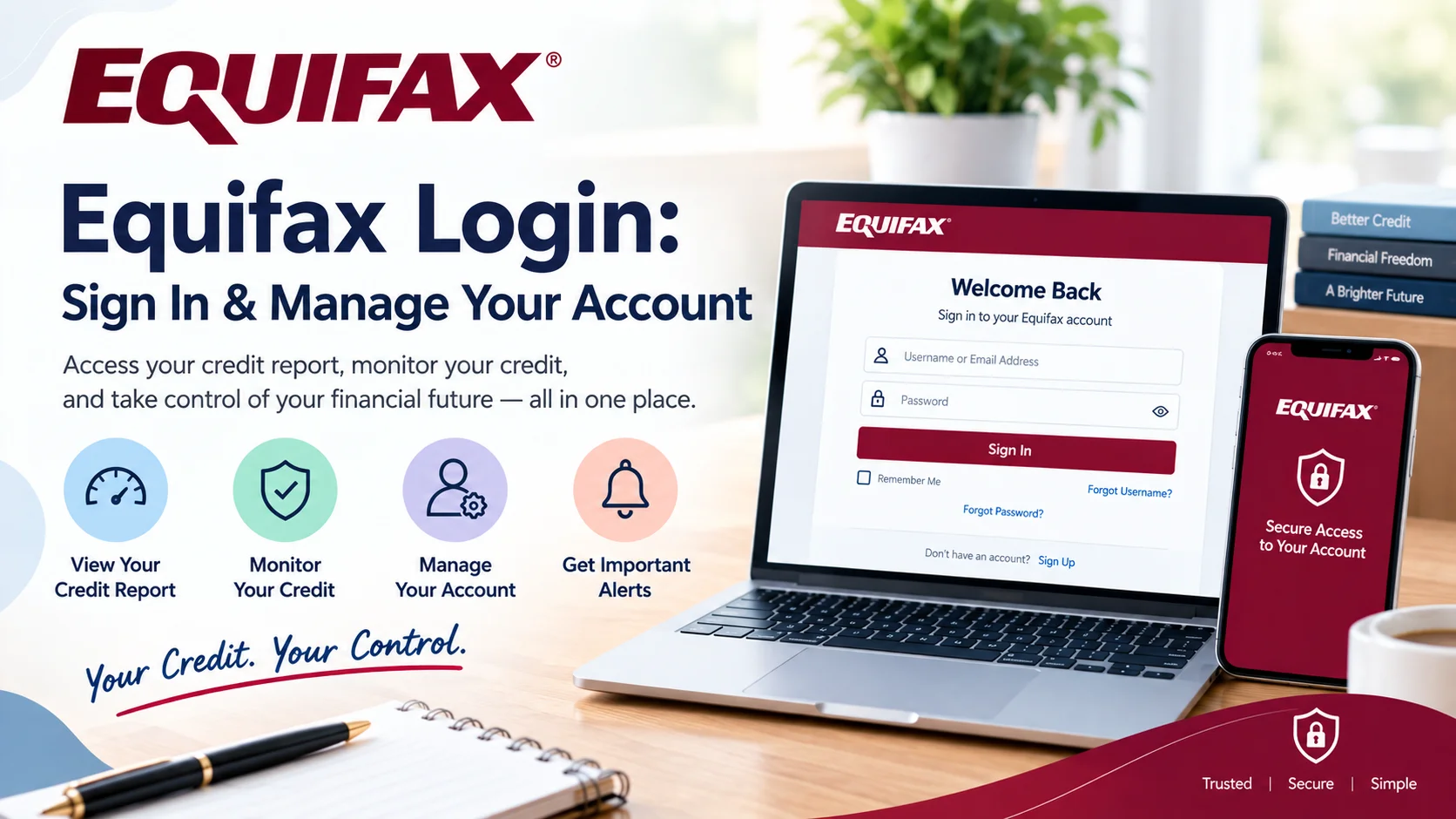
Equifax is one of the three major credit reporting agencies in the United States, alongside Experian and TransUnion. Managing your Equifax account allows you to monitor your credit score, review your credit report for errors, lock or freeze your credit file to prevent identity theft, and track financial updates in real time.
Getting Started with Equifax
Creating and managing an online account with Equifax gives you direct oversight of your credit health. Before logging in, it is helpful to understand what an account offers and what information you need to set one up.
Requirements for Setting Up an Account
To register for a new Equifax account, you must verify your identity to ensure your personal financial data remains secure. You will typically need to provide:
Full Legal Name: Including any suffixes (e.g., Jr., III).
Social Security Number (SSN): Required to match your account with your credit history.
Date of Birth: Used as an additional identity verification layer.
Current Residential Address: You may also need to provide previous addresses if you have moved recently.
Contact Information: A valid email address and phone number for account alerts and multi-factor authentication.
Key Benefits of an Online Equifax Account
Having direct online access to your Equifax file provides several distinct advantages:
Free Credit Reports: Access your Equifax credit report regularly to check for accuracy.
Credit Score Tracking: View your credit score and understand the factors influencing it, such as payment history and credit utilization.
Credit Lock and Freeze Management: Place, temporarily lift, or permanently remove credit freezes and locks with a few clicks.
Dispute Resolution: Submit and track disputes directly through the dashboard if you spot inaccurate information on your report.
Fraud Alerts: Set up initial or extended fraud alerts to warn potential lenders that your identity may be compromised.
Step-by-Step Equifax Login Guide
Accessing your Equifax dashboard requires following a secure login process. Whether you are using a desktop web browser or a mobile device, the procedure remains relatively standard.
Logging In via Web Browser
Navigate to the Official Portal: Open your preferred web browser and go directly to the official Equifax website. Always check the URL bar to ensure you are on the authentic domain.
Locate the Sign-In Button: Find the “Sign In” or “MyEquifax Login” button, usually located in the top right corner of the homepage.
Enter Credentials: Type in the username (or registered email address) and password associated with your account.
Complete Security Check: If prompted, pass the CAPTCHA or two-factor authentication (2FA) verification step.
Access Dashboard: Click “Log In” to enter your secure user account dashboard.
Logging In via Mobile Devices
If you prefer managing your credit on the go, you can access your account using a mobile browser or the official Equifax mobile application.
Mobile App Access: Download the official Equifax app from your device’s native app store. Launch the application, enter your standard credentials, and sign in. Many mobile devices support biometric login options, such as fingerprint or facial recognition, for faster access.
Mobile Browser Access: Open your phone’s web browser and navigate to the Equifax site. The interface automatically adjusts to mobile screen sizes, providing the same login fields as the desktop version.
Account Features and Dashboard Overview
Once signed into your account, you arrive at the central dashboard. This hub organizes all your credit services into easily navigable sections.
Reviewing Your Credit Report and Score
Your main dashboard displays your current credit score alongside key summaries of your report.
Score Factors: The dashboard highlights top factors driving your score up or down, such as your total debt balance, length of credit history, and recent inquiries.
Detailed Reports: You can open a full breakdown of open accounts, including credit cards, mortgages, auto loans, and personal loans, alongside their payment statuses.
Managing Credit Locks and Freezes
One of the most vital security tools in your Equifax account is controlling access to your credit file.
Credit Freeze: A legally mandated tool that prevents lenders from accessing your credit report to open new accounts. You can place or lift a freeze at any time through your account without charge.
Credit Lock: A feature offered through specific Equifax products that allows you to toggle access to your report on or off instantly using an interactive switch in the app or website.
Filing and Tracking Disputes
Inaccuracies on a credit report can negatively affect your credit score. If you spot an error—such as an incorrect balance, an unfamiliar account, or a payment wrongly marked as late—you can initiate a dispute online.
Navigate to the Disputes section of your portal.
Select the specific account or item you wish to challenge.
Choose the reason for the dispute (e.g., “Account does not belong to me” or “Incorrect payment history”).
Upload supporting documents, such as bank statements or paid receipts.
Submit the dispute and monitor its status directly from your dashboard. Most investigations conclude within 30 days.
Troubleshooting Common Login Issues
Encountering issues while attempting to log into your account can be frustrating, but most access problems can be resolved quickly using standard troubleshooting methods.
Forgotten Username or Password
If you cannot remember your login credentials, avoid making multiple failed attempts, as this may temporarily lock your account for security purposes.
Password Reset: Click the “Forgot Password?” link on the login page. Enter your registered email address to receive a secure password reset link. Follow the instructions to create a new, strong password.
Username Recovery: Click “Forgot Username?” and provide your full name, SSN, and date of birth to recover the email address associated with your profile.
Locked Accounts and Identity Verification
If your account is locked due to unusual activity or multiple failed login attempts, you may need to go through an identity verification process to restore access.
Verification Questions: You may be asked multiple-choice questions based on your personal financial history (e.g., former addresses, previous auto loan lenders, or mortgage amounts).
Document Submission: In some cases, Equifax may require you to upload a copy of a government-issued photo ID (driver’s license or passport) and a recent utility bill to confirm your identity before unlocking the account.
Browser and Technical Glitches
Technical difficulties on your device can sometimes interfere with the login portal. Try these quick fixes:
Clear Cache and Cookies: Outdated stored browser data can cause loading errors on secure portals.
Disable Browser Extensions: Certain ad blockers or privacy extensions may interfere with login scripts or security pop-ups.
Try Incognito/Private Mode: Opening a private browsing window helps rule out conflicts caused by cached data or extensions.
Switch Browsers: Test signing in using a different web browser (e.g., switching from Chrome to Firefox or Safari).
Security Best Practices for Your Equifax Account
Because your Equifax account contains highly sensitive financial and personal information, maintaining strict digital security is essential.
Essential Password Safety Rules
Create Unique Passwords: Never reuse a password on your Equifax account that you use for email, social media, or other websites.
Use Strong Combinations: Draft passwords that are at least 12 to 16 characters long, combining uppercase and lowercase letters, numbers, and special symbols.
Avoid Personal Information: Do not use easily guessable information like birthdays, street names, or family member names in your password.
Enabling Multi-Factor Authentication (MFA)
Multi-factor authentication adds a critical second layer of defense. When MFA is active, logging in requires both your standard password and a secondary code sent to your phone or generated by an authenticator app. This ensures that even if someone discovers your password, they cannot access your account without your physical device.
Protecting Against Phishing Scams
Cybercriminals often use fraudulent emails, text messages, or spoofed websites that look identical to official portal pages to steal login credentials.
Check the URL: Ensure the browser address reads
equifax.comwith a secure connection indicator (the padlock icon) before entering any information.Avoid Unsolicited Links: Never click on login links embedded in unexpected emails or text messages claiming your account is locked or suspended. Instead, open a new tab and navigate to the main website manually.
Verify Communications: Equifax representatives will never contact you out of the blue asking for your account password or full Social Security number.
Contacting Equifax Support
If online self-service options do not resolve your account issue, you can reach out directly to customer support for assistance.
Customer Service Channels
Phone Support: Call the official Equifax customer service number for assistance with login issues, dispute updates, or fraud reporting. Phone numbers are listed on the official website’s contact section.
Online Help Center: Search the built-in knowledge base for answers to frequent questions regarding subscriptions, credit reports, and account settings.
Mail Support: For formal disputes or document submissions, you can send correspondence via certified mail to Equifax’s official mailing address for credit reporting assistance.












Almawadahit.com: Insights, News & Useful Ideas - Football club menu
[…] or assessing sustainable energy shifts, these articles provide the contextual depth necessary for informed decision […]