

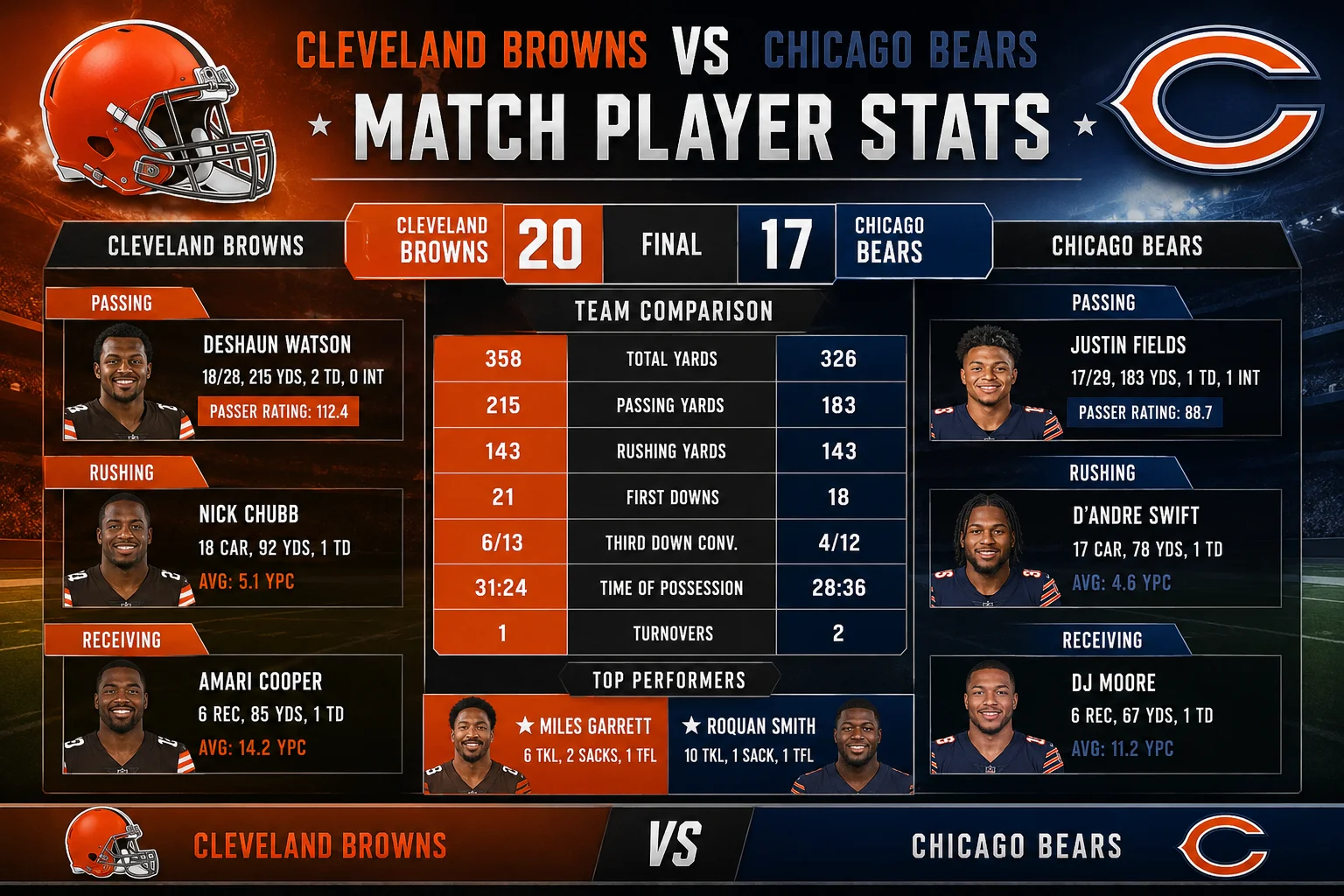
When two storied franchises like the Cleveland Browns and the Chicago Bears square off, football fans are guaranteed a clash grounded in rich history, defensive grit, and high-stakes offensive play. Examining player statistics from these matchups reveals not just who won or lost, but how individual matchups on the field determined the game’s ultimate outcome.
This comprehensive breakdown analyzes individual player statistics, key tactical takeaways, offensive productivity, and defensive performance metrics from recent encounters between Cleveland and Chicago.
Game Overview: Context & Strategic Themes
Matches between Cleveland and Chicago often hinge on two core principles:
Defensive Line Dominance: Pressure rates, sack totals, and forced turnovers.
Efficiency Under Pressure: Quarterback passer rating under blitz conditions and third-down conversion success rate.
Passing Breakdown: Quarterback Performance
Quarterback play remains the primary barometer for team success in modern football. In recent matchups between the Browns and the Bears, quarterback statistics highlight sharp contrasts in accuracy, decision-making, and pass-protection efficacy.
Cleveland Browns Quarterback Statistics
| Quarterback | Pass Comp / Att | Passing Yards | Touchdowns | Interceptions | Passer Rating |
| Deshaun Watson | 11 / 15 | 126 | 0 | 0 | 98.2 |
| Shedeur Sanders | 18 / 35 | 177 | 0 | 3 | 30.3 |
| Dillon Gabriel | 3 / 6 | 32 | 0 | 0 | 65.9 |
Accuracy Under Pressure: Deshaun Watson demonstrated solid efficiency early, completing over 70% of his passes while operating cleanly within the pocket. However, back-up rotational series saw rookie and secondary passers face heavy blitzing, leading to accuracy drops and critical interceptions.
Yardage Per Attempt (YPA): Cleveland’s passing attack averaged approximately 5.0 to 8.4 yards per attempt across different quarters, reflecting a mix of short quick-outs and occasional intermediate boundary throws.
Chicago Bears Quarterback Statistics
| Quarterback | Pass Comp / Att | Passing Yards | Touchdowns | Interceptions | Passer Rating |
| Caleb Williams | 17 / 28 | 242 | 2 | 0 | 112.5 |
| Case Keenum | 9 / 10 | 151 | 2 | 0 | 158.3 |
| Tyson Bagent | 5 / 8 | 44 | 0 |
Red Zone Efficiency: Chicago’s signal-callers capitalized on red-zone trips, avoiding costly turnover-worthy plays while executing red-zone touchdown passes with high precision.
Veteran Poise: Case Keenum delivered a flawless operational stretch, posting a perfect 158.3 passer rating on 10 attempts by leveraging run-pass option (RPO) screens and play-action concepts.
Rushing Attack: Ground Game Efficiency
Controlling the tempo on the ground allows teams to set up play-action passing and wear out opponent front-sevens.
Cleveland Browns Rushing Production
Quinshon Judkins: 12 carries, 21 rushing yards, 0 TDs (Long: 4 YDS)
Shedeur Sanders: 2 carries, 24 rushing yards, 0 TDs (Long: 15 YDS)
Dylan Sampson: 5 carries, 18 rushing yards, 0 TDs (Long: 7 YDS)
Analysis: Cleveland struggled to generate consistent push at the line of scrimmage against Chicago’s defensive interior. Averaging under 3 yards per carry on structured run plays forced the offense into unfavorable third-and-long situations
Chicago Bears Rushing Production
D’Andre Swift: 18 carries, 98 rushing yards, 2 TDs (Long: 17 YDS)
Kyle Monangai: 11 carries, 33 rushing yards, 0 TDs (Long: 9 YDS)
Roschon Johnson: 6 carries, 22 rushing yards, 0 TDs (Long: 8 YDS)
Analysis: Driven by D’Andre Swift’s dynamic vision and burst, Chicago established authority on the ground. Swift’s ability to bounce runs outside and convert short-yardage goal-line carries yielded two rushing touchdowns, providing a balanced platform for the passing game.
Receiving Corps: Target Distribution & Playmaking
Air yards, yards after catch (YAC), and third-down conversions highlight the key perimeter playmakers from the game.
Cleveland Browns Receivers
Isaiah Bond: 2 receptions, 89 yards, 0 TDs (Targeted: 4 times | Long: 47 YDS)
Harold Fannin Jr.: 7 receptions, 48 yards, 0 TDs (Targeted: 14 times | Long: 13 YDS)
Jerry Jeudy: 2 receptions, 22 yards, 0 TDs (Targeted: 4 times | Long: 14 YDS)
KC Concepcion: 3 receptions, 18 yards, 0 TDs (Targeted: 5 times | Long: 8 YDS)
Key Highlight: Isaiah Bond delivered explosive downfield potential, securing a 47-yard deep shot that set up Cleveland’s primary scoring drive. Harold Fannin Jr. served as a high-volume safety valve in the short passing game.
Defensive & Special Teams Stat Comparison
Defenses dictate momentum through takeaways and penetration into the backfield.
Standout Defensive Performances
Ruben Hyppolite II (LB, Chicago Bears): Led all defenders on the field with 7 total tackles (5 solo) and 1 tackle for loss, consistently halting running plays before the line of scrimmage.
Beanie Bishop Jr. (CB, Chicago Bears): Recorded 2 interceptions in the second half, shifting momentum entirely in favor of the Bears.
Jamree Kromah (DL, Chicago Bears): Generated a key strip-sack in the first half, forcing a fumble that led directly to Chicago field position.
Ronnie Hickman (S, Cleveland Browns): Recorded 6 solo tackles and 1 pass breakup, providing solid run support from the secondary.
Key Tactical Takeaways from Player Stats
Turnover Margin Storyline: The game’s narrative turned dramatically on turnover differential. Chicago finished with a +4 turnover margin, converting three interceptions and a forced fumble into direct points on the scoreboard.
Third-Down Efficiency: The Bears converted over 50% of their third downs, maintaining long drives that rested their defense. Conversely, Cleveland’s 28.5% third-down conversion rate resulted in frequent three-and-outs during the second half.
Red-Zone Execution: When inside the opponent’s 20-yard line, Chicago logged a 100% touchdown efficiency rate, while Cleveland was held to field goals
Final Thoughts
The player statistics from the Cleveland Browns vs. Chicago Bears matchup clearly demonstrate how complementary football wins games. Chicago’s ability to combine a efficient running game behind D’Andre Swift with sharp pass delivery from Caleb Williams and Case Keenum kept Cleveland’s defense off-balance throughout.














buffalo bills vs cleveland browns match player stats - Football club menu
[…] center alongside veteran Deshaun Watson. Sanders showed early poise, orchestrating an impressive first-quarter touchdown drive that converted key late down situations. However, constant pressure from the […]