

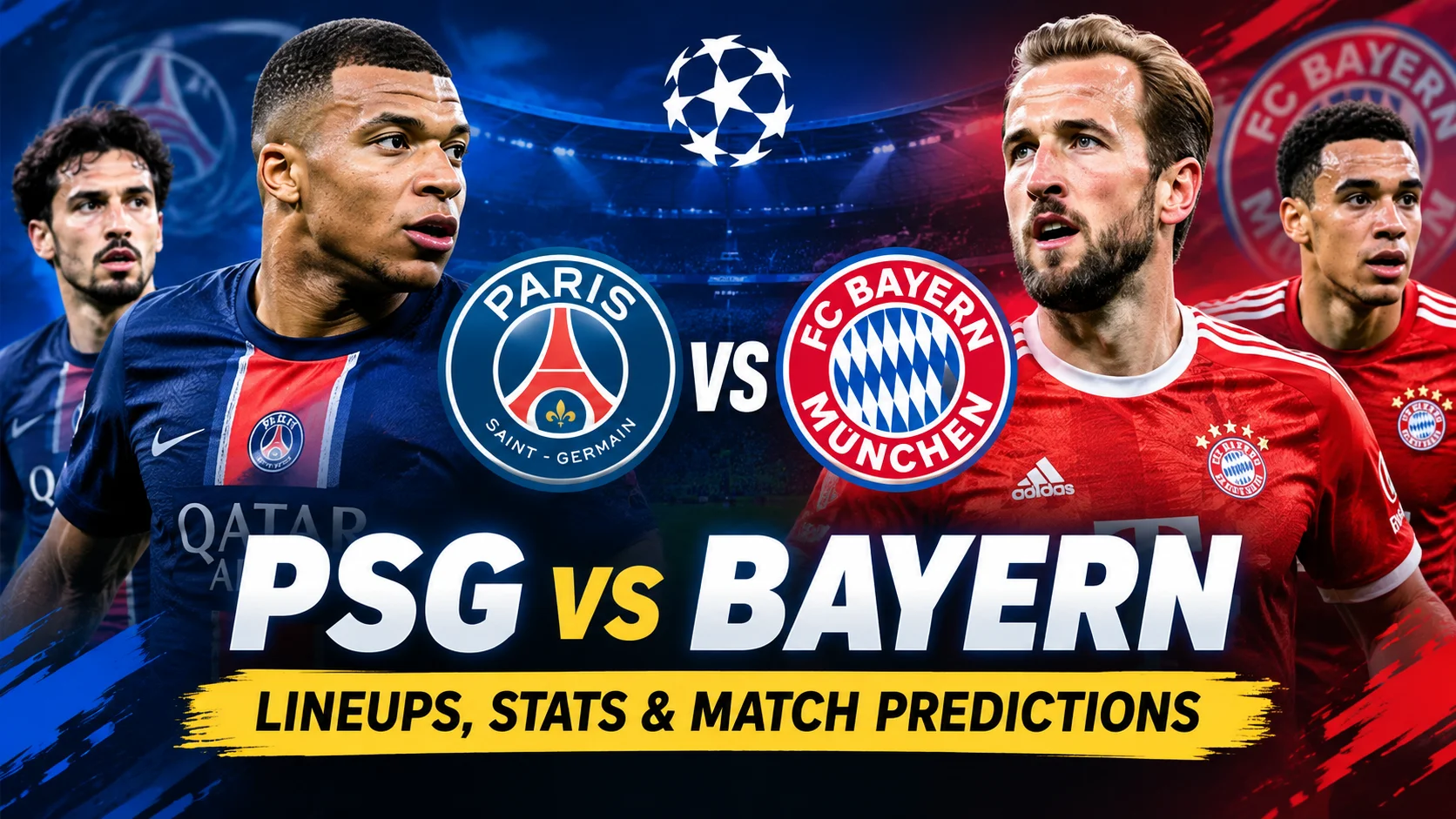
PSG vs Bayern has become one of the most compelling modern matchups in European football. Both clubs have regularly competed deep into the UEFA Champions League, bringing elite attacking talent, experienced midfielders, and strong tactical identities to their meetings. Their 2025/26 Champions League semi-final produced another unforgettable chapter, with Paris Saint-Germain winning the first leg 5-4 before a 1-1 draw in Munich sent PSG through 6-5 on aggregate.
The matchup is especially fascinating because both teams prefer proactive football. PSG can create danger through quick combinations, pressing, and wide attacks, while Bayern traditionally look to control possession and use their attacking players between the lines. The result is often an intense contest where momentum can change quickly.
PSG vs Bayern Lineups and Tactical Setup
Paris Saint-Germain Lineup
In the first leg of the 2026 semi-final, PSG used a 4-3-3 formation. Matvey Safonov started in goal behind Achraf Hakimi, Marquinhos, Willian Pacho, and Nuno Mendes. Warren Zaïre-Emery, Vitinha, and João Neves formed the midfield, while Désiré Doué, Ousmane Dembélé, and Khvicha Kvaratskhelia led the attack.
This setup gave PSG balance between midfield control and attacking width. Dembélé’s movement was particularly important because he could move centrally while Hakimi provided an additional attacking outlet from the right.
Bayern Munich Lineup
Bayern lined up in a 4-2-3-1 formation, with Manuel Neuer in goal. Josip Stanišić, Dayot Upamecano, Jonathan Tah, and Alphonso Davies started in defence, while Joshua Kimmich and Aleksandar Pavlović operated in midfield. Michael Olise, Jamal Musiala, and Luis Díaz played behind Harry Kane.
The structure allowed Bayern to create a strong attacking triangle behind Kane. Musiala could find pockets of space, Olise offered creativity from the right, and Díaz provided direct running and attacking intensity.
Key PSG vs Bayern Stats
The first leg demonstrated just how closely matched these teams could be despite their different approaches. Bayern enjoyed 57.4% possession compared with PSG’s 42.6%, while Bayern recorded eight shots on target to PSG’s five. PSG, however, produced 12 total shots compared with Bayern’s 10.
The most important statistic remained the scoreline. PSG scored five times, while Bayern found the net four times in a spectacular attacking contest. The nine-goal match was the highest-scoring semi-final in Champions League history at that point.
| Category | PSG | Bayern |
|---|---|---|
| Possession | 42.6% | 57.4% |
| Total shots | 12 | 10 |
| Shots on target | 5 | 8 |
| Corners | 2 | 5 |
| Passes received | 313 | 423 |
| Fouls | 14 | 4 |
These numbers show an important tactical lesson: possession alone did not determine the outcome. Bayern controlled more of the ball, but PSG were extremely effective when attacking space and turning opportunities into goals.
The Players Who Can Change the Game
Ousmane Dembélé
Dembélé was one of PSG’s biggest attacking threats during the semi-final. He scored twice in the first leg and then scored again in the second leg, giving PSG an early advantage in Munich. His acceleration, movement, and ability to attack from different positions make him difficult for defenders to contain.
Khvicha Kvaratskhelia
Kvaratskhelia produced a decisive performance in Paris, scoring twice in the opening match. His ability to carry the ball, attack defenders, and create opportunities from the left gave PSG another dangerous dimension.
Harry Kane
Kane remains one of Bayern’s most reliable attacking figures. He opened the scoring from the penalty spot in Paris and later scored Bayern’s only goal in the second leg. His movement, finishing, and ability to connect with midfielders make him a constant threat.
Michael Olise
Olise also played an important role in the first leg, scoring Bayern’s second goal. His ability to receive the ball in advanced positions and create shooting opportunities makes him an influential part of Bayern’s attacking structure.
Vitinha
For PSG, Vitinha’s midfield influence is equally important. His composure in possession allows PSG to progress the ball under pressure, while his positioning helps the team transition between defence and attack.
Tactical Battle to Watch
PSG’s Pressing and Transition Game
One of PSG’s biggest strengths is their ability to press after losing possession. The midfield can close passing lanes quickly, while the forwards attempt to force rushed decisions. When the ball is recovered, PSG can immediately attack through Dembélé, Kvaratskhelia, or Doué.
That combination creates a powerful attacking rhythm. PSG do not always need to dominate possession to control the most dangerous moments of a match.
Bayern’s Possession and Attacking Pressure
Bayern’s approach is often built around sustained possession. Kimmich can dictate play from midfield, while Musiala and Olise look for openings between the defensive and midfield lines.
Their approach can place opponents under significant pressure, particularly when Bayern recover the ball quickly after losing it. The challenge is avoiding defensive exposure when several players move forward.
Five Key Factors That Could Decide PSG vs Bayern
- Midfield control: The team that manages the central areas could dictate the tempo.
- Wide attacking: PSG’s wingers and Bayern’s wide players can create crucial one-on-one situations.
- Finishing: High-quality chances must be converted in major Champions League matches.
- Defensive transitions: Losing possession in dangerous areas can create immediate opportunities for the opponent.
- Goalkeeper performance: Safonov and Neuer can become decisive when attackers find clear chances.
Head-to-Head History
PSG vs Bayern has produced several memorable Champions League encounters. Bayern defeated PSG 1-0 in the 2020 Champions League final, while Bayern also eliminated Paris in the 2022/23 round of 16. UEFA records that Bayern had won seven of the teams’ previous nine meetings before PSG’s 5-4 victory in the 2026 semi-final first leg.
The history therefore gives Bayern an impressive record, but the latest chapter showed that PSG could finally reverse some of that recent dominance. Their 2026 semi-final victory was particularly significant because PSG had to withstand Bayern’s possession and attacking pressure across two demanding matches.
Match Prediction Analysis
Any PSG vs Bayern prediction should account for the quality and tactical flexibility of both sides. These are not teams that can be comfortably judged from possession statistics alone.
PSG’s attacking speed gives them a major advantage when the game becomes open. Dembélé, Kvaratskhelia, and Doué can exploit spaces behind defenders, while midfielders such as Vitinha and João Neves can support quick transitions.
Bayern, meanwhile, have the experience and attacking quality to punish defensive mistakes. Kane provides a reliable focal point, while Musiala, Olise, and Díaz can create different types of problems.
Based on the 2026 Champions League meetings, PSG’s ability to turn transitions into goals gives them a slight tactical edge in an open contest. Bayern’s possession and chance creation mean they should never be underestimated, however.
The strongest prediction is therefore a closely contested match with chances at both ends, rather than expecting a one-sided encounter. The 2026 semi-final illustrated exactly why: PSG won 5-4 in Paris despite having less possession, then secured a 1-1 draw in Munich to advance 6-5 overall.
Why This Rivalry Remains Special
The appeal of PSG vs Bayern goes beyond individual stars. It is a meeting between two clubs with ambitious European goals and different footballing traditions.
PSG’s modern identity emphasizes technical quality, aggressive pressing, speed, and creative attackers. Bayern combine possession, positional movement, physical intensity, and years of Champions League experience.
That contrast creates fascinating tactical battles. One team may dominate the ball while the other creates the sharper opportunities. A single transition, set piece, defensive mistake, or individual piece of brilliance can completely change the story.
Frequently Asked Questions:
When did PSG and Bayern last meet in the Champions League?
They met in the 2026 Champions League semi-final. PSG won the first leg 5-4 and drew the second leg 1-1, advancing 6-5 on aggregate.
Who won the 2020 Champions League final?
Bayern Munich defeated PSG 1-0 in the 2020 Champions League final.
Who scored in the 2026 first leg?
PSG’s scorers were Kvaratskhelia, João Neves, and Dembélé, while Bayern scored through Kane, Olise, Upamecano, and Luis Díaz.
What formation did PSG use?
PSG used a 4-3-3 formation in the first leg of the 2026 semi-final.
What formation did Bayern use?
Bayern used a 4-2-3-1 formation, with Kane leading the attack and Musiala, Olise, and Díaz operating behind him.
Final Thoughts
PSG vs Bayern remains a spectacular Champions League fixture because both clubs possess the quality to decide a match through attacking brilliance. Their 2026 semi-final proved that the rivalry can deliver drama, goals, tactical adjustments, and unforgettable individual performances.
PSG demonstrated that they can succeed without dominating possession, while Bayern showed why their experience and attacking depth make them such a formidable opponent. With players such as Dembélé, Kvaratskhelia, Kane, Musiala, Olise, and Vitinha involved, this matchup has all the ingredients for another memorable European contest.








Leave a Reply