

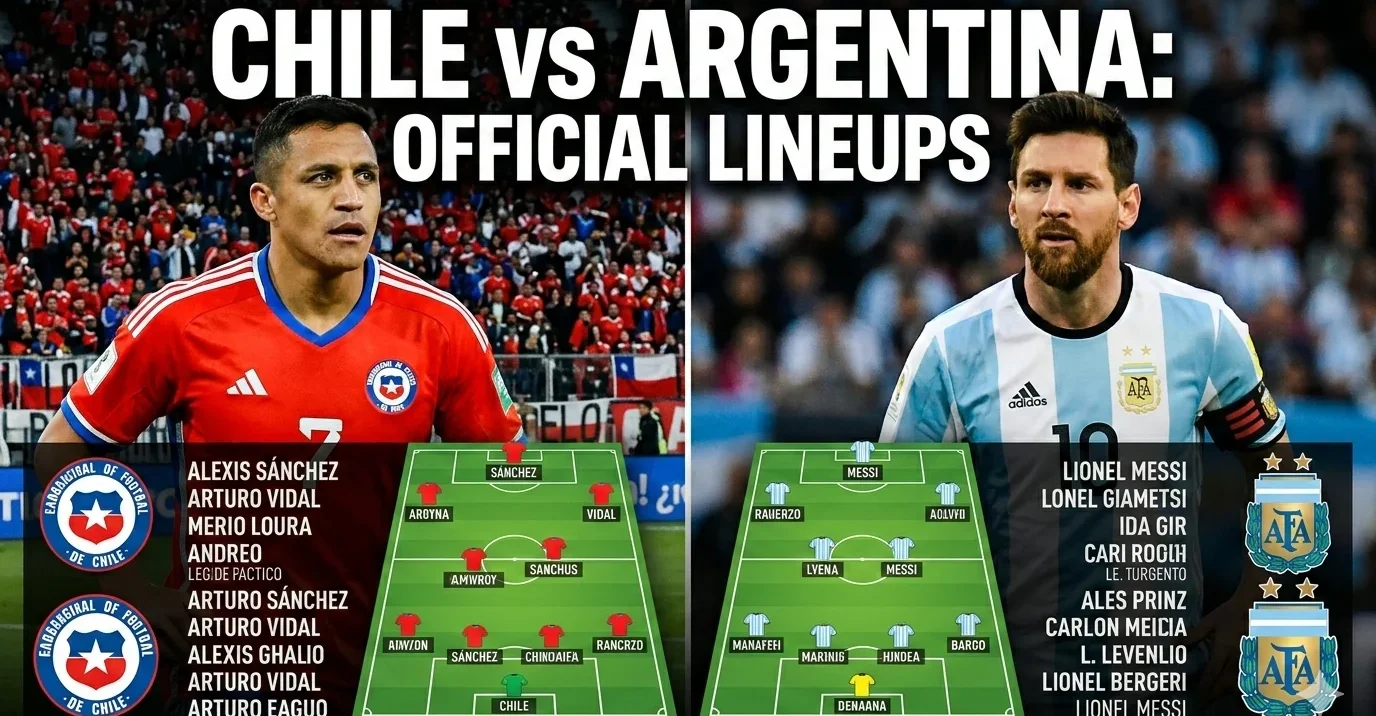
The confirmed starting XI for the chile national football team vs argentina national football team lineups clash highlights each team’s tactical approach and key players. Chile lined up in a disciplined 4‑3‑3, with Brayan Cortés in goal, a solid midfield trio of Pizarro, Echeverría, and Vidal, and Sánchez leading the attack alongside Osorio and Cepeda. Argentina also adopted a 4‑3‑3 formation, with Emiliano Martínez in goal, De Paul and Palacios orchestrating the midfield, and a forward line featuring Julián Álvarez, Thiago Almada, and Giuliano Simeone. These lineups reflect each team’s strategy: Chile emphasizing compactness and transitions, while Argentina focuses on possession, creativity, and attacking fluidity.
Confirmed Starting XI
Chile (Starting XI)
- GK: Brayan Cortés
- RB: Francisco Sierralta
- CB: Guillermo Maripán
- LB: Gabriel Suazo
- CM: Felipe Loyola
- CM: Rodrigo Echeverría
- CM: Vicente Pizarro
- CM: Arturo Vidal
- FW: Alexis Sánchez
- FW: Darío Osorio
- FW: Lucas Cepeda
Argentina (Starting XI)
- GK: Emiliano Martínez
- RB: Nahuel Molina
- CB: Cristian Romero
- CB: Nicolás Tagliafico
- LB: Leonardo Balerdi
- CM: Rodrigo De Paul
- CM: Exequiel Palacios
- CAM: Nico Paz
- RW/CF: Julián Álvarez
- LW/CAM: Thiago Almada
- CF: Giuliano Simeone
Formation Diagrams (SVG/Table)
Chile — 4-3-3 Formation
Cortés
Suazo
Maripán
Sierralta
Loyola
Pizarro
Echeverría
Vidal
Osorio
Sánchez
Cepeda
| Position | Player |
|---|---|
| GK | Brayan Cortés |
| RB | Gabriel Suazo |
| CB | Guillermo Maripán |
| CB | Francisco Sierralta |
| LB | Felipe Loyola |
| CM | Vicente Pizarro |
| CM | Rodrigo Echeverría |
| CM | Arturo Vidal |
| RW | Darío Osorio |
| ST | Alexis Sánchez |
| LW | Lucas Cepeda |
Argentina — 4-3-3 Formation
Martínez
Molina
Romero
Balerdi
Tagliafico
De Paul
Palacios
Nico Paz
Almada
Simeone
Álvarez
| Position | Player |
|---|---|
| GK | Emiliano Martínez |
| RB | Nahuel Molina |
| CB | Cristian Romero |
| CB | Leonardo Balerdi |
| LB | Nicolás Tagliafico |
| CM | Rodrigo De Paul |
| CM | Exequiel Palacios |
| CM | Nico Paz |
| RW | Thiago Almada |
| ST | Giuliano Simeone |
| LW | Julián Álvarez |
Argentina positioned Julián Álvarez centrally with Almada and Paz supporting wide.
Chile’s front trio featured Sánchez centrally with Osorio and Cepeda wide.
Bench & Substitutes Depth Chart
Chile – Bench & Substitutes Depth Chart
| # | Player | Position |
|---|---|---|
| 1 | Gabriel Castellón | GK |
| 12 | Lawrence Vigouroux | GK |
| 13 | Benjamín Kuscevic | CB |
| 16 | Igor Lichnovsky | CB |
| 2 | Fabián Hormazábal | RB / Mid |
| 15 | Esteban Pavez | DM / Mid |
| 7 | Marcelino Núñez | CM |
| 21 | Matías Sepúlveda | LM |
| 22 | Lucas Assadi | AM |
| 19 | Javier Altamirano | AM |
| 9 | Alexander Aravena | LW |
| 11 | Víctor Dávila | CF |
| Minute | In | Out | Type |
|---|---|---|---|
| 46’ | Fabián Hormazábal | Vicente Pizarro | Tactical |
| 46’ | Javier Altamirano | Arturo Vidal | Tactical |
| 58’ | Alexander Aravena | Darío Osorio | Tactical |
| 87’ | Marcelino Núñez | Felipe Loyola | Tactical |
| 87’ | Víctor Dávila | Alexis Sánchez | Tactical |
Argentina – Bench & Substitutes Depth Chart
| # | Player | Position |
|---|---|---|
| 12 | Gerónimo Rulli | GK |
| 1 | Walter Benítez | GK |
| 2 | Juan Foyth | CB |
| 4 | Kevin Lomónaco | CB |
| 15 | Facundo Medina | CB |
| 5 | Enzo Barrenechea | DM |
| 19 | Valentín Barco | CM |
| 8 | Emiliano Buendía | AM |
| 21 | Ángel Correa | AM / FW |
| 20 | Franco Mastantuono | RW / FW |
| 10 | Lionel Messi | RW / AM |
| 22 | Lautaro Martínez | CF |
| Minute | In | Out | Type |
|---|---|---|---|
| 57’ | Lionel Messi | Nico Paz | Tactical |
| 79’ | Facundo Medina | Leonardo Balerdi | Tactical |
| 80’ | Ángel Correa | Julián Álvarez | Tactical |
| 84’ | Juan Foyth | Giuliano Simeone | Tactical |
| 84’ | Franco Mastantuono | Thiago Almada | Tactical |
Tactical Analysis & Key Battles
Chile – 4-3-3
Defensive Shape: Chile set up in a disciplined 4-3-3, staying compact in the center to block Argentina’s attacking midfield. Fullbacks Suazo and Loyola pushed up slightly to provide width in attack.
Midfield Control: The midfield trio (Pizarro, Echeverría, Vidal) aimed to disrupt Argentina’s build-up, using physicality and pressing in the central zones. Vidal often dropped deep to support the center-backs while Pizarro and Echeverría transitioned quickly to counterattack.
Attack Strategy: Chile relied on quick transitions and wide play. Osorio and Cepeda stretched the Argentine defense while Sánchez remained the central pivot, linking midfield to attack.
Argentina – 4-3-3
Possession-Oriented Build-Up: Argentina dominated possession with a high line, often using De Paul and Palacios to control tempo. Nico Paz and Almada provided creative passing lanes between Chile’s lines.
Wide Penetration: Almada and Álvarez frequently attacked the flanks, creating overloads against Chile’s fullbacks. Simeone and Almada rotated in the final third to confuse markers and exploit gaps.
Defensive Pressure: Argentina’s backline stayed high, using offside traps and pressing Chile’s defenders during ball circulation.
Key Battles (Click to Expand)
Arturo Vidal vs Rodrigo De Paul
- Midfield enforcer vs playmaker. Vidal’s physicality aimed to disrupt Argentina’s rhythm, while De Paul tried to dictate play and exploit spaces in transition.
Sánchez vs Tagliafico
- Chile’s captain led attacks centrally, challenging Argentina’s left-back. Tagliafico balanced defensive duties with supporting wide attacks.
Osorio/Cepeda vs Molina/Álvarez
- Wide battle between Chile’s wingers and Argentina’s fullbacks, deciding overloads or wide opportunities.
Goalkeeper Duel: Cortés vs Martínez
- Critical saves influenced momentum. Martínez’s anticipation helped Argentina build from the back, while Cortés kept Chile in the game.
Midfield Triangles
- Chile’s compact midfield tried to close angles; Argentina countered with movement between the lines to open passing channels and create overloads.
- Chile’s compact midfield slowed Argentina but left space on the flanks.
- Argentina’s high pressing and quick passing allowed them to control possession and exploit Chile’s transitions.
- Set-pieces and wide duels were decisive in creating scoring chances.
- Substitutions like Messi (for Nico Paz) and Aravena (for Osorio) altered tactical dynamics in the second half.
Chile vs Argentina — Player Comparison
| Position | Chile Player | Key Attributes | Argentina Player | Key Attributes | Key Battle Notes |
|---|---|---|---|---|---|
| GK | Brayan Cortés | Reflexes, shot-stopping, distribution | Emiliano Martínez | Reflexes, positioning, distribution | Both keepers had crucial saves; Martínez influenced build-up from the back |
| RB | Gabriel Suazo | Crossing, defensive positioning | Nahuel Molina | Pace, overlapping runs | Suazo’s defensive discipline vs Molina’s wide penetration |
| CB | Guillermo Maripán | Aerial duels, tackling | Cristian Romero | Aggression, tackling, passing out | Physical duel in central defense; ball recovery crucial |
| CB | Francisco Sierralta | Marking, tackling | Leonardo Balerdi | Positioning, ball-playing | Chile tried to block space; Argentina sought penetration through Balerdi |
| LB | Felipe Loyola | Stamina, marking | Nicolás Tagliafico | Experience, attacking support | Left flank battles; Loyola contained Tagliafico’s forward runs |
| CM | Vicente Pizarro | Passing, defensive cover | Rodrigo De Paul | Playmaking, vision | Vidal vs De Paul triangle; central control battle |
| CM | Rodrigo Echeverría | Tackling, interceptions | Exequiel Palacios | Passing, positioning | Midfield duel; Chile focused on breaking Argentina’s rhythm |
| CM | Arturo Vidal | Leadership, tackling | Nico Paz | Creativity, movement | Vidal disrupted play, Paz sought spaces between lines |
| RW | Darío Osorio | Pace, dribbling | Thiago Almada | Dribbling, crossing | Wide duel; chances often originated from these matchups |
| ST | Alexis Sánchez | Finishing, link-up play | Giuliano Simeone | Movement, finishing | Central striker duel; Sánchez linked play, Simeone exploited spaces |
| LW | Lucas Cepeda | Speed, crossing | Julián Álvarez | Creativity, off-ball runs | Wide-left battle; decision-making in final third pivotal |
Latest Team News & Injury Updates
Argentina – Team News & Injuries
Key Updates:
- Valentín Carboni suffered a serious knee injury (ACL + partial LCL), ruling him out of the 2026 FIFA World Cup.
- Juan Foyth is out long-term after an Achilles rupture, unavailable for upcoming major matches.
- Giovani Lo Celso is recovering from a proximal muscle strain affecting availability.
- Lautaro Martínez has a leg/soleus muscle issue, raising doubts for upcoming fixtures.
- Nicolás Tagliafico is returning from a significant ankle sprain.
- Lionel Messi reintegrated into the squad after adductor injury, monitored for fitness.
- Past suspensions (Leandro Paredes, Enzo Fernández, Nicolás Otamendi) were match-specific and short-term.
Coaching staff remain cautious ahead of major tournaments; fitness reports updated regularly.
Chile – Team News & Injuries
Key Updates:
- No major international-level injuries reported as of March 2026.
- Focus remains on squad selection and balance rather than injury crises.
- Media coverage emphasizes performance and tactics rather than player absences.
- Club incidents like Javier Altamirano’s convulsive episode are not affecting national team status.
Chile’s squad remains largely fit, allowing coaching staff flexibility in line-up selection.
Head-to-Head Lineup Trends & History
Chile – Typical Approach
Formations: Predominantly 4‑3‑3 or 4‑2‑3‑1 in modern matchups.
Focus:
- Central midfield is often more defensive and physical, attempting to close down Argentina’s creative outlets.
- Frontmen like Alexis Sánchez, Eduardo Vargas, and Ben Brereton provide the core attacking threat in big games.
- Chile tends to set up compact, waiting to strike on transitions.
Trend: Chile’s coaches often favor experience and grit in midfield to counter Argentina’s playmakers.
Argentina – Typical Approach
Formations: Mostly 4‑3‑3 (occasionally variants with a “false nine” or narrow formation).
Focus:
- Prioritize possession and creativity, often deploying a playmaker (Messi, Mac Allister, De Paul).
- A balanced midfield mix of creative and box‑to‑box players allows Argentina to control tempo.
- Wide attackers and forward rotation keep opponents guessing.
Trend: Argentina’s lineup trends toward maximizing offensive creativity while maintaining central control.
Recent Head-to-Head Lineup Patterns (Last Few Meetings)
| Match | Formation Trend | Chile Focus | Argentina Focus |
|---|---|---|---|
| June 2025 – World Cup Qualifier | 4‑3‑3 (both) | Sánchez with wide support | High possession with Almada & Paz |
| Sep 2024 – World Cup Qualifier | 4‑3‑3 (Argentina) | Depth via Osorio & Vargas | Mix of Mac Allister, De Paul, Álvarez |
| June 2024 – Copa América | 4‑3‑3 (both) | Experienced defensive base | Messi, Mac Allister leading attack |
| June 2021 – Copa América | 4‑3‑3 (both) | Balanced but less creative | Creative pivot Lionel Messi |
| Jan 2022 – WC Qualifier | 4‑3‑3 | Vargas & Brereton key | Di María & Lautaro spearheading |
Across recent matchups, both teams frequently opt for a 4‑3‑3 base, but Argentina’s lineup tends to have more creative central influence, while Chile’s is more balanced toward midfield solidity.
FAQs – Chile vs Argentina Match
1. When was the last match between Chile and Argentina?
The most recent encounter between Chile and Argentina took place in June 2025 during the World Cup Qualifiers, with Argentina winning 1-0.
2. What formations did the teams use?
Both teams primarily used a 4-3-3 formation in recent matches, with Argentina focusing on creative midfield play and Chile maintaining defensive solidity and counterattack options.
3. Who were the standout players in recent fixtures?
Key players included Alexis Sánchez, Arturo Vidal, and Brayan Cortés for Chile, and Lionel Messi, Rodrigo De Paul, and Emiliano Martínez for Argentina.
4. Were there any notable injuries impacting the teams?
Argentina had several key injuries including Valentín Carboni (ACL) and Juan Foyth (Achilles), while Chile reported no major national team injuries recently.
5. What are the head-to-head trends between Chile and Argentina?
Historically, Argentina tends to dominate possession and create through central playmakers, while Chile balances midfield solidity with counterattacking and wide options.
Conclusions
chile national football team vs argentina national football team lineups fielded competitive lineups reflecting their tactical philosophies. Chile relied on experience and a compact midfield to counter Argentina’s creative threats, with Sánchez leading the attack. Argentina, meanwhile, emphasized possession, fluid movement, and attacking width, with Messi, Álvarez, and Almada providing the creative spark. The clash of styles — Chile’s disciplined structure versus Argentina’s attacking dynamism — set the stage for a tightly contested and strategically rich encounter.









Leave a Reply