

Organizations planning large-scale online examinations, employee assessments, and professional certification programs need more than a basic testing tool. They need a reliable platform that can handle thousands of exams, manage candidates, organize results, and support growing testing requirements. This is where Test.com Pricing Enterprise Plans becomes an important consideration for businesses and institutions comparing assessment software.
Test.com is associated with Gauge Online, an online examination and certification platform designed for organizations with professional testing requirements. Its Enterprise pricing structure includes an annual software subscription, hosting charges, and an initial setup fee. Additional costs may depend on examination volume, integrations, and optional services.
Understanding these expenses before purchasing can help organizations prepare a realistic budget and avoid unexpected charges. This guide explores Test.com enterprise annual costs, setup fees, volume-based pricing, plan differences, and important questions to ask before requesting a customized quotation.
Understanding Test.com and Its Enterprise Testing Platform
Test.com, Inc. provides Gauge Online, a platform designed to help organizations create, deliver, and manage online examinations. It is intended for professional testing environments rather than organizations that only need simple classroom quizzes.
The platform can support certification programs, employee assessments, training examinations, and professional qualification processes. These activities often involve large numbers of candidates, structured question banks, examination records, and reporting requirements.
Who Can Benefit From Test.com Enterprise?
Enterprise testing software can be useful for several types of organizations:
-
Certification organizations: Manage professional examinations and credentialing programs.
-
Training companies: Evaluate employees, students, and course participants.
-
Government agencies: Organize structured qualification and assessment programs.
-
Trade associations: Deliver examinations for industry memberships and professional standards.
-
Large businesses: Conduct employee training, compliance assessments, and internal evaluations.
The main advantage is having examination management and candidate administration within a centralized system.
Test.com Pricing Enterprise Plans: Annual Costs and Fees
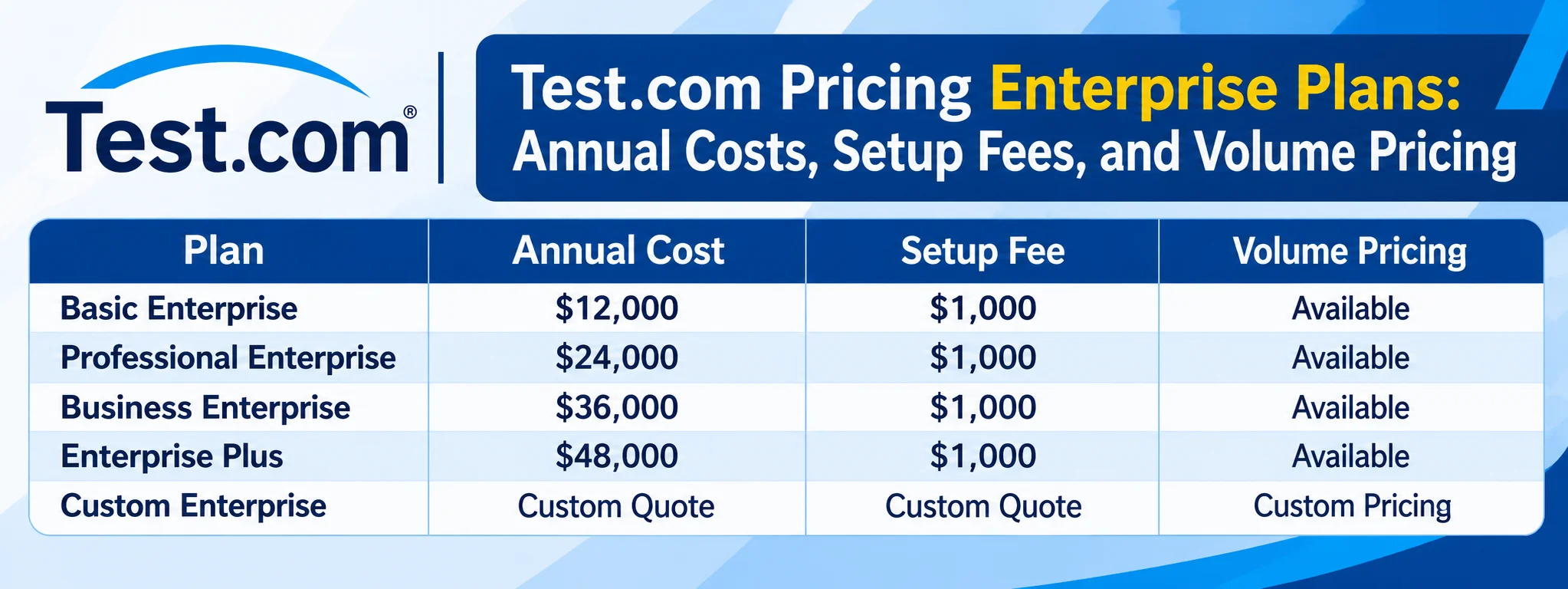
The Enterprise plan is designed for organizations with substantial testing requirements. Publicly reported starting prices associated with Gauge include a $10,000 annual software fee, $1,000 annual hosting charge, and $2,000 one-time setup fee.
These amounts should be treated as starting figures rather than a guaranteed quotation. Your final agreement may depend on testing volume, technical requirements, and additional services.
How the Enterprise Annual Pricing Structure Works
The published Enterprise pricing has three main components. Each serves a different purpose, so buyers should review them separately when calculating their first-year investment.
1. Annual Software Subscription
The Enterprise software subscription starts at $10,000 per year. This is the main platform charge and provides access to the Enterprise offering.
It is intended for organizations administering more than 10,000 examinations annually. The platform includes access to enterprise-focused capabilities such as certification and badging, proctoring integration, lessons, eCommerce functionality, and developer tools.
The actual subscription may change depending on the organization’s examination volume and requirements.
2. Annual Hosting Fee
Gauge lists an additional $1,000 hosting charge for Enterprise customers.
Hosting is an important part of the overall budget because organizations need a dependable environment for examination delivery, candidate records, and certification activities.
Before signing an agreement, confirm the hosting billing schedule, service coverage, storage arrangements, and whether any additional infrastructure requirements could affect the final amount.
3. One-Time Setup Fee
The published Enterprise setup fee is $2,000.
This is an initial charge rather than a recurring annual subscription component. Setup and onboarding should be discussed in detail because organizations may need assistance with platform configuration, existing examination content, user records, and technical integrations.
Gauge states that its onboarding team supports data migration, including existing user records, examination history, and question banks. Buyers should confirm the precise migration scope and implementation timeline in their agreement.
Test.com Enterprise First-Year Cost Calculation
Understanding the combined charges makes financial planning easier. Based on the published starting prices, the basic first-year calculation is:
-
Annual Enterprise software: $10,000
-
Annual hosting: $1,000
-
One-time setup: $2,000
Calculated first-year starting cost
$13,000
Annual software and hosting
$11,000
One-time setup
$2,000
Illustrative calculation using published starting prices, not a personalized vendor quotation.
After the initial setup, the software and hosting components total approximately $11,000 annually, assuming the published rates remain unchanged and the setup fee is not charged again.
These calculations do not establish a guaranteed renewal price or include every possible additional service.
How Test.com Volume Pricing Works
Examination volume is one of the most important factors when evaluating Test.com Pricing Enterprise Plans.
Organizations conducting thousands of examinations have different requirements from businesses delivering hundreds of thousands of assessments. Their server capacity, administrative workflows, support needs, and certification activities may also differ.
Gauge states that Enterprise volume pricing starts at $3 per test, with the rate decreasing as examination volume increases. The company invites high-volume organizations to request a customized plan based on their actual requirements.
Understanding Per-Test Pricing
A per-test pricing model connects software expenses to examination activity. This can help organizations estimate costs using their expected annual testing numbers.
For example, consider an organization planning 15,000 examinations annually.
At the published starting rate of $3 per test, a simple volume illustration would be:
15,000 × $3 = $45,000.
However, this is only an illustrative calculation, not a confirmed $45,000 customer quotation. Gauge also publishes a $10,000 annual Enterprise starting price, so buyers should ask whether the volume calculation replaces, supplements, or is incorporated into the base subscription.
This distinction is important when comparing a customized quote with the public pricing information.
Why Higher Examination Volume Can Change the Price
Organizations with larger testing programs may qualify for lower per-test rates.
For example, an organization administering 20,000 exams should not automatically assume it will receive the same unit price as a program delivering 100,000 exams.
The final arrangement depends on the volume and modules included in the agreement. Request pricing at several projected usage levels to understand how the cost changes as the program expands.
Enterprise Features That Influence the Investment
The Enterprise offering is designed around larger certification operations. Its value depends on how effectively the available tools support an organization’s daily requirements.
Certification and Digital Badging
Certification and badging capabilities help organizations recognize successful candidates and manage professional credentials.
Digital credentials can make achievements easier to distribute and verify. They are particularly useful for professional associations, training providers, and organizations that issue qualifications after successful examinations.
Examination Proctoring Integration
Examination security is important when assessments determine professional eligibility or workplace qualifications.
Gauge supports proctoring integrations that allow organizations to connect examination delivery with external monitoring services. Buyers should confirm which providers are available and whether their preferred proctoring service involves separate charges.
Developer Tools and Integrations
Enterprise customers can connect Gauge with existing business systems through technical integrations.
Published Enterprise capabilities include:
-
REST API access for connecting external applications.
-
Webhooks for exchanging real-time information.
-
Single sign-on (SSO) for centralized authentication.
-
Custom branding and interface adjustments.
-
Audit trails and access-control capabilities.
Lessons and eCommerce
The Enterprise plan also lists lessons and eCommerce capabilities.
Lessons can support structured learning pathways before candidates attempt examinations. eCommerce functionality can help organizations collect examination, program, or renewal fees through configured payment workflows.
For organizations managing several certification programs, these capabilities can make the testing process more organized.
Additional Costs to Consider Before Choosing Enterprise
The published starting price provides a useful budgeting reference, but organizations should also investigate expenses that may arise during implementation and daily operations.
Proctoring and Examination Security
Remote proctoring can involve additional service charges depending on the provider, monitoring method, and number of supervised examinations.
Ask whether proctoring is included in the proposed Enterprise package or billed separately for each session.
Integration and Customization
Although Gauge lists API access, webhooks, and SSO among its Enterprise capabilities, complex integration projects may require additional development work.
Organizations should identify their existing LMS, CRM, HR, and membership systems before requesting a quotation.
Data Migration and Training
Moving from an existing testing platform involves more than transferring candidate names. Question banks, examination histories, certification records, and user permissions may also need attention.
Confirm whether migration and administrator training are covered by the setup fee.
Additional Examination Usage
Unexpected increases in examination volume can affect annual spending. Ask the vendor how additional tests are calculated, whether unused allowances carry forward, and whether the organization can adjust its plan during the contract period.
How to Choose the Right Enterprise Pricing Arrangement
Selecting an enterprise testing platform should begin with a clear understanding of your organization’s operational needs.
A low starting subscription may appear attractive, but it does not necessarily represent the lowest long-term investment.
Consider these five steps before making a purchasing decision:
-
Calculate annual examination volume: Estimate how many candidates will take examinations during the next 12 months.
-
Identify essential features: Determine whether you need digital credentials, proctoring, lessons, eCommerce, API access, and SSO.
-
Review implementation requirements: Understand the work involved in migrating existing data and configuring the platform.
-
Compare annual and one-time charges: Separate subscription fees, hosting, setup, and optional services.
-
Request a written quotation: Ask for a complete cost breakdown covering expected usage, additional examinations, renewals, and support.
These steps help procurement teams compare actual operating expenses rather than relying entirely on advertised starting prices.
Questions to Ask Before Signing an Enterprise Agreement
A detailed vendor discussion can prevent misunderstandings after implementation. Consider asking the following questions:
-
Does the $10,000 starting subscription include the examination volume we expect?
-
How is the $3-per-test volume rate applied to the annual agreement?
-
Are hosting and setup charged separately?
-
Which proctoring services involve additional payments?
-
Are data migration, training, API access, and technical support included?
-
What happens if our examination volume increases during the contract?
-
Are there any renewal, cancellation, or additional usage charges?
Getting written answers is particularly important for organizations with annual procurement budgets or strict financial approval procedures.
Frequently Asked Questions
1. How much does Test.com Enterprise cost annually?
The Enterprise software subscription starts at $10,000 per year. Hosting adds $1,000 annually, while initial setup costs $2,000. The calculated starting first-year total is approximately $13,000.
2. Does Test.com charge a one-time setup fee?
Yes. Gauge publishes a $2,000 one-time setup fee for Enterprise customers. Confirm which onboarding, configuration, and migration services are covered.
3. Does Test.com offer volume-based pricing?
Yes. Enterprise volume pricing starts at $3 per test, with lower rates available as examination volume increases. Final pricing depends on the organization’s requirements.
4. Which organizations should consider the Enterprise plan?
It is designed for large-scale certification programs and organizations requiring more than 10,000 examinations annually. Government agencies, professional associations, and training providers may find its capabilities useful.
5. Can organizations try Gauge before purchasing?
Yes. Gauge advertises a 30-day free trial without requiring a credit card. Organizations can also request a demonstration and a customized pricing estimate.
Final Thoughts
Understanding Test.com Pricing Enterprise Plans requires looking beyond the annual subscription. The published Enterprise starting price of $10,000 per year, additional $1,000 hosting fee, and $2,000 one-time setup charge produce a calculated first-year starting investment of approximately $13,000.
Volume pricing is another important consideration. Gauge starts its Enterprise volume pricing at $3 per test and indicates that higher examination volumes can qualify for reduced rates. However, organizations should clarify how this pricing interacts with the annual subscription before preparing their final budget.
The platform offers examination delivery, certification and badging, proctoring integrations, lessons, eCommerce, and developer tools. These capabilities can make it a useful option for organizations managing extensive professional assessment programs.










Leave a Reply