

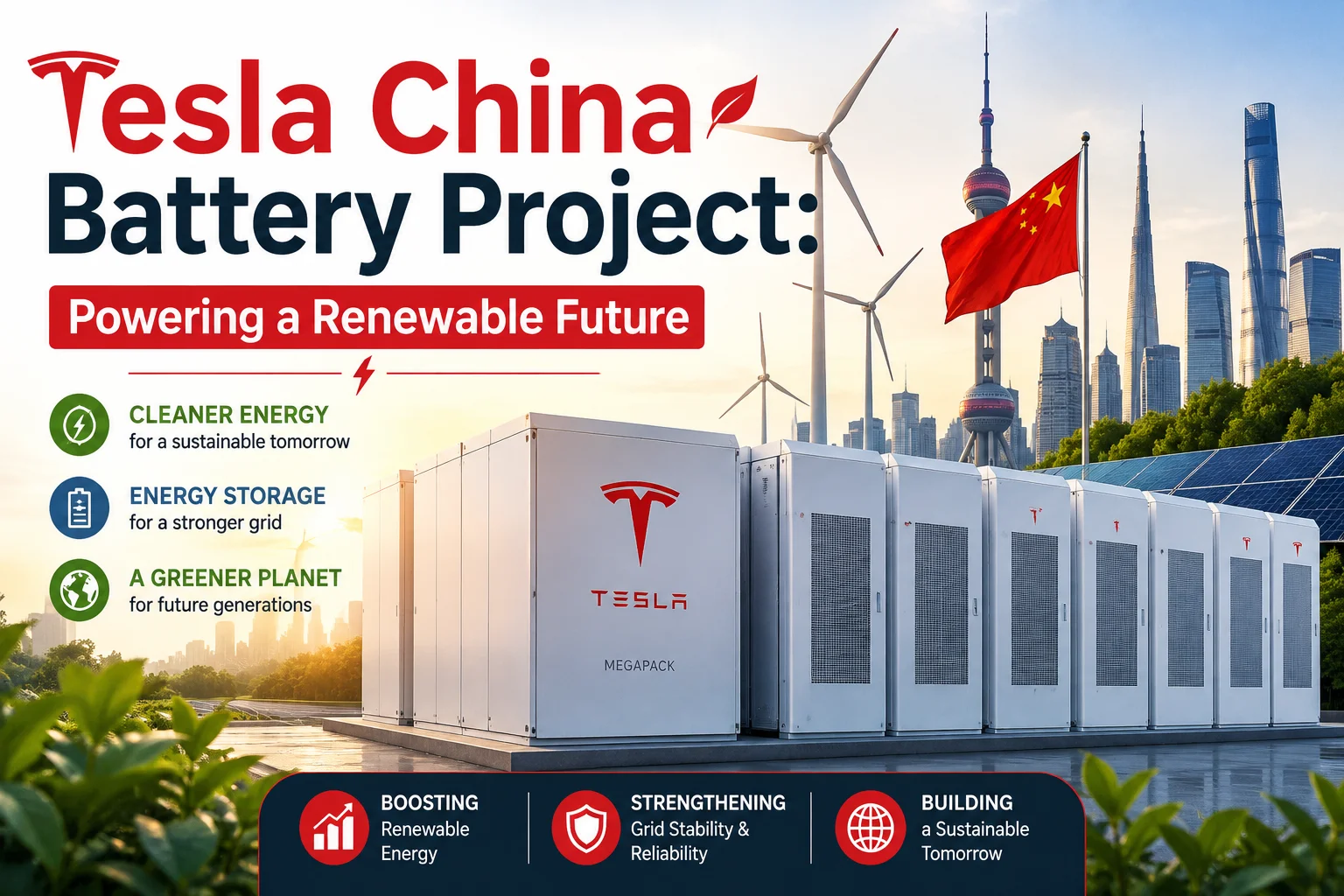
Tesla’s growing presence in China’s energy-storage industry marks an important step in the global shift toward cleaner and more reliable energy. Although Tesla is best known for its electric vehicles, energy storage has become an increasingly important part of the company’s broader clean energy strategy.
At the center of this expansion is Tesla’s Shanghai Megafactory, which manufactures Megapack battery systems for large-scale energy-storage applications. These systems are designed to store electricity and help power grids manage changing levels of supply and demand.
Tesla’s Shanghai Megafactory
Tesla’s Shanghai Megafactory is located in the Lin-gang Special Area of Shanghai. Construction began in May 2024, and production started in February 2025, making it Tesla’s first dedicated energy-storage manufacturing facility outside the United States.
The facility occupies approximately 200,000 square meters and represents an investment of around 1.45 billion yuan, equivalent to roughly $200 million. Tesla planned the factory with an annual production capacity of up to 10,000 Megapack units, representing nearly 40 gigawatt-hours of energy-storage capacity.
The rapid construction timeline is another notable feature of the project. Tesla moved from the start of construction to production in less than a year, allowing the company to quickly establish additional manufacturing capacity for large-scale battery systems.
How Megapack Can Support Renewable Energy
One of the biggest challenges facing renewable energy is the difference between when electricity is produced and when it is needed.
Solar farms, for instance, can generate significant amounts of electricity during the middle of the day. However, electricity demand can remain high or increase during the evening, when solar production has already declined.
Energy storage provides a way to move electricity from one period to another.
A solar project can send excess electricity into a Megapack while renewable generation is strong. That stored power can then be supplied to the grid later when production falls or demand rises. A similar approach can be used with wind power, whose output can vary throughout the day.
Tesla positions Megapack as a utility scale storage solution that can support renewable generation, grid stability, frequency and voltage management, and periods of peak electricity demand.
As a result, battery storage is not simply a backup technology. It can become an important tool for managing modern electricity networks.
Why China Needs More Energy Storage
China has emerged as one of the world’s largest markets for renewable energy, with massive investments in solar and wind generation. This rapid expansion creates significant opportunities but also puts additional pressure on the country’s electricity infrastructure.
One challenge is renewable-energy curtailment. This occurs when electricity generated by renewable facilities cannot be fully used or transmitted because of grid limitations, demand patterns, or other infrastructure constraints.
Recent reporting has highlighted growing concerns about renewable-energy curtailment as China’s clean-energy capacity expands faster than some parts of its grid infrastructure. Reuters reported that an estimated 360 terawatt-hours of renewable electricity was curtailed during the first half of 2026, emphasizing the importance of additional transmission capacity, grid flexibility, and energy storage.
Large batteries could help absorb some surplus electricity and make it available at a later time. However, storage is only one part of the solution. Expanding transmission networks, improving grid management, and developing flexible electricity demand are also important.
Tesla’s Expanding Energy Business in China
The Shanghai Megafactory also highlights how Tesla’s business in China is moving beyond electric vehicles.
Tesla already operates a major vehicle manufacturing facility in Shanghai. Its energy-storage factory adds another significant part to the company’s presence in the Chinese market.
The Megafactory focuses on producing Megapack systems for utility-scale and commercial applications. Multiple Megapacks can be combined to create large storage installations capable of supporting electricity grids and renewable-energy projects.
Tesla has also become involved in additional grid-storage developments in China. A separate grid-side energy-storage project in Shanghai has been reported with an overall investment of approximately 4 billion yuan, with its first phase planned to provide around 300 megawatt-hours of storage capacity.
These projects demonstrate the growing importance of stationary battery storage within Tesla’s broader energy strategy.
Benefits for Solar and Wind Projects
Large-scale batteries can provide renewable-energy projects with greater flexibility. Instead of using electricity only when it is generated, storage allows some of that power to be used later.
Potential benefits include:
- Storing surplus solar and wind electricity
- Supplying electricity during periods of high demand
- Supporting grid frequency and stability
- Reducing stress on electricity networks
- Improving the utilization of renewable generation
- Providing grid-support and backup capabilities
- Potentially reducing reliance on some conventional peak-generation resources
Tesla says Megapack installations can operate alongside renewable-energy facilities and release stored electricity according to grid requirements.
For renewable developers, this flexibility can make solar and wind power more practical by allowing electricity to be shifted toward periods when it is most valuable.
Shanghai’s Global Importance
Tesla’s Shanghai Megafactory could have significance beyond the Chinese domestic market. The facility has already been used to manufacture Megapacks for international projects.
In July 2025, the factory reportedly reached the milestone of producing its 1,000th Megapack system for shipment to Europe. With planned annual production of up to 10,000 units, the facility provides Tesla with substantial additional capacity for the global energy-storage market.
Shanghai could therefore become an important manufacturing hub for stationary battery systems serving customers outside China.
Global demand for energy storage is expected to remain important as countries invest in solar and wind farms, modernize electricity grids, expand electric transportation, and build energy-intensive facilities such as data centers.
Having manufacturing capacity in China also positions Tesla close to one of the world’s largest renewable-energy markets.
Challenges Facing Large-Scale Battery Storage
Despite its potential, battery storage cannot solve every problem associated with renewable energy.
Large storage projects require substantial investment, suitable grid connections, land, infrastructure, and effective operational management. Batteries also have finite lifespans and depend on complex global supply chains for raw materials and components.
Recycling and responsible end-of-life management will become increasingly important as more stationary batteries are deployed around the world.
Another limitation is duration. Batteries are particularly useful for shifting electricity over relatively short periods, but they may not be sufficient during extended periods of low solar or wind production.
For that reason, future energy systems will likely require a combination of technologies. Expanded transmission networks, flexible electricity demand, diverse generation sources, and different forms of energy storage can work alongside lithium-ion batteries.
What Tesla’s China Project Means for Renewable Energy
Tesla’s Shanghai battery project reflects a broader transformation taking place across the energy industry.
The future of renewable energy is not simply about installing more solar panels and wind turbines. It also requires smarter ways to manage electricity after it has been generated.
Energy storage can help connect renewable production with consumer demand by allowing electricity to be stored during periods of high generation and released when it is needed.
China’s enormous renewable-energy expansion makes the country an important market for developing and deploying these technologies. Tesla’s Shanghai Megafactory places the company directly within this rapidly growing energy-storage ecosystem.
Final Thoughts
Tesla’s China battery project represents more than another manufacturing expansion. It connects Tesla’s battery technology with one of the world’s fastest-growing renewable-energy markets.
The Shanghai Megafactory’s Megapack systems are designed to store large amounts of electricity and provide greater flexibility to power grids. For China, such technology could help manage increasing levels of solar and wind generation while supporting grid reliability.











Google Maps Media Controls Removed: Why They Disappeared - Football club menu
[…] Maps supported services such as Spotify and YouTube Music through its media playback integration. The feature could previously be managed through Google Maps navigation […]