

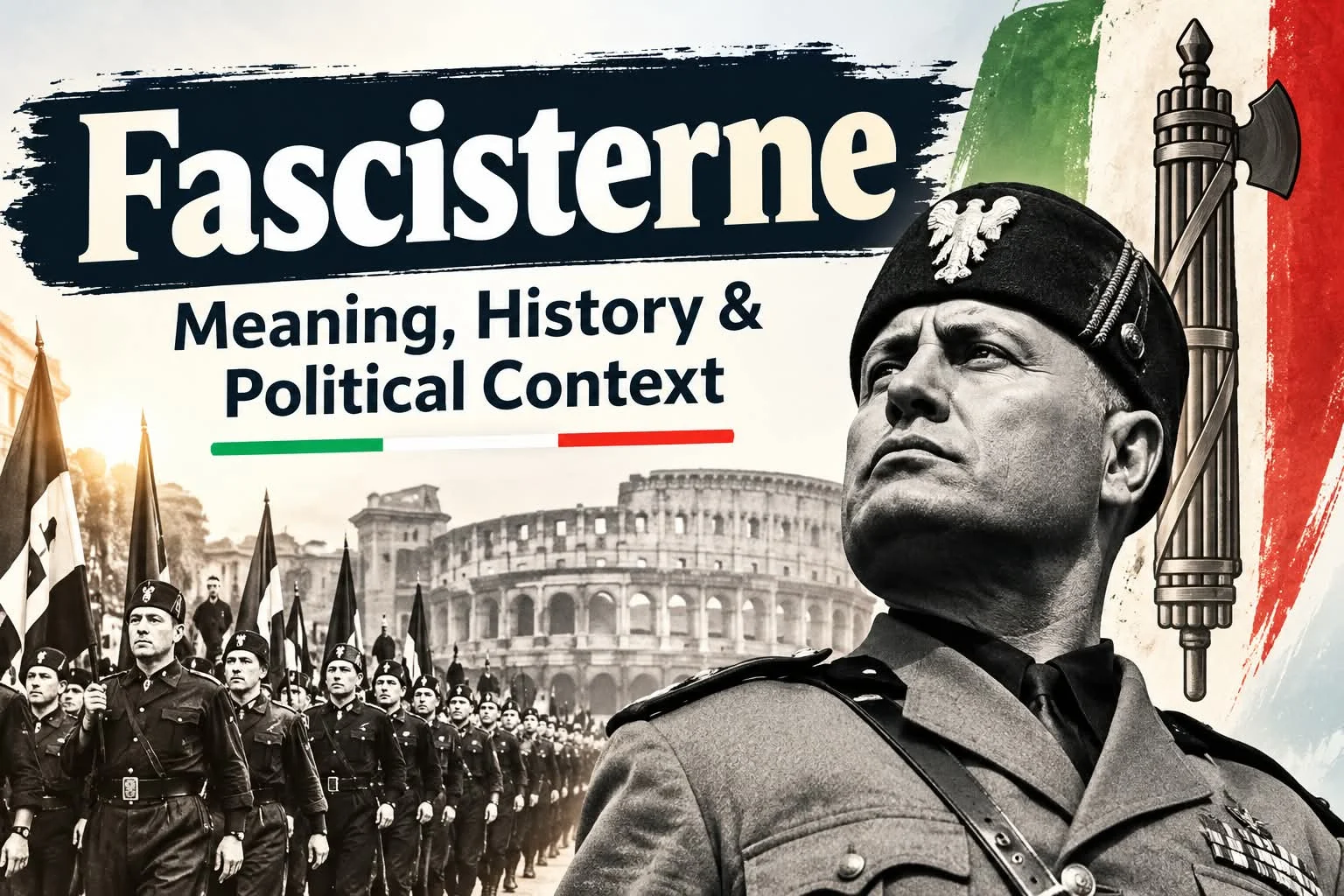
Fascisterne is a Scandinavian-language term associated with fascists, referring to people who support or are associated with fascism. The word connects to the broader political concept of fascism, an authoritarian political ideology that developed in Europe during the early twentieth century.
Understanding the term requires looking at both its linguistic meaning and the historical movement behind it. Fascism has appeared in different forms and political settings, so the historical context is important when discussing the word accurately.
What Does Fascisterne Mean?
The Basic Meaning
In Danish, “fascisterne” can be understood as “the fascists.” It is the definite plural form referring to people identified as fascists.
The word itself comes from the broader term fascist, which is derived from fascism. Fascism historically became associated with movements that emphasized strong centralized authority, nationalism, political unity, and opposition to liberal democratic and socialist movements.
Why Context Matters
The meaning of Fascisterne can depend on how the word is being used. In a historical discussion, it may refer specifically to members or supporters of fascist movements. In a modern political discussion, the term may be used to describe people or organizations that are claimed to exhibit characteristics associated with fascism.
Because the term can carry strong political implications, it is important to distinguish a historical description from a modern political accusation.
The Historical Origins of Fascism
Fascism in Early Twentieth-Century Europe
Modern fascism emerged in Europe after the First World War. Italy became particularly important in its development, with Benito Mussolini establishing a fascist political movement that eventually became the ruling political force in the country.
The period following the First World War included economic difficulties, political instability, social conflict, and fears surrounding revolutionary movements. These conditions contributed to the growth of several radical political movements across Europe.
Fascist Italy
Mussolini and his supporters promoted an authoritarian system centered on strong national leadership and the idea that individual interests should be subordinated to the state and the national community.
Fascist Italy also developed a political system that restricted opposition and reduced democratic freedoms. Political opponents and independent institutions faced increasing pressure as the regime consolidated power.
Fascism and Nationalism
The Role of National Identity
Nationalism was an important element of many fascist movements. Fascist political organizations often presented the nation as a central source of identity and demanded political unity around national objectives.
This approach differed from political systems that emphasized individual political rights, pluralism, or competition between multiple parties and viewpoints.
Political Unity and Authority
Fascist movements generally rejected the idea that society should be organized primarily around competing political interests. Instead, they promoted centralized authority and political unity.
This emphasis on authority is one reason historians commonly distinguish fascist systems from liberal democratic traditions, which generally depend on political competition, elections, institutional checks, and protected civil liberties.
Fascisterne in Historical Discussions
Political Movements and Supporters
When historians use terms corresponding to “fascists,” they may refer to people who belonged to organized fascist parties or movements. These groups existed in different European countries and did not all have identical programs.
For that reason, fascism should not be treated as a completely uniform political phenomenon. Different movements adapted fascist ideas to their own national circumstances.
The Interwar Period
The years between the First and Second World Wars were particularly important for the development of fascist politics. Economic crises, political polarization, and dissatisfaction with existing institutions created environments in which authoritarian movements could gain support.
The rise of Nazi Germany under Adolf Hitler is one of the most consequential examples associated with the wider history of fascism. Nazi ideology shared important authoritarian and ultranationalist characteristics with fascism while also having distinctive racial and antisemitic doctrines.
Fascism During the Second World War
Fascist and fascist-aligned governments played an important role in the political history of the Second World War. Italy under Mussolini became an ally of Nazi Germany, while other European countries experienced fascist or collaborationist movements.
The period was marked by dictatorship, political repression, war, persecution, and widespread destruction. Studying this history helps explain why the word fascism carries such strong historical significance today.
How the Term Is Used Today
Historical Usage
In historical writing, terms such as Fascisterne can be used descriptively to discuss people connected with fascist movements. Historians generally examine their organizations, political ideas, actions, and historical circumstances rather than treating the term as a simple political label.
Modern Political Usage
In contemporary political discussions, “fascist” can also be used as an accusation against political individuals, organizations, or policies. However, such usage should be examined carefully.
Not every authoritarian policy or nationalist position is automatically fascist. Scholars generally consider multiple characteristics and the broader political context when studying whether a movement fits established definitions of fascism.
Why Studying Fascisterne Matters
Learning about Fascisterne and the history of fascism provides a way to understand major political developments of the twentieth century. It also demonstrates how political movements can emerge during periods of instability and how democratic institutions can be affected by authoritarian politics.
Historical understanding is especially useful because it separates documented events from modern political rhetoric. Examining original political programs, historical records, institutional changes, and the actions of governments provides a clearer picture of what fascist movements actually represented.
Frequently Asked Questions
What does Fascisterne mean?
Fascisterne is a Scandinavian-language term meaning “the fascists.” It refers to people associated with or identified with fascism.
Where did fascism originate?
Modern fascism emerged in Europe during the early twentieth century, with Italy under Benito Mussolini playing a central role in its early development.
Is Fascisterne a political party?
The word itself is not necessarily the name of one specific political party. It is a term referring to fascists or people associated with fascist politics.
What are common characteristics of fascism?
Historical fascist movements commonly emphasized authoritarian leadership, intense nationalism, political unity, opposition to liberal democracy, and suppression of political opposition. Specific movements differed in their beliefs and policies.
Why is the term politically significant?
Fascism had a major impact on twentieth-century European history, particularly through authoritarian regimes, political repression, and its connection to the conflicts and events surrounding the Second World War.
Final Thought
Fascisterne is best understood through its historical and linguistic context. Meaning “the fascists,” the term connects to the broader history of fascism, an authoritarian political tradition that developed in Europe during the twentieth century. Studying its origins, political characteristics, and historical consequences can provide a clearer understanding of one of the most significant political phenomena of modern European history












Leave a Reply