

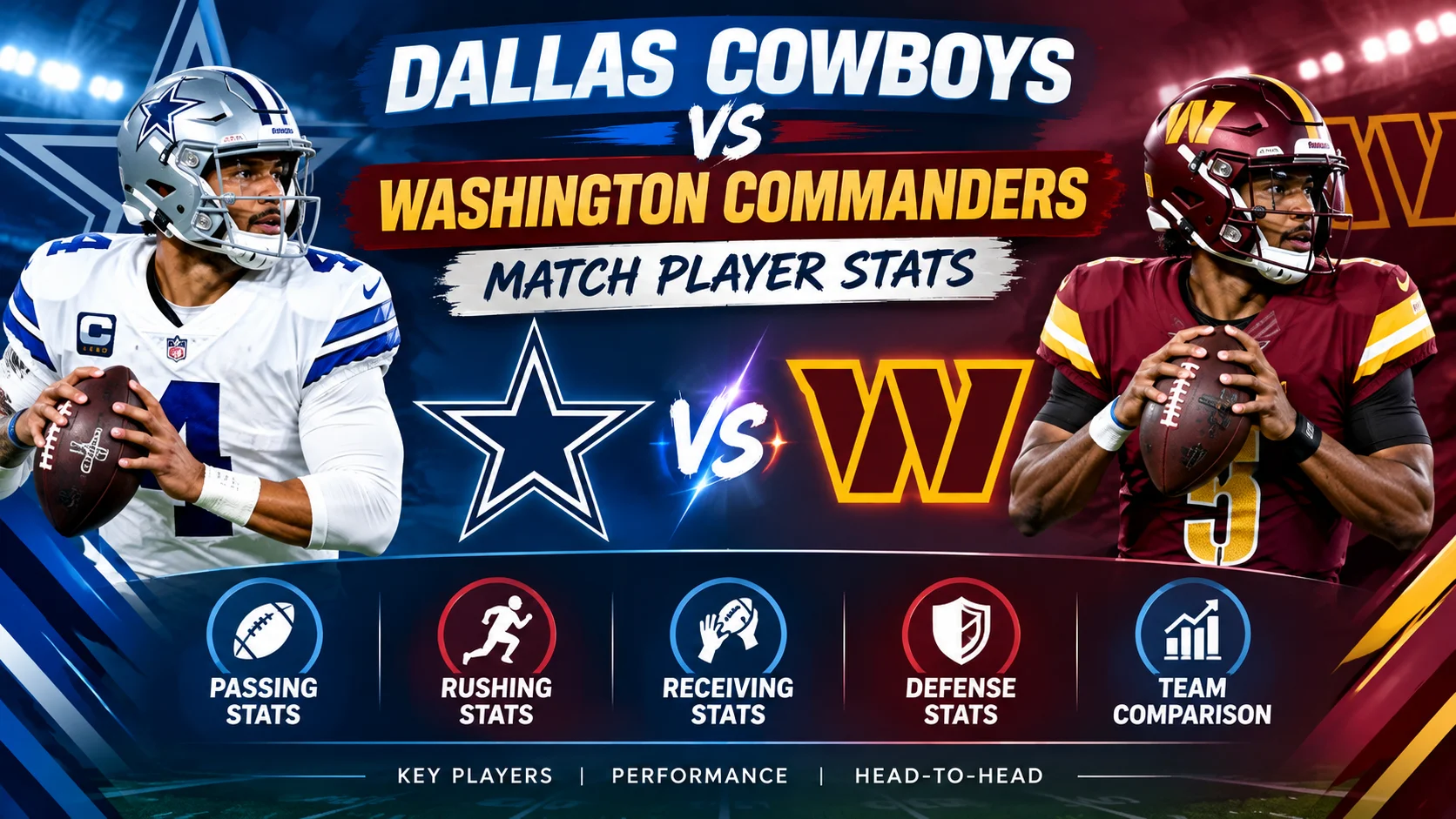
The historic rivalry between the Dallas Cowboys and the Washington Commanders stands as one of the most storied, intense, and consequential matchups in National Football League (NFL) history. Decades of division titles, bitter regular-season battles, and high-stakes postseason drama have shaped this NFC East feud into a premier spectacle on the NFL calendar. When these two teams meet, team record and current standings often fade into the background every play carries championship-level intensity.
Analyzing their recent clash provides deep insight into how tactical execution, individual star performances, and fundamental skill groups dictate the outcome in high-pressure games. This article delivers a comprehensive analysis of the game’s statistics, offensive and defensive performances, structural play-calling, and pivotal individual contributions that defined the outcome.
Game Overview: Dynamics and Matchup Summary
In their latest regular-season collision, the Dallas Cowboys secured a command performance against the Washington Commanders. Dallas set the pace early using a multi-dimensional offensive scheme, while Washington strove to maintain rhythmic, quick release passing sequences despite key injuries on their side of the ball.
The game unfolded as a battle of efficiency. Dallas leveraged big-play dynamic passing combined with an opportunistic running game, while Washington struggled with situational efficiency, penalty yards, and converting drives in the red zone.
| Team Metric | Dallas Cowboys | Washington Commanders |
| Final Score | 44 | 22 |
| Total Offensive Yards | 409 | 341 |
| Passing Yards | 269 | 190 |
| Rushing Yards | 140 | 151 |
| First Downs | 21 | 18 |
| Turnovers Lost | 0 | 2 |
| Time of Possession | 31:12 | 28:48 |
Offensive Breakdown: Player Statistics and Impact
Quarterback Performance: Dak Prescott vs. Washington Signal-Callers
The quarterback position offered a stark contrast in execution and stability throughout the contest.
Dak Prescott (Dallas Cowboys)
Dak Prescott produced a clinic in pre-snap recognition and pocket management. Operating behind a disciplined offensive line, Prescott efficiently targeted mid-range zone soft spots while delivering vertical explosive plays when Washington showed single-high coverage.
Completions / Attempts: 21 / 30
Passing Yards: 264
Touchdown Passes: 3
Interceptions: 0
Passer Rating: 130.4
Prescott’s ability to avoid turnovers while maintaining a high completion percentage kept the Dallas offense ahead of the chains throughout all four quarters.
Washington Quarterbacks (Jayden Daniels & Marcus Mariota)
Washington’s offensive game plan faced a severe disruption after primary quarterback Jayden Daniels exited the contest during the third quarter due to a hamstring injury. Prior to his departure, Daniels showed glimpses of dynamic dual-threat capability.
Jayden Daniels: 11/20 CMP/ATT, 156 YDS, 1 PASS TD, 35 RUSH YDS, 1 RUSH TD, 1 FUM
Marcus Mariota: 4/10 CMP/ATT, 63 YDS, 0 TD, 1 INT
The injury forced Washington into predictable passing downs late in the second half, allowing the Dallas pass rush to pin its ears back and squeeze the pocket.
Rushing Attack: Establishing Ground Dominance
Both teams placed heavy emphasis on establishing the ground game early to setup play-action concepts.
Running Back Yardage Breakdown
════════════════════════════════════════════════════════════════════
Dallas:        [ J. Williams: 116 YDS ]  | [ Team Total: 140 YDS ]
Washington:    [ Team Rushing: 151 YDS ] | [ J. Daniels: 35 YDS  ]
════════════════════════════════════════════════════════════════════
Javonte Williams (Dallas Cowboys): Williams delivered his signature physical, downhill running style, breaking tackles in the secondary to post 116 yards on 19 carries alongside a rushing touchdown. His ability to gain yards after contact kept Dallas balanced.
Washington Backfield: With primary rushing duties split among running backs and scrambles from the quarterback spot, Washington totaled 151 rushing yards. However, the inability to consistently convert short-yardage scenarios late in third downs stalled critical drives.
Receiving Corps and Playmakers
The air attack yielded pivotal moments that swung momentum firmly in favor of Dallas.
Dallas Pass-Catchers
CeeDee Lamb: 5 receptions, 110 receiving yards, 1 touchdown. Highlighted by a 74-yard touchdown reception where Lamb beat press coverage down the sideline.
Jake Ferguson: 7 receptions, 48 receiving yards, 2 touchdowns. Ferguson served as Prescott’s primary safety valve inside the red zone.
George Pickens: 4 receptions, 82 receiving yards. Pickens generated major vertical threat value, stretching Washington’s secondary high safety alignment.
Washington Pass-Catchers
Zach Ertz: 3 receptions, 37 receiving yards, 1 touchdown. Ertz hauled in a crucial 6-yard touchdown grab during the first half.
J. Lane: 3 receptions, 60 receiving yards. Lane provided key third-down conversions out of the slot.
Defensive Performance and Special Teams
Defensive Standouts and Game-Changing Plays
Defense turned out to be the major point of differentiation in the box score. The Dallas defensive unit capitalized on forced errors and disruption.
DaRon Bland (Dallas CB): Recorded the play of the game with a 68-yard interception return for a touchdown (Pick-6) in the second half, effectively sealing victory for the Cowboys.
Dallas Front Seven: Sacked Washington signal-callers 3 times while generating continuous pressure on 3rd-and-long situations.
Washington Defense: Showed resilience early against the run but struggled in zone coverages against Dallas’ multi-receiver sets, giving up 269 net passing yards.
Special Teams Execution
Brandon Aubrey (Dallas Kicker): Continued his record setting placekicking form, converting multiple field goal attempts, including a spectacular 61-yard kick in the second quarter.
Strategic Takeaways and Season Outlook
The statistical profile of this Dallas Cowboys vs. Washington Commanders game highlights clear tactical conclusions:
Efficiency on Early Downs: Dallas gained an average of 6.3 yards on first-down plays, eliminating third-and-long obstacles.
Turnover Margin: Dallas converted two takeaway opportunities into 14 points, while playing clean football with zero turnovers lost.
Red Zone Conversion: Dallas converted 80% of its visits into touchdowns inside the 20-yard line, whereas Washington was frequently held to field goals or turnovers on downs.
As both franchise rosters navigate the competitive waters of the NFC East, this matchup once again demonstrated that execution in high-leverage situations and individual playmaker production remains the ultimate decider in one of football’s greatest rivalries.







where to watch los angeles rams vs seahawks - Football club menu
[…] game usually starts with checking your local broadcast schedule. Because both teams belong to the National Football Conference (NFC), the majority of their Sunday afternoon matchups are broadcast on regional network […]