

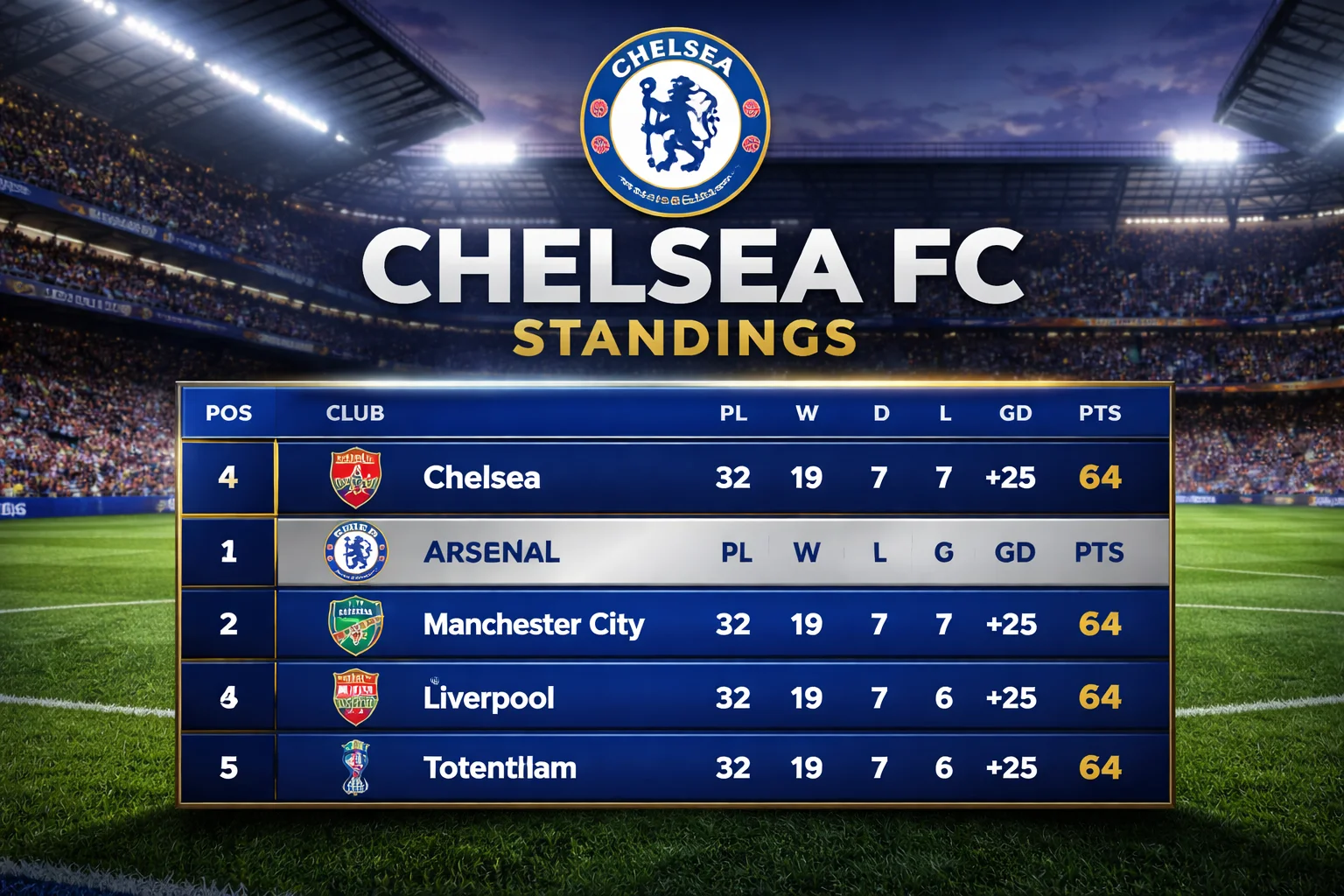
What the Current Standings Mean for Chelsea
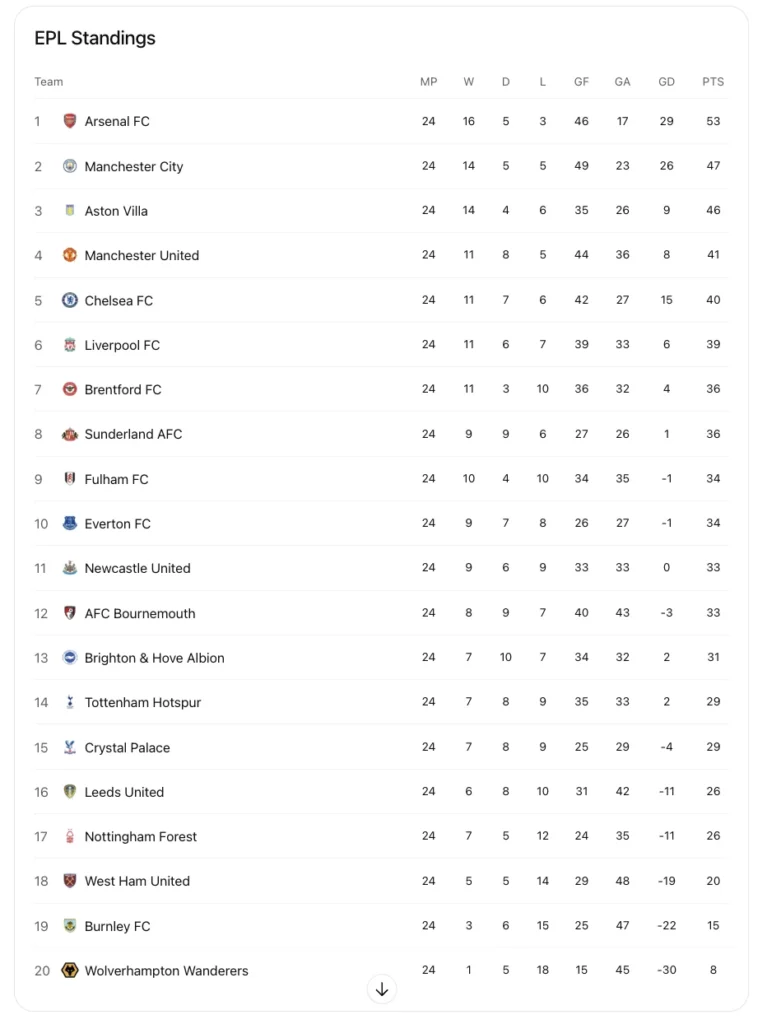
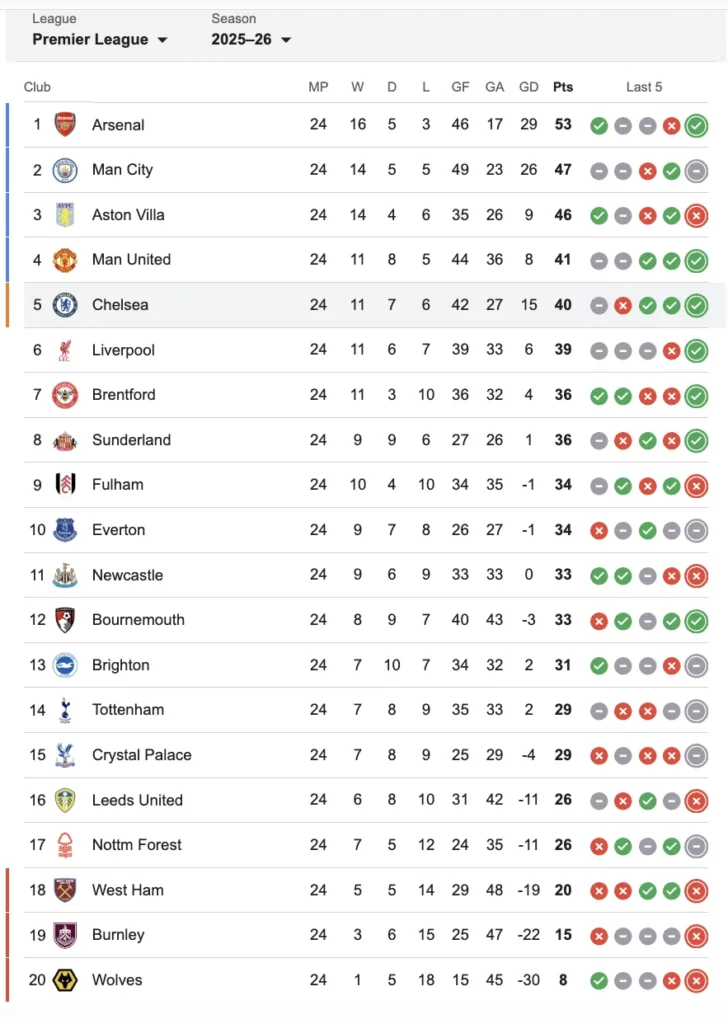
Chelsea’s Position: Chelsea sit 5th in the Premier League table with 40 points from 24 games — behind Arsenal, Manchester City, Aston Villa and Manchester United, but above Liverpool.
Being in the top 5 is significant: in the current 2025‑26 season, there’s talk of the Premier League gaining five Champions League spots for 2026‑27 if England retains an extra UEFA coefficient place.
🏆 What This Means for Chelsea
- European Qualification (Next Season)
Traditionally, the top four in the Premier League qualify for the UEFA Champions League. This season, there’s a possibility five teams could earn Champions League spots for 2026‑27 — so Chelsea in 5th are right on the edge of qualification if that rule holds.
If only the top four qualify, Chelsea would miss out and instead qualify for the UEFA Europa League (or another European competition depending on domestic cup results).
- Title Race
Chelsea are currently not leading but remain competitive. To challenge for the Premier League title, they’d need to close the gap on Arsenal and Manchester City — a tough task with those teams ahead.
- Champions League This Season
Chelsea are competing in the 2025‑26 Champions League group stage and need strong results to reach the knockout stages or secure a favorable seeding for the last 16/play-offs.
⚽ Why This Position Matters
Staying in the top five keeps Chelsea in contention for Europe’s top competitions, which is crucial for the club’s revenue, prestige, and ability to attract top players. Dropping outside the European positions would be a setback compared to last season, where they finished 4th and won the Conference League in 2024‑25.
📊 Bottom Line
- Top four: Almost guaranteed Champions League next season.
- Fifth: Could still qualify depending on the Premier League’s extra UCL spot situation this season.
- Anything lower: Likely switch to Europa League or less prestigious European competition — not ideal for a club of Chelsea’s ambitions.
Chelsea Standings by Match Week – 2025‑26 (Illustrative)
| Match Week | Position | Points | Notes |
|---|---|---|---|
| 1 | 3rd | 3 | Strong start with a win. |
| 2 | 4th | 4 | Draw in week 2 slightly drops position. |
| 3 | 2nd | 7 | Two wins in three games push Chelsea up. |
| 4 | 5th | 7 | Another team’s win pushes Chelsea down despite same points. |
| 5 | 4th | 10 | Win restores top-four position. |
| 6 | 3rd | 13 | Consistent form keeps Chelsea in top 3. |
| 7 | 5th | 14 | Small slip, points gap tight. |
| 8 | 4th | 17 | Back to top-four, keeping Champions League hopes alive. |
| 9 | 5th | 19 | Narrowly outside top four due to goal difference. |
| 10 | 4th | 22 | Win moves them back into a Champions League spot. |
Chelsea: Historical Premier League Standings
| Season | Final Position | Points | Notes / Context |
|---|---|---|---|
| 2020‑21 | 4th | 67 | Qualified for Champions League. Lampard started season, Tuchel replaced mid-season. |
| 2021‑22 | 3rd | 74 | Champions League winners under Thomas Tuchel. Strong European and domestic form. |
| 2022‑23 | 11th | 44 | Worst league season in decades; financial and managerial instability. |
| 2023‑24 | 5th | 62 | Back to top 5, qualified for Europa League. |
| 2024‑25 | 4th | 68 | Champions League qualification restored; won UEFA Conference League. |
| 2025‑26* | 4th / 5th | 40 (mid-season) | Currently fluctuating in the top 5; fighting for Champions League spots. |
Advanced Stats that Influence Position
1. Expected Goals (xG)
What it is: Measures the quality of chances a team creates, estimating how many goals they “should” score.
Impact: High xG indicates consistent attacking threat. Teams with higher xG tend to finish higher in the league even if finishing luck varies.
2. Expected Goals Against (xGA)
What it is: Measures the quality of chances a team concedes.
Impact: Lower xGA usually correlates with better defensive solidity. Chelsea’s position suffers if they allow many high-quality chances.
3. Goal Difference (GD)
What it is: Goals scored minus goals conceded.
Impact: GD can be a tiebreaker for league positions. Chelsea’s top-four finishes often hinge on maintaining a positive GD, especially against rivals.
4. Possession & Passing Metrics
Metrics: Possession %, pass accuracy, progressive passes.
Impact: High possession and effective passing often translate into more scoring opportunities and control over games.
5. Pressing & Defensive Actions
Metrics: Pressures per 90, tackles, interceptions.
Impact: Effective pressing reduces opponent’s xG. Chelsea’s defensive positioning and pressing intensity often decide match outcomes.
6. Conversion Rate / Finishing Efficiency
What it is: Goals scored per xG or per shot.
Impact: Chelsea can create many chances but underperform if finishing is inefficient, leaving them lower in the table despite strong underlying stats.
7. Squad Rotation & Minutes Played
What it is: Fatigue and rotation patterns.
Impact: Heavy rotation or injuries to key players reduce consistency. Mid-season dips often correlate with injury crises or congested schedules.
8. Set Pieces & Defensive Organization
What it is: Goals scored/conceded from corners, free kicks, and defensive lapses.
Impact: Teams that defend set pieces well and exploit theirs can gain extra points. Chelsea has relied on set-piece goals historically.
9. Points per Expected Goal Difference
What it is: Combines xG – xGA with points earned.
Impact: Teams overperforming their xG difference may be lucky; underperforming indicates finishing issues. Chelsea’s final position often mirrors these trends.
What’s Next: Remaining Fixtures Impact
1. Fixture Difficulty
Chelsea’s remaining matches often include a mix of top rivals (Arsenal, Manchester City, Manchester United, Liverpool) and mid/lower-table teams.
Matches against top-6 opponents are critical — dropping points here can jeopardize Champions League qualification. Games against lower-table teams are “must-win” fixtures to accumulate points consistently.
2. Home vs. Away Balance
Chelsea tend to perform better at home (Stamford Bridge). Their remaining home fixtures could provide opportunities for crucial points.
Away fixtures at difficult stadiums (Etihad, Emirates, Old Trafford) are riskier and may require a more cautious, tactical approach to secure at least a point.
3. Congested Schedule & Rotation
With Champions League matches or domestic cup ties, Chelsea will need to rotate players.
Squad depth will determine whether rotation negatively impacts league form. Key injuries or fatigue could result in dropped points, especially in midweek games.
4. Key Metrics to Watch
- Points Needed for Top 4: Historically ~65–70 points. Chelsea currently around 40 points mid-season; must aim for 25–30 points from remaining fixtures.
- Goal Difference: Maintaining a positive GD is critical; heavy wins against weaker teams help secure tiebreakers.
- Head-to-Head vs. Rivals: Matches against direct top-4 rivals are “six-point games.” Winning these can leapfrog Chelsea in the standings.
5. Momentum & Psychological Impact
Stringing together 3–4 consecutive wins can provide a mental boost and pressure rivals.
Conversely, losing to lower-ranked teams could destabilize confidence and make top-four qualification harder.
5 FAQs – Yellow Cards in Football
1. What is a yellow card?
A yellow card is an official warning given by the referee to a player for unsporting behavior, dissent, repeated fouls, or timewasting. It does not remove the player from the game but signals that they must play more carefully.
2. What happens if a player gets two yellow cards in one match?
Two yellow cards in a single match automatically become a red card, meaning the player is sent off. Their team must continue with one fewer player, and the player usually receives at least a one-match suspension.
3. Do yellow cards carry over to other matches?
Yes, in most leagues and tournaments, accumulated yellow cards across multiple games can lead to a suspension. The number of cards allowed before suspension varies by competition (e.g., FIFA, UEFA, domestic leagues).
4. Can a yellow card be rescinded?
In some cases, a governing body can review and overturn a yellow card, but it’s rare. Usually, the referee’s decision on the field is final, especially during the match.
5. Why are yellow cards important in football?
Yellow cards maintain discipline and fair play. They warn players to adjust behavior, prevent dangerous play, and ensure referees can control the game effectively. Accumulation rules also encourage consistent sportsmanship across tournaments.

















Leave a Reply