

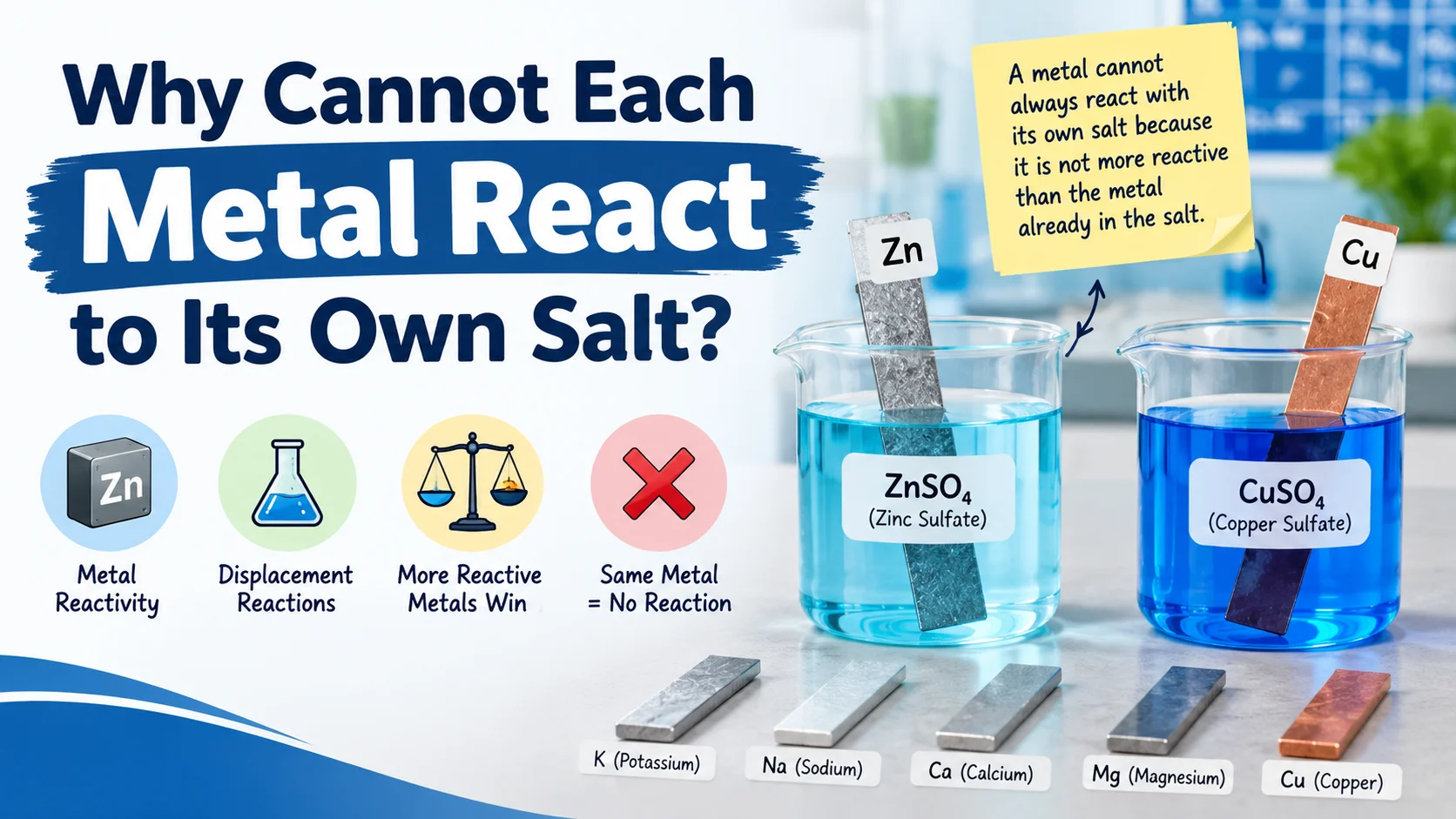
Reacting a metal with its own salt solution is one of the most fundamental concepts in inorganic chemistry and electrochemistry. When a piece of zinc is placed into a solution of zinc sulfate, or a copper strip is submerged in copper nitrate, students and researchers alike often ask: Why doesn’t a chemical reaction occur? Why don’t we see gas bubbles, color changes, or drastic chemical transformations?
Understanding the Fundamentals of Metal-Salt Reactions
Before analyzing why a metal does not react with its own salt, it is essential to establish how metals react with salt solutions in general.
Single Displacement Reactions
In general inorganic chemistry, a reaction between a metal and a salt solution typically proceeds as a single displacement reaction (or single replacement reaction). The general chemical equation for a single displacement process is:
Where:
A is a elemental metal.
BC is an ionic salt dissolved in water, composed of a metal cation ($\text{B}^+$) and an anion ($\text{C}^-$).
AC is the new salt formed in solution.
B is the displaced elemental metal.
For a single displacement reaction to proceed spontaneously, metal A must be more reactive (a stronger reducing agent) than metal B.
The Reactivity Series and Standard Reduction Potentials
The reactivity of a metal describes its tendency to lose electrons and form positive ions (cations):
The reactivity series ranks metals based on their willingness to undergo oxidation. In electrochemistry, this intrinsic property is quantified using standard reduction potentials ($E^\circ$).
A metal with a very negative standard reduction potential readily loses electrons (strong reducing agent).
A metal cation with a higher (more positive) reduction potential gains electrons easily.
When a reactive metal like iron ($\text{Fe}$) is immersed in a solution containing copper ions ($\text{Cu}^{2+}$), iron reduces copper because iron has a greater drive to lose electrons than copper does. As a result, copper precipitates out of solution, and iron dissolves.
Thermodynamics of Metal-Salt Interactions
The fundamental reason a metal cannot undergo a net reaction with its own salt lies in thermodynamics, specifically Gibbs Free Energy ($\Delta G$).
Gibbs Free Energy and Spontaneity
For any chemical process occurring at constant temperature and pressure, the condition for spontaneity is governed by the change in Gibbs Free Energy ($\Delta G^\circ$):
Where:
$n$ is the number of moles of electrons transferred.
$F$ is Faraday’s constant ($96,485\text{ C/mol}$).
$E^\circ_{\text{cell}}$ is the standard electromotive force (EMF) or cell potential of the reaction.
For a reaction to occur spontaneously in the forward direction, $\Delta G^\circ$ must be negative, which requires $E^\circ_{\text{cell}}$ to be positive.
Calculating Cell Potential for a Metal and Its Own Salt
Consider what happens if we attempt a displacement reaction using a metal $\text{M}$ and its ionic cation $\text{M}^{n+}$:
To determine the standard cell potential ($E^\circ_{\text{cell}}$) for this proposed reaction, we split it into half-reactions:
Oxidation half-reaction (Anode):
$$\text{M (s)} \rightarrow \text{M}^{n+}\text{(aq)} + n e^- \quad (E^\circ_{\text{ox}} = -E^\circ_{\text{red}})$$Reduction half-reaction (Cathode):
$$\text{M}^{n+}\text{(aq)} + n e^- \rightarrow \text{M (s)} \quad (E^\circ_{\text{red}})$$
To calculate $E^\circ_{\text{cell}}$:
Since the cathode species ($\text{M}^{n+}$) and the anode species ($\text{M}$) belong to the exact same metal system:
Thermodynamic Implication of Zero Cell Potential
When $E^\circ_{\text{cell}} = 0\text{ V}$:
When the change in Gibbs Free Energy is zero, there is no driving force for a chemical reaction to proceed in either direction. The system is naturally at chemical equilibrium. Without a negative $\Delta G^\circ$, no net physical or chemical chemical transformation can occur.
Dynamic Equilibrium at the Microscopic Level
Although there is no net chemical reaction, saying “nothing happens” at the atomic level is a common misconception. The solid metal and its salt solution engage in continuous dynamic exchange.
Oxidation and Reduction Rates
Oxidation (Dissolution): Zinc atoms on the metal surface lose electrons and enter the aqueous solution as zinc ions:
$$\text{Zn (s)} \rightarrow \text{Zn}^{2+}\text{(aq)} + 2 e^-$$Reduction (Deposition): Zinc ions in the solution collide with the metal surface, acquire electrons, and deposit as neutral zinc atoms:
$$\text{Zn}^{2+}\text{(aq)} + 2 e^- \rightarrow \text{Zn (s)}$$
The Condition of Dynamic Equilibrium
In a system where a metal is in contact with its own ion solution, the rate of oxidation ($r_{\text{ox}}$) rapidly becomes equal to the rate of reduction ($r_{\text{red}}$):
   Solid Metal Surface                Aqueous Solution
+-----------------------+          +--------------------+
|  M  --->  M^n+ + ne-  |  =====>  |  Dissolution Rate  |
|                       |          |         ||         |
|  M^n+ + ne-  <---  M  |  <=====  |  Deposition Rate   |
+-----------------------+          +--------------------+
Because atoms are leaving the lattice at the exact same rate that cations are returning to it, the total mass of the solid metal electrode remains completely constant over time, and the concentration of metal ions in the solution does not change.
Demonstration via Isotopic Tracing
Scientists have proven the presence of this microscopic dynamic equilibrium using radioactive isotopes.
If a pure strip of copper ($\text{Cu}$) is immersed in a copper sulfate ($\text{CuSO}_4$) solution prepared with radioactive copper isotopes (e.g., $^{64}\text{Cu}^{2+}$), testing the system after a short time reveals that the solid copper metal strip has become radioactive, while the solution’s overall radioactivity decreases proportionally.
This exchange proves that atoms continuously trade places between the solid and liquid phases, even though no macroscopically observable chemical change occurs.
The Electric Double Layer and Electrode Potential
Formation of the Helmholtz Double Layer
If the metal has a slight tendency to dissolve, it leaves excess electrons on the metal surface, giving the solid a negative charge. This negative surface attracts positive cations ($\text{M}^{n+}$) from the solution, creating a layer of positive charge in the liquid right against the metal interface.
If cations deposit onto the metal faster initially, the metal surface acquires a positive charge, attracting negative anions from the solution to the liquid interface.
This microscopic arrangement of opposite charges at the metal-solution interface is called the Helmholtz Electric Double Layer.
    Metal Phase (-)  |  Solution Phase (+)
  +------------------|------------------+
  |    e-     e-     |   M^n+    M^n+   |
  |    e-     e-     |   M^n+    M^n+   |
  |    e-     e-     |   M^n+    M^n+   |
  +------------------|------------------+
                     ^
             Interface Boundary
The Nernst Equation and Concentration Dependence
The potential difference across this double layer is called the electrode potential ($E$). It is quantitatively described by the Nernst Equation:
Where:
$R$ is the universal gas constant ($8.314\text{ J/(mol}\cdot\text{K)}$).
$T$ is the absolute temperature in Kelvin.
$[\text{M}^{n+}]$ is the molar concentration of metal ions in solution.
Concentration Cells: An Exception That Proves the Rule
While a metal cannot react with a single solution of its own salt under uniform conditions, it can generate a current if two different concentrations of the same salt solution are combined in an electrochemical cell setup. This arrangement is known as a concentration cell.
How Concentration Cells Work
A concentration cell consists of two half-cells with identical metal electrodes and identical ionic species, but at different ion concentrations:
Anode (Dilute Solution, $C_{\text{dil}}$): Lower concentration of $\text{M}^{n+}$.
Cathode (Concentrated Solution, $C_{\text{conc}}$): Higher concentration of $\text{M}^{n+}$.
                 [ Voltmeter / Wire ]
                /                    \
     +---------+                      +---------+
     | Anode   |                      | Cathode |
     | Metal M |                      | Metal M |
     +---------+                      +---------+
          |                                |
   +--------------+                +--------------+
   | Salt Solution|  <===Salt===>  | Salt Solution|
   | (Dilute C1)  |    Bridge      | (Conc. C2)   |
   +--------------+                +--------------+
Cell Potential in Concentration Cells
Applying the Nernst equation to the combined cell yields:
The equation simplifies to:
Because $[\text{M}^{n+}]_{\text{conc}} > [\text{M}^{n+}]_{\text{dil}}$, the natural logarithm is positive, yielding a positive $E_{\text{cell}}$.
Reaction Driven by Entropy
In a concentration cell, a reaction occurs because the universe favors equalizing concentration gradients (maximizing entropy):
At the anode, the metal dissolves to increase ion concentration in the dilute chamber:
$$\text{M (s)} \rightarrow \text{M}^{n+}\text{(dilute)} + n e^-$$At the cathode, metal ions deposit out of solution to decrease ion concentration in the concentrated chamber:
$$\text{M}^{n+}\text{(concentrated)} + n e^- \rightarrow \text{M (s)}$$
The electrons flow through an external circuit until both chambers reach equal concentrations ($C_{\text{dil}} = C_{\text{conc}}$). Once equalized, $E_{\text{cell}}$ drops back to $0\text{ V}$, and net electron flow stops.
Summary of Key Takeaways
Thermodynamic Equilibrium ($\Delta G^\circ = 0$): The standard cell potential ($E^\circ_{\text{cell}}$) for a metal reacting with its own ion is exactly zero volts, meaning there is no thermodynamic driving force for a net chemical transformation.
Dynamic Equilibrium ($r_{\text{ox}} = r_{\text{red}}$): Oxidation and reduction occur continuously at identical rates on the metal surface. Atoms swap places between the solid metal and liquid phase continuously without altering the total mass or concentration.












Equifax Login: Sign In & Manage Your Account - Football club menu
[…] register for a new Equifax account, you must verify your identity to ensure your personal financial data remains secure. You will typically need to […]