

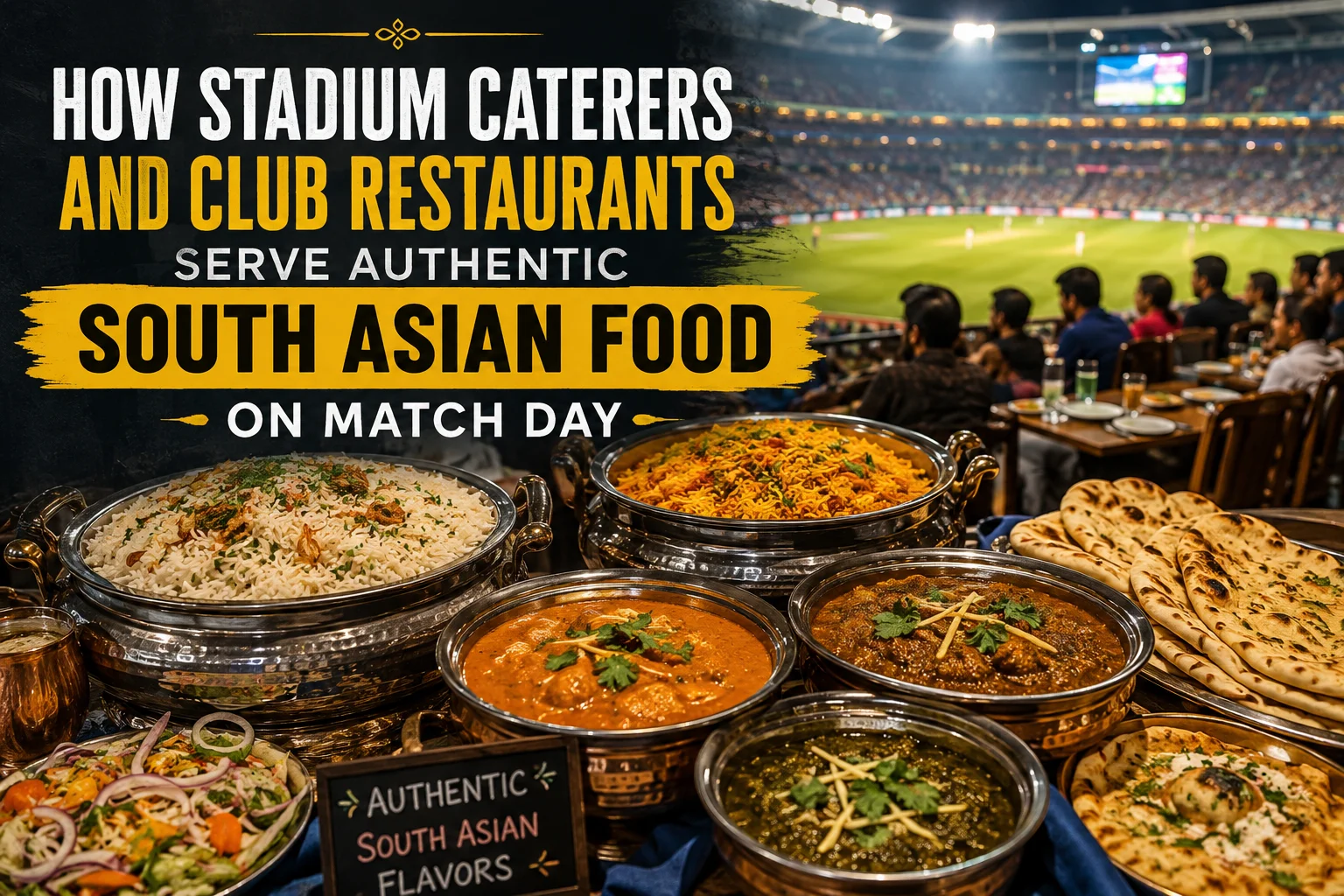
South Asian and halal food has become increasingly visible in stadium catering across North America and the UK. The trouble is, the concession stand version rarely does it justice. Here’s what’s actually changing and what the equipment behind it looks like.
Walk through the concession stands at a major football ground on match day and you’ll notice the food landscape has shifted quite a bit over the past decade.
Alongside the burgers and hot dogs that have defined sports venue catering for as long as stadiums have existed, you’ll increasingly find halal options and South Asian street food and at the venues that have actually invested in doing it right, something that looks and smells nothing like what a heat-lamp counter can turn out.
Stadium catering for South Asian and halal audiences isn’t a niche consideration anymore.
In cities with large South Asian, Middle Eastern, and Muslim communities Birmingham, London, Manchester, Leicester in the UK; Houston, Chicago, New York, Toronto in North America fans showing up to football and soccer grounds expect food that actually reflects their dietary needs and tastes. Venues are starting to take that seriously.
The real question is whether they’re doing it properly, and that comes down almost entirely to equipment.
The Challenge of Stadium Catering
Stadium catering runs into constraints that a restaurant kitchen simply doesn’t deal with. Everything has to be made in volume, served within a tight window the hour before kickoff, then half-time and produced from concession points that often have limited space, limited gas hookups, and infrastructure that varies wildly from venue to venue.
It’s easy to see why heat-and-serve or batch-cooked food is so appealing to stadium operators: it scales, it’s predictable, and it doesn’t demand specialized equipment.
The problem is that South Asian food, especially the tandoor-cooked dishes people are actually craving, just doesn’t hold up as heat-and-serve.
Naan sitting under a heat lamp turns leathery within minutes. Tandoori chicken cooked hours ahead and held loses the exact texture that makes it worth eating in the first place.
Seekh kebab reheated from a batch cook loses that exterior char that’s really the whole point of the dish.
The venues that have actually solved this have done it by bringing the cooking to the concession point itself, instead of cooking centrally and shipping it out. And the piece of equipment making that possible is the compact, mobile tandoor oven.
The operational math of stadium catering works against quality at almost every turn. A concession stand typically has 45 to 90 minutes of real demand around kickoff, and another 15 to 20 at half-time.
During that window, every single item needs to go from prep to hand-off in under two minutes, or the queue blows past whatever crowd-management tolerance the venue can live with. Most street food concepts can’t hit both the throughput and the quality bar at the same time.
Tandoor cooking is one of the rare exceptions, and it works because the oven itself is fast naan in under two minutes, seekh in five, tandoori chicken pieces in ten. That speed isn’t a shortcut around quality.
It’s a byproduct of the same high-temperature physics that produces the quality in the first place.
Mobile Tandoor Ovens at Sports Venues
Portable clay-oven cooking at events isn’t a new idea — street food culture across South Asia has always found ways to adapt tandoor cooking for mobile use.
What’s actually changed is the availability of purpose-built, NSF-certified mobile catering equipment that meets the safety and compliance bar commercial venues need to clear.
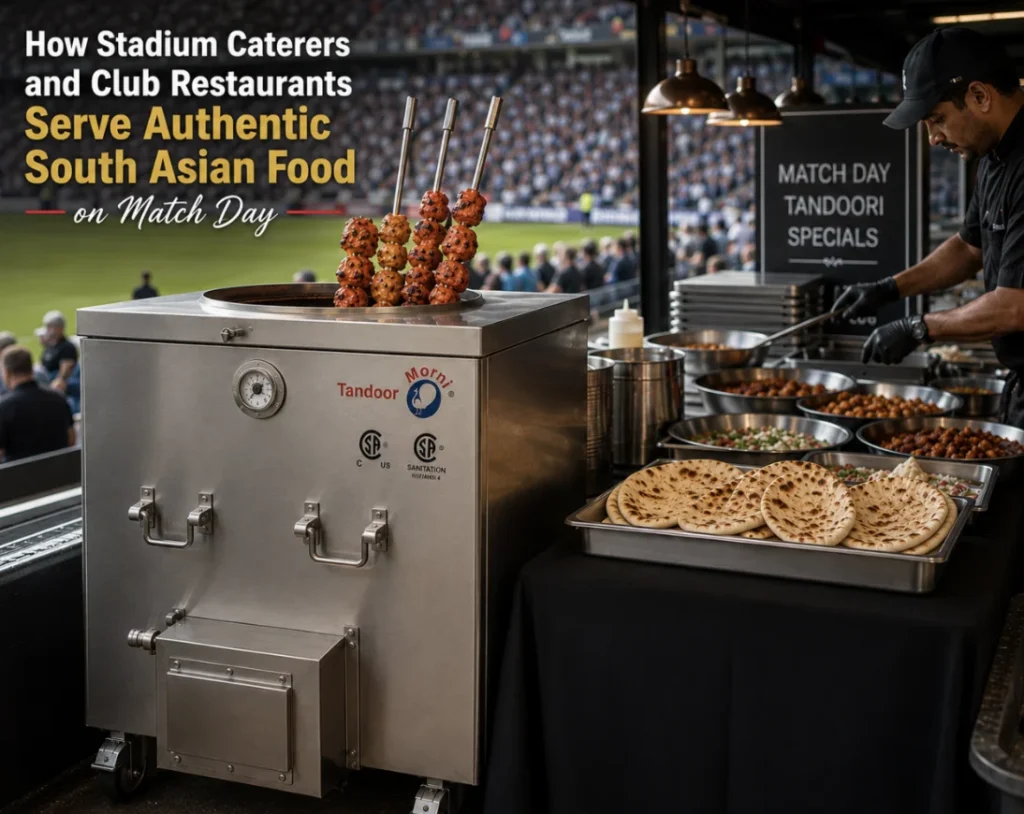
A Food Truck Tandoor Oven the compact, certified format built specifically for mobile catering can be set up at a concession point, brought up to temperature before the gates even open, and used to cook naan and tandoori items to order all through the service window.
What comes out of it is genuinely different from anything a conventional catering unit can produce, because the physics of radiant clay heat at 800–900°F just can’t be matched by a gas-burner grill or a convection oven.
For venue operators, that means the concession stand can serve food actually worth eating, at the speed stadium service demands naan in under two minutes, seekh kebab in five, tandoori chicken pieces in ten.
This was never really a quality-versus-speed tradeoff. It’s about having the right equipment in the right spot.
The logistics of putting a mobile tandoor at a stadium concession point are also a lot more manageable than most venue operators assume going in.
A compact catering tandoor arrives on a wheeled stand, hooks up to a propane connection and a standard gas regulator, and reaches operating temperature in about 25 to 30 minutes.
It fits behind a standard concession counter and can be run by one trained staff member.
The footprint is roughly what you’d get from a commercial flat-top grill, and the ventilation needs are similar to any open-flame cooking equipment most permanent concession stands already have that infrastructure in place. The real barrier isn’t space or plumbing.
It’s simply deciding to source the right equipment and train someone to run it properly.
Halal Compliance and the Certified Equipment Question
For operators serving halal food, the equipment question gets an extra layer of complexity.
Halal compliance involves more than ingredients alone; food-service operators also need appropriate controls for preparation, cleaning, utensils and equipment use, and prevention of cross-contamination between halal and non-halal items.
The exact requirements depend on the relevant halal certification body and its standard.
The Catering Charcoal Tandoor format built for events and outdoor venues where gas supply is limited or just not available runs on the same clay-heat principles as a gas tandoor but uses charcoal as fuel instead.
Charcoal tandoors have historically been the go-to format in traditional South Asian street food settings, and bringing that same format into stadium catering gives operators both authenticity and the compliance credentials they need.
Certified commercial equipment such as equipment meeting NSF/ANSI 4 in the US can provide useful sanitation and construction documentation for food-service operations.
However, NSF/ANSI 4 is a commercial food-equipment sanitation standard, not a halal certification.
Halal compliance must be assessed separately under the requirements of the relevant halal certification body.
Stadium operators and club catering managers new to halal food service may need to provide documentation covering ingredient sourcing, preparation controls, cleaning procedures, and equipment use.
Commercial equipment documentation can support the broader compliance process, but it does not by itself establish that a food operation is halal-certified. Operators should confirm the specific documentation and separation requirements with their chosen halal certification body.
What Good Stadium Catering Food Actually Looks Like
The difference between well-executed South Asian stadium food and the approximation most venues currently serve is obvious the moment you see it. Fresh naan cooked to order comes with a blistered surface and steam still rising off it at hand-off.
Seekh kebab straight from a live clay oven has a caramelized exterior that holds together in your hand instead of crumbling apart. Tandoori chicken pieces have that slightly dry, heavily spiced exterior over still-moist meat, the unmistakable signature of real clay-heat cooking.
Venues in cities with large South Asian fan bases that commit to fresh, on-site tandoor cooking may be better positioned to meet demand from fans seeking authentic South Asian food.
Bringing genuine mobile tandoor equipment to the concession point can help preserve the texture and freshness that are often lost with reheated batch food, while still supporting fast service during peak match-day windows.
The sports venue food landscape is moving faster than most people outside the industry realize.
Fans who already eat at Indian and halal restaurants that do this properly are increasingly unwilling to settle for less once they get to the ground. Venues that solve the equipment question now stand to gain a real edge in a market that’s only going to keep growing.
The commercial case for doing South Asian stadium catering properly can also be attractive, but results will vary by venue, menu pricing, demand, staffing, and operating costs.
Fresh naan, seekh kebab, and tandoori chicken may encourage repeat purchases and help make food a more memorable part of the match-day experience.
For club catering managers, the return on specialized equipment should be evaluated using actual sales, throughput, labor, fuel, and maintenance data rather than assuming a fixed spend-per-head or payback advantage.












Leave a Reply