

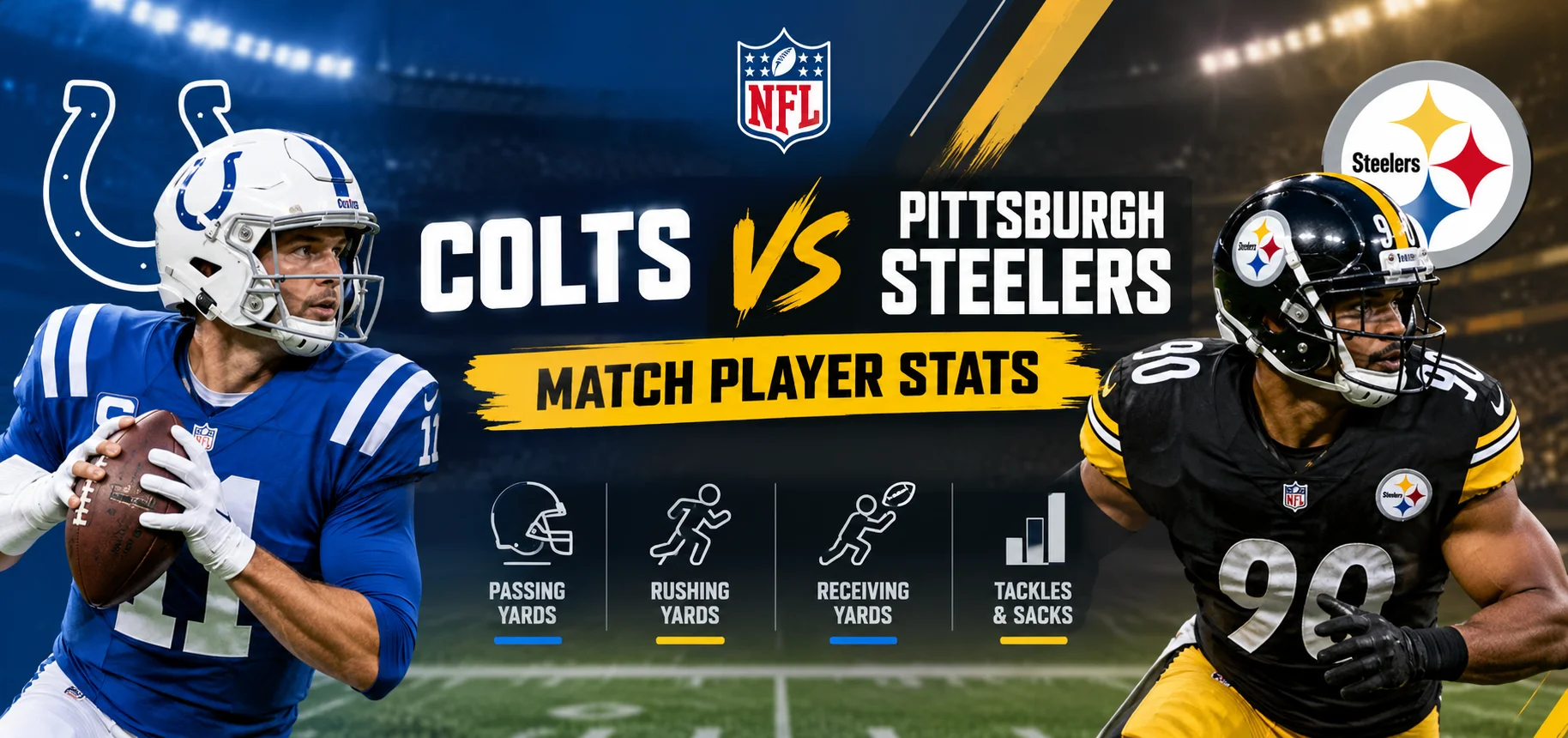
The Colts vs Pittsburgh Steelers match player stats from the October 11, 2026, NFL matchup reveal how explosive offensive plays, quarterback efficiency, and red-zone execution shaped the result. The Pittsburgh Steelers defeated the Indianapolis Colts 34–22 at Acrisure Stadium, delivering a significant performance in Week 5 of the 2026 NFL season.
Although Indianapolis produced 332 total yards and maintained possession for 32 minutes, Pittsburgh made better use of its offensive opportunities. Steelers running back Jaylen Warren emerged as the game’s standout performer, while quarterback Aaron Rodgers delivered three touchdown passes. On the Colts’ side, quarterback Daniel Jones accumulated passing yards, tight end Tyler Warren provided a reliable receiving option, and kicker Spencer Shrader converted five field goals.
The final score reflected an important difference between the teams: Indianapolis moved the football but struggled to turn promising drives into touchdowns, whereas Pittsburgh capitalized on explosive plays and finished crucial possessions in the end zone.
Colts vs Pittsburgh Steelers Match Overview
The Week 5 meeting took place on October 11, 2026, in Pittsburgh, Pennsylvania. Both teams entered the contest looking to improve their early-season records and strengthen their positions in the AFC playoff picture.
Pittsburgh won 34–22, improving its record to 3–2, while Indianapolis fell to 2–3.
| Match detail | Information |
|---|---|
| Matchup | Indianapolis Colts vs Pittsburgh Steelers |
| Competition | NFL regular season |
| Season | 2026 |
| Week | Week 5 |
| Match date | October 11, 2026 |
| Stadium | Acrisure Stadium |
| Final score | Colts 22–34 Steelers |
| Winning team | Pittsburgh Steelers |
| Leading offensive performer | Jaylen Warren |
| Standout quarterback | Aaron Rodgers |
Quarter-by-Quarter Score
| Quarter | Indianapolis Colts | Pittsburgh Steelers |
|---|---|---|
| First quarter | 6 | 7 |
| Second quarter | 7 | 10 |
| Third quarter | 6 | 7 |
| Fourth quarter | 3 | 10 |
| Final score | 22 | 34 |
Pittsburgh established an early advantage and maintained its lead throughout the game. Indianapolis remained competitive, but the Steelers’ ability to produce touchdowns at decisive moments prevented the visitors from completing a comeback.
Colts vs Pittsburgh Steelers Match Player Stats: Team Comparison
The team statistics illustrate why the Steelers won despite Indianapolis recording more passing yards and running more offensive plays.
| Team statistic | Indianapolis Colts | Pittsburgh Steelers |
|---|---|---|
| Total net yards | 332 | 352 |
| Passing yards | 266 | 225 |
| Rushing yards | 66 | 127 |
| Total offensive plays | 69 | 54 |
| Yards per play | 4.8 | 6.5 |
| Time of possession | 32:00 | 28:00 |
| Turnovers | 0 | 0 |
| Penalties | 9 | 6 |
| Penalty yards | 59 | 50 |
| Final points | 22 | 34 |
The most noticeable difference was rushing production. Pittsburgh generated 127 rushing yards compared with Indianapolis’s 66, giving the Steelers a stronger balance between passing and running.
The Steelers also averaged 6.5 yards per offensive play, significantly more than the Colts’ 4.8. This difference shows how effectively Pittsburgh turned individual plays into substantial gains.
Both teams finished without a turnover, so Pittsburgh’s victory was not primarily the result of Indianapolis giving the ball away. Instead, explosive plays, touchdown conversion, and rushing efficiency separated the teams.
Indianapolis Colts Player Stats and Performance
Daniel Jones: Passing Statistics
Daniel Jones led the Colts’ passing attack and finished with 267 passing yards. He completed 24 of 44 attempts without throwing an interception or a touchdown.
| Passing statistic | Daniel Jones |
|---|---|
| Completions | 24 |
| Passing attempts | 44 |
| Completion percentage | 54.5% |
| Passing yards | 267 |
| Passing touchdowns | 0 |
| Interceptions | 0 |
| Passer rating | 72.8 |
Jones helped Indianapolis move the football downfield, but the absence of a passing touchdown was a major limitation. Pittsburgh forced the Colts to settle for field goals on multiple possessions, preventing the offense from matching the Steelers’ scoring pace.
His 267 passing yards demonstrated that Indianapolis could create opportunities through the air. However, yardage alone was insufficient because the offense needed more successful finishes near the goal line.
The Colts also attempted considerably more offensive plays than Pittsburgh. That additional volume did not produce a corresponding scoring advantage, highlighting the importance of efficiency over raw statistics.
Jonathan Taylor: Rushing and Receiving Stats
Jonathan Taylor entered the matchup as one of Indianapolis’s most important offensive players. Pittsburgh’s defense limited his rushing opportunities and prevented him from establishing the consistent ground attack the Colts needed.
| Rushing and receiving statistic | Jonathan Taylor |
|---|---|
| Rushing attempts | 15 |
| Rushing yards | 45 |
| Yards per carry | 3.0 |
| Rushing touchdowns | 0 |
| Receptions | 3 |
| Receiving yards | 37 |
| Total yards from scrimmage | 82 |
Taylor averaged three yards per rushing attempt, making it difficult for Indianapolis to rely on its traditional running game. His 37 receiving yards offered an additional contribution, but the overall performance fell short of what the Colts needed.
Pittsburgh’s defensive front limited running lanes and forced Indianapolis to depend more heavily on passing. With Taylor unable to generate explosive runs, the Steelers could focus on containing Jones and defending the passing game.
Tyler Warren: A Reliable Receiving Target
Colts tight end Tyler Warren was among the team’s most productive offensive players. He recorded seven receptions for 83 receiving yards and also scored a rushing touchdown.
| Statistic | Tyler Warren |
|---|---|
| Receptions | 7 |
| Receiving yards | 83 |
| Receiving touchdowns | 0 |
| Rushing touchdowns | 1 |
Warren provided Jones with an effective option over the middle of the field and helped Indianapolis maintain offensive momentum. His receiving production was particularly important because the Colts struggled to create consistent gains through their ground attack.
His rushing touchdown also demonstrated his value beyond conventional receiving duties. Nevertheless, one touchdown from a non-quarterback offensive player was not enough to overcome Pittsburgh’s more productive scoring performance.
Spencer Shrader: Special Teams Performance
Kicker Spencer Shrader played a central role in the Colts’ scoring effort.
| Kicking statistic | Spencer Shrader |
|---|---|
| Field goals made | 5 |
| Field goals attempted | 5 |
| Field-goal percentage | 100% |
| Longest field goal | 57 yards |
| Extra points made | 1 |
| Total points | 16 |
Shrader converted all five field-goal attempts, including long kicks from 57 and 56 yards. His accuracy kept Indianapolis within reach for much of the contest.
However, the Colts’ dependence on field goals also highlighted a weakness in their offensive execution. Drives that could have produced touchdowns instead generated three points, allowing Pittsburgh to preserve its advantage.
Pittsburgh Steelers Player Stats and Performance
Aaron Rodgers: Quarterback Statistics
Aaron Rodgers delivered one of Pittsburgh’s most important performances, combining accurate passing with effective touchdown production.
| Passing statistic | Aaron Rodgers |
|---|---|
| Completions | 22 |
| Passing attempts | 31 |
| Completion percentage | 71.0% |
| Passing yards | 235 |
| Passing touchdowns | 3 |
| Interceptions | 0 |
| Passer rating | 120.8 |
Rodgers completed 22 passes for 235 yards and three touchdowns without throwing an interception. His 71% completion rate helped Pittsburgh sustain drives and take advantage of defensive openings.
The veteran quarterback established an early rhythm and connected with several receiving options. His connection with Jaylen Warren produced an explosive touchdown, while tight end Pat Freiermuth provided an effective target near the goal line.
Rodgers’ performance was especially valuable because Pittsburgh did not need a large volume of passing attempts to generate points. The offense created big gains, converted scoring opportunities, and remained efficient throughout the game.
Jaylen Warren: The Match’s Standout Player
Jaylen Warren was the most influential individual performer in the Colts vs Pittsburgh Steelers matchup. His combination of rushing and receiving production created major problems for Indianapolis’s defense.
| Statistic | Jaylen Warren |
|---|---|
| Rushing yards | 101 |
| Receiving yards | 87 |
| Total yards from scrimmage | 188 |
| Touchdowns | 2 |
| Longest touchdown reception | 80 yards |
| Longest touchdown run | 50 yards |
Warren accumulated 188 yards from scrimmage, including 101 rushing yards and 87 receiving yards. He scored twice on two remarkable explosive plays.
His first touchdown came on an 80-yard reception from Rodgers. Warren caught the pass and accelerated downfield, turning a routine passing opportunity into a game-changing score.
His second touchdown came on a 50-yard rushing play in the third quarter. The run demonstrated his ability to find openings, break through defensive pressure, and finish a long gain.
Warren’s performance was historically notable because he became the first NFL player since Herschel Walker in 1986 to record both an 80-yard touchdown reception and a rushing touchdown of at least 50 yards in the same game.
His production changed the game’s momentum and gave Pittsburgh an offensive weapon that Indianapolis struggled to contain.
Pat Freiermuth: Red-Zone Production
Pat Freiermuth also played an important role in the Steelers’ victory, particularly when Pittsburgh needed to convert possessions into touchdowns.
| Receiving statistic | Pat Freiermuth |
|---|---|
| Receptions | 5 |
| Receiving yards | 44 |
| Receiving touchdowns | 2 |
Freiermuth caught five passes for 44 yards and two touchdowns. Although his receiving yardage was lower than that of some other players, his scoring impact was substantial.
His first touchdown helped Pittsburgh establish a lead, while his second gave the Steelers additional separation in the fourth quarter.
The performance highlighted the importance of red-zone execution. Indianapolis accumulated passing yards but struggled to finish drives with touchdowns, while Freiermuth helped Pittsburgh convert key opportunities into seven-point possessions.
Germie Bernard: An Important Receiving Contribution
Rookie receiver Germie Bernard also made a valuable contribution to Pittsburgh’s passing attack.
| Receiving statistic | Germie Bernard |
|---|---|
| Receptions | 6 |
| Receiving yards | 80 |
| Receiving touchdowns | 0 |
Bernard recorded six receptions for 80 yards, producing career highs in both categories. His performance was particularly significant because Pittsburgh entered the contest dealing with receiver availability concerns.
His ability to contribute alongside Warren and Freiermuth gave Rodgers additional passing options. That distribution of offensive production made it more difficult for Indianapolis to concentrate exclusively on stopping one player.
Key Player Stats Comparison
The following comparison summarizes several of the leading performers from both teams.
| Player | Team | Key statistics | Main contribution |
|---|---|---|---|
| Daniel Jones | Colts | 267 passing yards, 0 TD, 0 INT | Passing production |
| Jonathan Taylor | Colts | 45 rushing yards, 37 receiving yards | Ground and receiving attack |
| Tyler Warren | Colts | 7 receptions, 83 yards, 1 rushing TD | Receiving and scoring |
| Spencer Shrader | Colts | 5-of-5 field goals | Special teams scoring |
| Aaron Rodgers | Steelers | 235 passing yards, 3 TD, 0 INT | Touchdown passing |
| Jaylen Warren | Steelers | 188 total yards, 2 TD | Explosive plays |
| Pat Freiermuth | Steelers | 5 receptions, 44 yards, 2 TD | Red-zone production |
| Germie Bernard | Steelers | 6 receptions, 80 yards | Receiving support |
These statistics reveal different offensive approaches. Indianapolis relied heavily on Jones’s passing volume and Shrader’s accuracy, whereas Pittsburgh combined productive quarterback play with a more effective rushing attack and multiple touchdown scorers.
Why the Pittsburgh Steelers Won
1. Explosive Offensive Plays
Warren’s 80-yard touchdown reception and 50-yard touchdown run were decisive moments. Both plays generated immediate scoring opportunities and helped Pittsburgh create separation on the scoreboard.
2. Better Rushing Efficiency
Pittsburgh recorded 127 rushing yards, nearly twice Indianapolis’s 66. This advantage gave the Steelers greater offensive balance and created opportunities for play-action passing.
3. Successful Touchdown Conversion
The Colts scored 22 points, with much of their production coming from field goals. Pittsburgh scored 34 points and converted important possessions into touchdowns.
4. Effective Defensive Pressure
The Steelers limited Taylor’s rushing effectiveness and made Indianapolis work for its passing yards. Pittsburgh also stopped the Colts on 11 of 15 third-down attempts, disrupting their ability to sustain drives.
5. Balanced Offensive Contributions
Rodgers, Warren, Freiermuth, and Bernard all made meaningful contributions. The Steelers were not dependent on a single type of offensive play, making their attack more difficult to predict.
Five Major Takeaways From Colts vs Steelers
- Jaylen Warren delivered the standout performance: His 188 total yards and two explosive touchdowns helped determine the outcome.
- Aaron Rodgers controlled the passing game: Three touchdown passes and zero interceptions gave Pittsburgh a reliable scoring foundation.
- Daniel Jones accumulated yards without a passing touchdown: His 267 passing yards were not enough to match Pittsburgh’s scoring efficiency.
- Spencer Shrader remained perfect on field goals: Five successful attempts provided Indianapolis with 16 points.
- Red-zone execution made the difference: Pittsburgh scored touchdowns when it mattered, while Indianapolis repeatedly settled for field goals.
What the Match Means for Both Teams
For Pittsburgh, the victory demonstrated the value of offensive versatility. Rodgers continued to produce touchdown passes, Warren supplied explosive running and receiving plays, and Freiermuth converted opportunities near the goal line. Maintaining that balance could help the Steelers remain competitive in the AFC.
For Indianapolis, the defeat exposed areas that require improvement. The Colts generated 332 total yards and avoided turnovers, but their inability to finish enough drives with touchdowns proved costly. Improving rushing efficiency and converting red-zone possessions into seven-point scores would give the team a better chance in future matchups.
The result also reinforced an important lesson in NFL football: a team can produce respectable yardage totals and still lose when its opponent is more efficient in high-value situations.
Frequently Asked Questions
1. What was the final score of Colts vs Pittsburgh Steelers?
The Pittsburgh Steelers defeated the Indianapolis Colts 34–22 on October 11, 2026, at Acrisure Stadium in Pittsburgh.
2. Who was the best player in the Colts vs Steelers match?
Jaylen Warren was the standout performer. He accumulated 188 yards from scrimmage and scored two touchdowns, including an 80-yard reception and a 50-yard rushing touchdown.
3. How many passing yards did Aaron Rodgers record?
Aaron Rodgers completed 22 of 31 passes for 235 yards and three touchdowns without an interception.
4. How did Daniel Jones perform against Pittsburgh?
Daniel Jones completed 24 of 44 passes for 267 yards. He did not throw a touchdown or an interception, and his passing production was not enough to secure a victory.
5. Which Colts players recorded the most notable statistics?
Tyler Warren led Indianapolis with seven receptions for 83 yards and added a rushing touchdown. Spencer Shrader converted all five field-goal attempts, while Daniel Jones recorded 267 passing yards.
Final Thoughts
The Colts vs Pittsburgh Steelers match player stats tell the story of a game decided by efficiency, explosive plays, and touchdown production. Pittsburgh’s 34–22 victory was built around Aaron Rodgers’ three touchdown passes, Jaylen Warren’s outstanding 188-yard performance, and Pat Freiermuth’s two receiving touchdowns.
Indianapolis showed that it could move the football, maintain possession, and generate points through the kicking game. However, the Colts struggled to match Pittsburgh’s explosive offensive production and convert enough promising drives into touchdowns.
For NFL fans analyzing this matchup, the most important statistics are Warren’s two long touchdowns, Rodgers’ efficient passing performance, Indianapolis’s limited rushing output, and the difference in total scoring. Together, these numbers explain why Pittsburgh emerged victorious despite the Colts recording more passing yards and controlling possession for longer.












Leave a Reply