

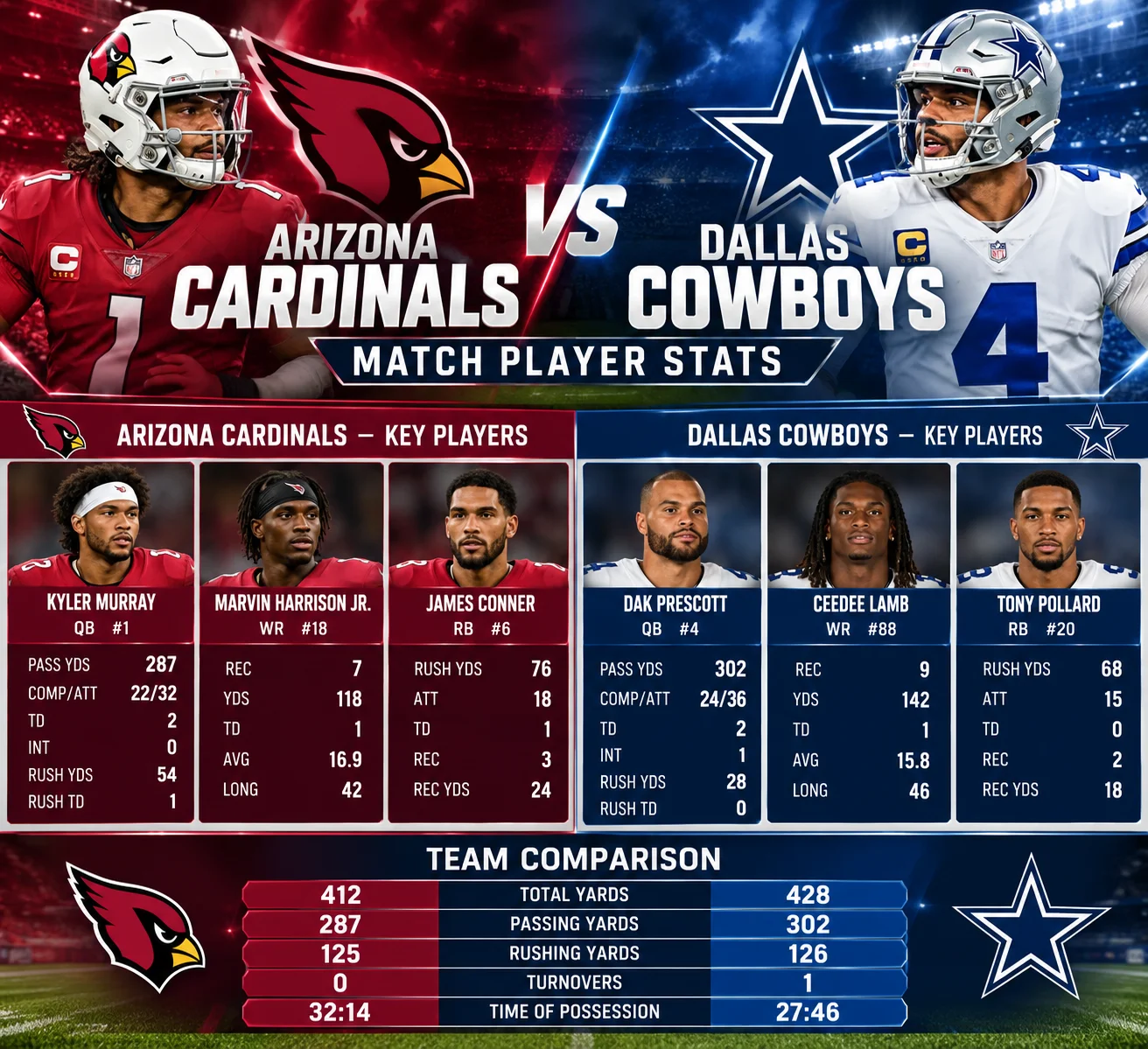
The Arizona Cardinals vs Dallas Cowboys match player stats provide a detailed look at how individual performances shaped the Cardinals’ 27–17 victory over the Cowboys in Week 9 of the 2025 NFL season. Arizona produced 340 total net yards, while Dallas finished with 333. Although the overall yardage was close, the Cardinals were more efficient in several important areas, including passing, possession, and penalties.
The matchup featured notable performances from Jacoby Brissett, Emari Demercado, Marvin Harrison Jr., Dak Prescott, CeeDee Lamb, and Javonte Williams. Looking beyond the final score reveals how quarterback efficiency, rushing production, receiving opportunities, and disciplined execution influenced the result.
Arizona Cardinals vs Dallas Cowboys Match Player Stats at a Glance
Arizona controlled the game for 33 minutes and 20 seconds, compared with 26 minutes and 40 seconds for Dallas. The Cardinals also committed only two penalties for 10 yards, while the Cowboys were penalized six times for 55 yards.
| Category | Arizona Cardinals | Dallas Cowboys |
|---|---|---|
| Final Score | 27 | 17 |
| Total Net Yards | 340 | 333 |
| Passing Yards | 261 | 250 |
| Time of Possession | 33:20 | 26:40 |
| Penalties | 2 | 6 |
| Penalty Yards | 10 | 55 |
| Passing TDs | 2 | 1 |
| Interceptions | 0 | 1 |
These numbers demonstrate why the contest was closer statistically than the final score suggested. Arizona did not overwhelm Dallas in total yardage, but it made better use of its opportunities.
Cardinals Offensive Player Performance
Jacoby Brissett Sets the Passing Tone
Jacoby Brissett delivered one of the most important performances in the matchup. He completed 21 of 31 attempts for 261 yards, threw two touchdown passes, and finished without an interception. His longest completion covered 50 yards, while his passer rating reached 115.1.
Brissett’s accuracy helped Arizona sustain drives and create scoring opportunities. More importantly, his clean performance protected the Cardinals from costly turnovers. Against a Dallas offense capable of producing explosive plays, that efficiency became a powerful advantage.
Emari Demercado Leads the Ground Game
Emari Demercado was the leading Arizona rusher. He carried the ball 14 times for 79 yards, averaging 5.6 yards per attempt. His longest run covered 19 yards.
The Cardinals received additional rushing production from Zonovan Knight, Greg Dortch, and Brissett. As a group, Arizona’s rushing attack helped keep Dallas’ defense from focusing exclusively on the passing game.
Arizona’s Receiving Production
Arizona’s passing success was supported by several receiving targets. Marvin Harrison Jr. and Trey McBride were particularly important contributors, with both finding the end zone during the game. Their production gave Brissett reliable options in important situations.
McBride’s ability to create opportunities across the middle added another dimension to the Cardinals’ attack. Harrison Jr., meanwhile, provided a dangerous downfield presence that could stretch the Cowboys’ coverage.
Dallas Cowboys Offensive Player Performance
Dak Prescott Provides Consistent Production
Dak Prescott passed for 250 yards in the matchup and helped Dallas remain competitive throughout the contest. However, the Cowboys could not match Arizona’s efficiency when it mattered most.
Prescott’s passing numbers were respectable, but Arizona’s defense successfully limited Dallas’ ability to turn possessions into enough points. The Cowboys finished with 17 points despite generating 333 total net yards.
Javonte Williams Makes an Impact
Javonte Williams was one of Dallas’ notable rushing contributors, producing 83 yards on the ground. His physical running gave the Cowboys useful yardage and helped keep the offense balanced.
Dallas needed more consistent production from its complete offensive unit, however. Arizona’s defense prevented the Cowboys from turning several opportunities into the type of scoring output needed to overcome the Cardinals’ second- and third-quarter momentum.
CeeDee Lamb Remains a Key Target
CeeDee Lamb continued to be an important part of the Cowboys’ passing attack. His route-running ability and reliable hands made him a central option for Prescott.
However, Arizona’s defensive approach limited Dallas’ overall effectiveness. Lamb’s individual production was valuable, but the Cowboys needed more contributions across the receiving group to change the game’s momentum.
Five Key Takeaways From the Match
- Jacoby Brissett was highly efficient: His 261 passing yards, two touchdowns, and zero interceptions created a strong foundation for Arizona.
- Arizona protected the football: The Cardinals avoided an interception through the air, helping them maintain control.
- Discipline favored Arizona: The Cardinals had only two penalties compared with six for Dallas.
- The rushing attack mattered: Demercado’s 79 yards helped Arizona maintain offensive balance.
- Time of possession was important: Arizona held the ball for nearly seven more minutes than Dallas.
How the Statistics Shaped the Final Result
The most revealing part of the Arizona Cardinals vs Dallas Cowboys match player stats is that the teams were relatively close in total yardage. Arizona had 340 yards and Dallas had 333, a difference of only seven yards.
That small gap shows that winning football is not always about producing dramatically more yardage. Arizona benefited from efficient quarterback play, fewer penalties, strong possession numbers, and better execution in scoring situations.
Dallas, on the other hand, moved the football but struggled to turn enough drives into points. Penalties also created additional obstacles. The 45-yard difference in penalty yardage was especially significant because those lost yards can quickly change field position and drive efficiency.
Why Player Stats Matter Beyond the Box Score
A traditional box score provides valuable information, but it does not always explain the complete story. Passing yards show quarterback production, while rushing statistics reveal how effectively a team moved the ball on the ground. Receiving numbers can highlight which players became important targets.
However, statistics become more meaningful when viewed together.
For example, Brissett’s 261 passing yards were important, but his zero interceptions made the performance even stronger. Demercado’s 79 rushing yards mattered because they helped Arizona maintain balance. Likewise, Dallas’ 333 total yards show that the Cowboys were capable of moving the ball, even though the scoreboard ultimately favored Arizona.
This combination of individual and team statistics makes the matchup particularly useful for evaluating offensive execution.
Frequently Asked Questions
Who won the Cardinals vs Cowboys matchup?
The Arizona Cardinals defeated the Dallas Cowboys 27–17 in the 2025 regular-season matchup.
How many passing yards did Jacoby Brissett record?
Brissett completed 21 of 31 passes for 261 yards and two touchdowns.
Who led Arizona in rushing?
Emari Demercado led the Cardinals with 79 rushing yards on 14 attempts.
How many total yards did Dallas produce?
The Cowboys recorded 333 total net yards during the game.
Which team had more time of possession?
Arizona controlled possession for 33:20, while Dallas had the ball for 26:40.
Final Thoughts
The Arizona Cardinals vs Dallas Cowboys match player stats show that Arizona’s victory came from more than simply scoring 27 points. Jacoby Brissett delivered an efficient passing performance, Emari Demercado provided valuable rushing production, and Arizona’s overall execution remained disciplined.
Dallas produced competitive numbers of its own, particularly through its passing and rushing attack. Nevertheless, penalties, possession, and scoring efficiency created the decisive difference.
The final 27–17 score therefore tells only part of the story. A deeper look at the player statistics reveals how Arizona combined accurate quarterback play, balanced offense, defensive pressure, and disciplined execution to secure an impressive road victory.














Leave a Reply