

look at the history, results, and playing styles of two respected international football teams. Mexico, widely known as El Tri, brings technical ability, quick passing, and passionate home support, while England, nicknamed the Three Lions, has traditionally relied on physical strength, attacking quality, and tactical discipline.
Their rivalry has developed through international friendlies and FIFA World Cup matches. England has historically held the advantage in their head-to-head record, but Mexico has also produced memorable victories. Their latest meeting, a dramatic 3–2 England victory in the 2026 FIFA World Cup Round of 16, added another important chapter to the rivalry.
This article examines the teams’ historical results, head-to-head statistics, recent World Cup encounter, tactical approaches, key players, and the numbers that help explain their performances.
Mexico National Football Team vs England National Football Team Stats: Head-to-Head Record
The historical record between Mexico and England shows a clear advantage for England. Across their 10 recorded senior international meetings through July 2026, England has won seven matches, Mexico has won two, and one game has ended in a draw.
These results include friendly matches and World Cup fixtures. Although England has collected more victories, individual matches have demonstrated that Mexico can compete effectively when its passing game, movement, and attacking pressure work together.
Overall Head-to-Head Statistics
| Statistical category | Mexico | England |
|---|---|---|
| Total matches | 10 | 10 |
| Wins | 2 | 7 |
| Draws | 1 | 1 |
| Losses | 7 | 2 |
| Goals scored | 9 | 26 |
| Goals conceded | 26 | 9 |
Note: The goal totals above reflect the historical scorelines listed in the match record, including the 2026 World Cup encounter.
England’s seven victories demonstrate its stronger historical record. The goal difference also highlights several high-scoring England performances, particularly the 8–0 win in 1961 and the 4–0 victory in 2001.
However, historical statistics should not be treated as a guarantee of future results. Different generations of players, managers, formations, and competition circumstances can significantly change the balance between two national teams.
Mexico vs England: Previous Match Results
Looking at individual results helps explain how the rivalry has evolved over several decades.
| Date | Match | Competition |
|---|---|---|
| May 24, 1959 | Mexico 2–1 England | International friendly |
| May 10, 1961 | England 8–0 Mexico | International friendly |
| July 16, 1966 | England 2–0 Mexico | FIFA World Cup |
| June 1, 1969 | Mexico 0–0 England | International friendly |
| June 9, 1985 | Mexico 1–0 England | Ciudad de México Cup |
| May 17, 1986 | England 3–0 Mexico | International friendly |
| March 29, 1997 | England 2–0 Mexico | International friendly |
| May 25, 2001 | England 4–0 Mexico | International friendly |
| May 24, 2010 | England 3–1 Mexico | International friendly |
| July 5, 2026 | Mexico 2–3 England | FIFA World Cup |
The table illustrates England’s consistency across different periods, while Mexico’s victories in 1959 and 1985 show that the North American side has enjoyed success in this matchup.
Mexico’s Historical Victories
Mexico’s first recorded victory over England came in May 1959, when it secured a 2–1 result. That match established an early example of Mexico’s ability to challenge an established European opponent.
Mexico also defeated England 1–0 in June 1985 during the Ciudad de México Cup tournament. Playing in Mexico offered a familiar environment, and the result demonstrated the value of home conditions and local support.
These victories remain important when evaluating the rivalry because they show that the historical record is not entirely one-sided.
England’s Strongest Results
England’s most emphatic victory came in May 1961, when the Three Lions defeated Mexico 8–0. The result remains one of the most striking scorelines between the teams.
England also recorded convincing wins in 2001 and 1986. Those performances reflected its ability to turn possession, movement, and attacking opportunities into substantial scoreline advantages.
The 2026 World Cup meeting, by contrast, was much closer and showed how much the competitive balance can change over time.
Mexico National Football Team vs England National Football Team Stats in the 2026 World Cup
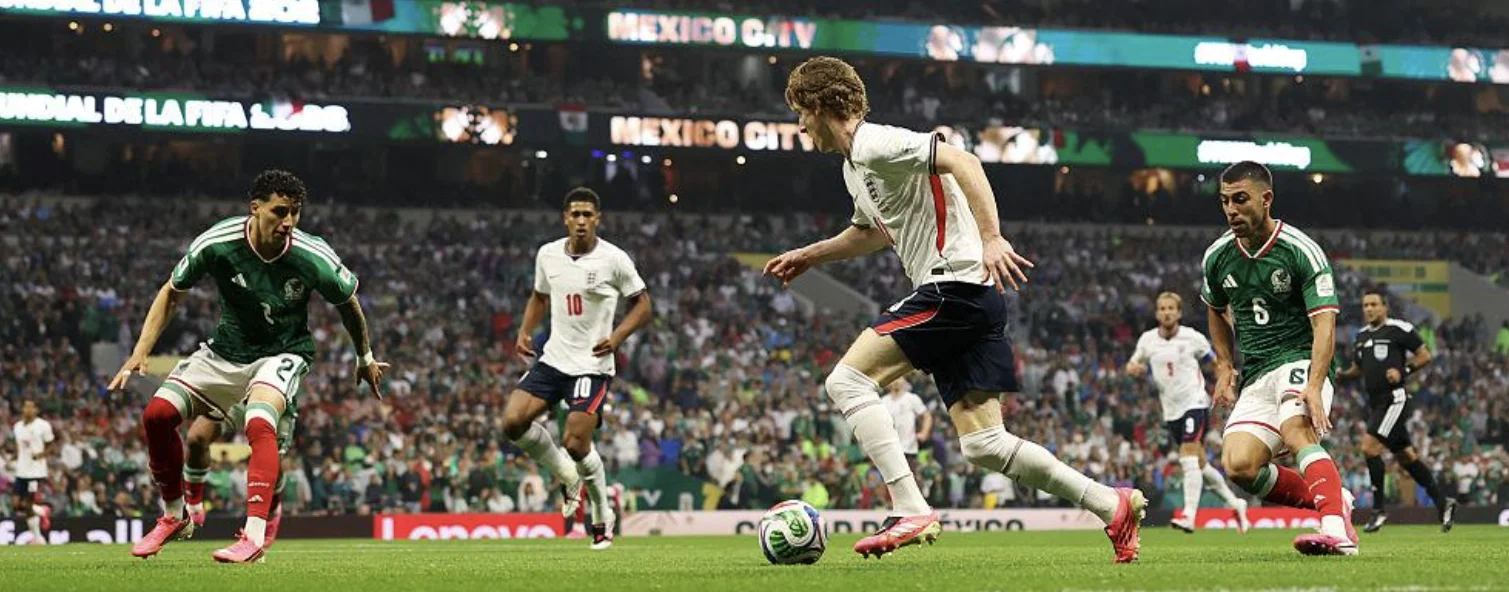
The latest meeting took place in the Round of 16 of the 2026 FIFA World Cup. England defeated Mexico 3–2 in an entertaining contest that featured five goals, a red card, and sustained pressure from the Mexican team.
England established a two-goal advantage through Jude Bellingham before Mexico responded. Harry Kane subsequently converted a penalty, while Mexico’s late effort made the closing stages tense.
Match Summary
| Match detail | Information |
|---|---|
| Competition | FIFA World Cup 2026 |
| Round | Round of 16 |
| Final score | Mexico 2–3 England |
| Half-time score | Mexico 1–2 England |
| Venue | Estadio Banorte, Mexico City |
| Attendance | 80,824 |
| Mexico goalscorers | Julián Quiñones, Raúl Jiménez |
| England goalscorers | Jude Bellingham (2), Harry Kane |
The match was particularly significant because it was only the second World Cup meeting between these national teams. England had also defeated Mexico 2–0 during the group stage of the 1966 World Cup.
Goal Timeline
| Minute | Team | Event |
|---|---|---|
| 36′ | England | Jude Bellingham scored |
| 38′ | England | Bellingham scored again |
| 42′ | Mexico | Julián Quiñones reduced the deficit |
| 54′ | England | Jarell Quansah was sent off |
| 60′ | England | Harry Kane scored a penalty |
| 69′ | Mexico | Raúl Jiménez scored a penalty |
England’s quick double gave the visitors control of the scoreline early in the match. Mexico responded before half-time, keeping the contest alive.
Quansah’s dismissal changed the tactical situation in the second half. England had to defend with 10 players, while Mexico gained additional opportunities to push forward. Kane’s penalty restored a two-goal cushion, and Jiménez’s spot kick made the final stages more competitive.
Despite Mexico’s pressure, England held on to secure progression.
Mexico vs England Match Statistics
The statistical breakdown of the 2026 meeting reveals an interesting contrast between possession and finishing.
| Match statistic | Mexico | England |
|---|---|---|
| Possession | 66.9% | 33.1% |
| Total shots | 20 | 6 |
| Shots on target | 5 | 5 |
| Corners | 12 | 2 |
| Accurate passes | 418 | 195 |
| Passing accuracy | 92.1% | 79.9% |
| Final score | 2 | 3 |
Statistics refer to the 2026 World Cup Round of 16 match.
Possession and Passing Accuracy
Mexico controlled nearly two-thirds of possession and completed considerably more accurate passes. Its 12 corners compared with England’s two also reflected sustained attacking pressure.
These numbers suggest that Mexico was able to move the ball effectively and repeatedly enter dangerous areas. However, possession alone does not determine a match’s outcome. Teams must also convert their opportunities and prevent opponents from creating high-quality chances.
England’s lower possession share did not prevent it from scoring three times. The team demonstrated that efficient attacking play can be decisive even when an opponent controls the ball for longer periods.
Shooting Efficiency
Mexico recorded 20 total shots, while England registered six. Both teams managed five shots on target.
This difference is especially interesting because Mexico produced substantially more attempts without scoring as many goals. England made better use of its limited shooting opportunities, while Mexico’s greater volume of attacking play did not translate into a victory.
The numbers do not tell the entire story, but they highlight an important football principle: the quality and timing of chances can matter as much as the total number of shots.
Mexico National Football Team: Playing Style and Strengths
Mexico has traditionally built its international identity around technical skill, quick combinations, and movement between midfield and attack. The team’s ability to retain possession can help it dictate the tempo and create opportunities through short passing sequences.
Possession-Based Attacking
Mexico’s technical players are comfortable receiving the ball under pressure and linking up in tight spaces. This style can be especially effective against teams that defend deep or allow midfielders time to turn and distribute.
The 2026 encounter illustrated this approach through Mexico’s possession advantage and high number of corners.
Attacking Width and Movement
Wide players can stretch defensive lines, create crossing opportunities, and open spaces for central attackers. When Mexico combines width with midfield support, it can force opponents to defend across a larger area.
However, advancing too many players can leave space behind the full-backs. Against a team with quick forwards, those spaces can become a defensive weakness.
Key Strengths
- Strong short-passing combinations.
- Ability to maintain possession under pressure.
- Energetic attacking movement.
- Potential advantage from home support.
- Capacity to create pressure through wide areas and set pieces.
Mexico’s challenge is to combine its technical quality with defensive balance and clinical finishing, particularly when facing opponents that counterattack quickly.
England National Football Team: Playing Style and Strengths
England has traditionally combined physical intensity with technical quality and attacking depth. Its players can threaten through direct transitions, structured build-up play, crosses, and individual creativity.
Clinical Attacking
The 2026 match demonstrated England’s ability to turn limited possession into decisive scoring opportunities. Bellingham’s two goals established an early advantage, while Kane’s penalty provided another important breakthrough.
England’s attacking effectiveness came from converting key moments rather than dominating the possession statistics.
Defensive Organisation
England’s defensive structure was tested significantly after Quansah’s dismissal. Playing with 10 men required greater concentration, compact positioning, and disciplined management of space.
Holding onto the lead under pressure demonstrated resilience, although the match also highlighted the difficulty of defending against a team generating repeated attacks.
Key Strengths
- Individual quality in advanced positions.
- Ability to exploit spaces during transitions.
- Threat from central attacking players.
- Experience in major international competitions.
- Capacity to defend under difficult circumstances.
England’s main tactical challenge is maintaining defensive stability while ensuring its attackers receive enough support to create scoring opportunities.
Mexico vs England: Key Players and Match Influence
Individual performances can shape the outcome of an international fixture, particularly when the teams have contrasting approaches.
| Player | Team | Contribution |
|---|---|---|
| Jude Bellingham | England | Scored twice in the 2026 match |
| Harry Kane | England | Converted a penalty |
| Julián Quiñones | Mexico | Scored Mexico’s first goal |
| Raúl Jiménez | Mexico | Converted a penalty |
| Jordan Pickford | England | Helped England withstand late pressure |
Bellingham’s two goals were crucial because they gave England an early advantage. Kane’s experience and penalty conversion added another decisive moment.
For Mexico, Quiñones helped restore hope before half-time, while Jiménez’s penalty brought the score to 3–2. Mexico’s attacking players demonstrated persistence, but the team could not complete the comeback.
The performances illustrate how individual contributions and team structure work together. A side may dominate possession, but decisive finishing and defensive interventions can ultimately determine the result.
Tactical Comparison: Mexico vs England
The matchup brings together two approaches that can create an engaging contest.
| Tactical factor | Mexico | England |
|---|---|---|
| Typical approach | Technical possession and combinations | Structured build-up and transitions |
| Main attacking focus | Width, passing, and movement | Direct attacks and individual quality |
| Potential advantage | Ball retention and territorial pressure | Clinical finishing and transition speed |
| Possible weakness | Space behind advancing defenders | Reduced control when pressed aggressively |
| Important priority | Convert possession into goals | Maintain balance while creating chances |
These descriptions represent broad tendencies rather than fixed rules. Both teams can adjust their formations, pressing intensity, and attacking approach depending on the manager’s plan and available players.
Mexico benefits when it moves the ball quickly enough to disrupt England’s defensive shape. England benefits when it wins possession and attacks before Mexico can reorganise.
The 2026 match offered a clear example of this tactical contrast: Mexico controlled much of the ball, but England’s scoring efficiency proved decisive.
Five Important Facts About Mexico vs England Stats
- England leads the historical record: The teams had met 10 times through July 2026, with England winning seven matches.
- Mexico has recorded two victories: Its wins came in 1959 and 1985.
- Their first World Cup meeting was in 1966: England won 2–0 during its championship-winning tournament.
- The 2026 World Cup encounter finished 3–2: England advanced after a competitive Round of 16 match.
- Mexico dominated possession in 2026: It recorded 66.9% possession and 20 shots, but England scored three goals from six attempts.
These facts help explain why head-to-head records, match statistics, and tactical analysis should be considered together rather than in isolation.
What the Statistics Tell Us About Future Meetings
Historical results favour England, but future fixtures will depend on the teams’ current squads, preparation, fitness, and tactical decisions.
Mexico can improve its chances by converting possession into higher-quality chances and protecting the spaces left by attacking full-backs. Better finishing would help the team turn territorial dominance into a more favourable result.
England can build on its historical advantage by remaining efficient in front of goal while improving its ability to control matches when opponents apply sustained pressure. Its defensive organisation will be especially important against teams capable of creating repeated chances.
The 2026 meeting also shows why one match cannot fully describe either team’s overall quality. Mexico’s higher possession and shot totals did not produce a win, while England’s clinical finishing secured the result.
For readers analysing future Mexico vs England fixtures, the most useful indicators include shots on target, chances conceded, possession under pressure, set-piece performance, and the ability to protect a lead.
Frequently Asked Questions
1. Who has won more matches between Mexico and England?
England has won more matches historically. Through their 10 recorded senior international meetings up to July 2026, England had seven victories, Mexico had two, and one match ended in a draw.
2. What was the score of the latest Mexico vs England match?
England defeated Mexico 3–2 in the Round of 16 of the 2026 FIFA World Cup. Jude Bellingham scored twice, and Harry Kane converted a penalty for England.
3. How many times have Mexico and England played in the World Cup?
The teams had met twice in the FIFA World Cup through July 2026. England won 2–0 in 1966 and 3–2 in 2026.
4. Which team dominated possession in the 2026 match?
Mexico dominated possession with 66.9%, compared with England’s 33.1%. Mexico also recorded 20 shots and 12 corners, but England scored one more goal.
5. Why did England win despite having less possession?
England made effective use of its scoring opportunities and established a two-goal lead early in the match. Although Mexico created considerable attacking pressure, England’s finishing and defensive resilience helped it preserve the advantage.
Final Thoughts
The Mexico national football team vs England national football team stats reveal a rivalry in which England has historically enjoyed greater success, but Mexico has demonstrated its ability to challenge the Three Lions.
England’s seven wins from 10 recorded meetings underline its historical advantage. Nevertheless, Mexico’s two victories, its technical strengths, and its impressive possession numbers in the 2026 World Cup meeting show that the contest is more nuanced than the overall record suggests.
The 3–2 result in 2026 provided a particularly clear example of the difference between controlling a match and winning it. Mexico produced more shots, completed more accurate passes, and earned more corners, yet England’s clinical finishing made the difference.












Leave a Reply