

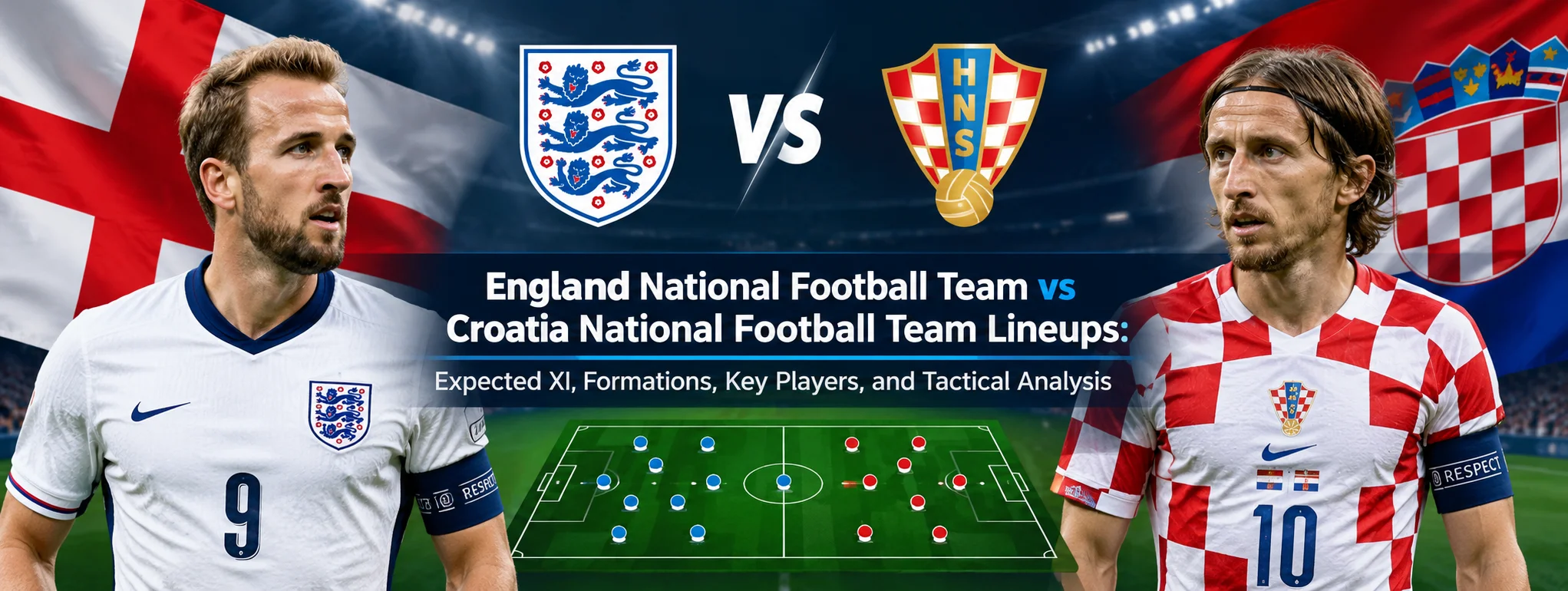
The England national football team vs Croatia national football team lineups were a major talking point ahead of their UEFA Nations League meeting on October 3, 2026. The two European sides entered the contest with different tactical approaches, experienced midfielders, and attacking players capable of changing the game. England ultimately produced a remarkable performance, defeating Croatia 7–0 in Rijeka.
The match provided an important look at England’s attacking quality and Croatia’s defensive challenges. Harry Kane led the scoring with two goals, while Bukayo Saka also scored twice. Jude Bellingham, Anthony Gordon, and Morgan Rogers completed England’s seven-goal performance.
For football fans, the starting lineups reveal how managers organize their teams, distribute responsibilities, and attempt to exploit weaknesses. England combined a strong midfield with pace on the wings, while Croatia relied on experienced players such as Luka Modrić and Mateo Kovačić to control possession and build attacks.
England National Football Team vs Croatia National Football Team Lineups: Match Overview
The October 3 meeting took place at Stadion HNK Rijeka in Croatia as part of the 2026–27 UEFA Nations League. England secured a convincing victory after scoring four goals in the first half and adding three more after the break.
| Match detail | Information |
|---|---|
| Match | Croatia vs England |
| Competition | UEFA Nations League 2026–27 |
| Match date | October 3, 2026 |
| Venue | Stadion HNK Rijeka, Rijeka |
| Final score | Croatia 0–7 England |
| Half-time score | Croatia 0–4 England |
| England manager | Thomas Tuchel |
| Croatia manager | Slaven Bilić |
| England captain | Harry Kane |
| Croatia captain | Luka Modrić |
England’s performance demonstrated the importance of an effective starting lineup, intelligent movement, and clinical finishing. Croatia struggled to contain England’s attacking players, particularly when the visitors moved the ball quickly through midfield and into the penalty area.
England National Football Team Starting Lineup
England selected a balanced starting XI featuring Jordan Pickford in goal, a versatile defensive line, two central midfielders, three attacking midfielders or wingers, and Harry Kane as the main striker.
England Starting XI
| Position | Player | Primary responsibility |
|---|---|---|
| Goalkeeper | Jordan Pickford | Shot-stopping and distribution |
| Right-back | Jarell Quansah | Defensive coverage and support in possession |
| Centre-back | Ezri Konsa | Defensive organization and marking |
| Centre-back | Marc Guéhi | Interceptions and defensive recovery |
| Left-back | Lewis Hall | Defensive support and forward movement |
| Central midfielder | Elliot Anderson | Ball progression and midfield coverage |
| Central midfielder | Alex Scott | Possession and distribution |
| Right winger | Bukayo Saka | Chance creation and attacking runs |
| Attacking midfielder | Jude Bellingham | Linking midfield and attack |
| Left winger | Anthony Gordon | Pace, pressing, and goal threat |
| Striker | Harry Kane | Finishing and attacking leadership |
England’s lineup offered a useful combination of defensive stability, midfield energy, creativity, and finishing ability. Kane provided the focal point in attack, while Saka and Gordon stretched Croatia’s defensive structure from the wide areas.
Bellingham operated behind the striker, where he could receive the ball between the lines, combine with the wingers, and arrive in dangerous positions around the penalty area.
England’s Formation and Tactical Approach
England’s personnel supported a flexible 4-2-3-1 structure. The formation gave the team a defensive foundation while allowing its four main attackers to move into advanced positions.
The back four provided the first defensive line, with Anderson and Scott offering support in central areas. Their responsibilities included recovering possession, distributing the ball, and helping England maintain control when Croatia attempted to build attacks.
Bellingham played an important connecting role. Rather than remaining close to the central midfielders, he could move into spaces behind Croatia’s midfield and provide passing options for Kane.
Saka and Gordon supplied width and direct attacking movement. Their ability to carry the ball forward made it difficult for Croatia to defend narrowly without leaving space near the touchlines.
England’s attacking plan was particularly effective because the players moved with purpose and converted their opportunities. The resulting 7–0 scoreline highlighted how dangerous a coordinated attacking unit can become when individual quality is supported by effective team movement.
Croatia National Football Team Starting Lineup
Croatia entered the match with a side combining international experience and younger players. Luka Modrić and Mateo Kovačić provided experience in midfield, while Joško Gvardiol and Luka Vušković formed part of the defensive structure.
Croatia Starting XI
| Position | Player | Primary responsibility |
|---|---|---|
| Goalkeeper | Dominik Livaković | Goalkeeping and defensive communication |
| Right-back | Josip Stanišić | Defensive coverage and support on the right |
| Centre-back | Luka Vušković | Central defensive duties |
| Centre-back | Joško Gvardiol | Defensive recovery and ball progression |
| Left-back | Ivan Perišić | Wide coverage and attacking support |
| Central midfielder | Mateo Kovačić | Ball retention and progression |
| Central midfielder | Luka Modrić | Playmaking and possession control |
| Right-sided attacker | Franjo Ivanović | Forward movement and attacking pressure |
| Attacking midfielder | Martin Baturina | Creativity between the lines |
| Left-sided attacker | Petar Sučić | Supporting attacks and connecting play |
| Striker | Petar Musa | Leading the attack and occupying defenders |
Croatia’s lineup was designed to combine midfield control with attacking movement from the wide positions. Modrić’s passing range and Kovačić’s ability to carry the ball forward offered ways to progress through England’s midfield.
Gvardiol provided defensive versatility, while Perišić offered experience and the ability to contribute in advanced areas.
However, Croatia found it difficult to maintain defensive organization against England’s movement. Once England established a substantial lead, Croatia faced the additional challenge of attempting to attack without leaving further spaces for the opposition.
Croatia’s Formation and Tactical Approach
Croatia’s starting personnel also supported a 4-2-3-1 shape. Modrić and Kovačić were central to the team’s buildup, while Baturina operated in an advanced midfield role.
The approach depended on Croatia retaining possession long enough to create opportunities through central combinations and wide support. Modrić could dictate the tempo, and Kovačić could carry the ball past the first line of pressure.
The difficulty arose when England pressed effectively and transitioned quickly into attack. Croatia needed its defensive line and midfield to remain compact, but England’s wide players and Bellingham repeatedly threatened spaces between defenders.
The result showed that technical quality in midfield is not always enough on its own. Teams must also protect the defensive areas around their penalty box and respond quickly when possession is lost.
England vs Croatia Lineups: Key Player Comparison
The individual matchups offered several interesting tactical battles. England had an attacking advantage through its wingers and central striker, while Croatia looked to its experienced midfielders to create control.
| Key matchup | England player | Croatia player | Tactical importance |
|---|---|---|---|
| Goalkeeper | Jordan Pickford | Dominik Livaković | Shot-stopping and distribution |
| Defensive leadership | Marc Guéhi | Joško Gvardiol | Organization and recovery |
| Midfield control | Elliot Anderson | Mateo Kovačić | Ball progression and pressure resistance |
| Playmaking | Jude Bellingham | Luka Modrić | Creativity and movement between the lines |
| Wide attack | Bukayo Saka | Ivan Perišić | Width, dribbling, and defensive coverage |
| Central finishing | Harry Kane | Petar Musa | Penalty-area movement and goal scoring |
The comparison illustrates the different responsibilities across the pitch. England’s midfielders and attackers worked together to create dangerous situations, while Croatia needed greater coordination between its central midfield and defensive line.
Kane’s finishing proved especially important. His movement forced Croatia’s defenders to remain alert, and his ability to convert chances gave England an early advantage.
Match Timeline: How England Won 7–0
England’s goals arrived at important moments, allowing the visitors to control the match and increase the pressure on Croatia.
| Minute | Scorer | Team | Match impact |
|---|---|---|---|
| 8′ | Harry Kane | England | Put England ahead early |
| 21′ | Jude Bellingham | England | Increased England’s advantage |
| 39′ | Anthony Gordon | England | Strengthened England’s control |
| 45′ | Bukayo Saka | England | Made it 4–0 before half-time |
| 53′ | Harry Kane | England | Extended the lead after the break |
| 68′ | Bukayo Saka | England | Added England’s sixth goal |
| 87′ | Morgan Rogers | England | Completed the 7–0 victory |
England’s early goal changed the tactical situation. Croatia could no longer approach the match with the same emphasis on patient buildup, as it needed to find a way back into the contest.
Bellingham’s goal increased the pressure, and further strikes from Gordon and Saka left Croatia with a difficult deficit before half-time.
Kane scored again early in the second half, reducing the likelihood of a Croatian comeback. Saka added another goal before Rogers completed the scoring late in the match.
The timeline reflects England’s clinical performance. Rather than relying on a single scoring spell, the team continued creating and converting opportunities throughout the game.
Five Major Tactical Takeaways
- England’s attacking movement: The combination of Kane, Bellingham, Saka, and Gordon created several threats for Croatia’s defensive line.
- The importance of an early goal: Kane’s eighth-minute strike gave England a strong platform and forced Croatia to take greater risks.
- Midfield coordination: Anderson and Scott helped connect the defensive unit with England’s advanced players.
- Croatia’s defensive difficulties: The hosts struggled to contain England’s movement and prevent further goals after falling behind.
- Squad depth: England was able to introduce fresh attacking options, with Morgan Rogers scoring late in the game.
These points help explain why starting lineups should be evaluated alongside tactical execution. A formation can look balanced on paper, but its effectiveness depends on positioning, communication, decision-making, and the ability to respond to changes during a match.
Substitutions and Squad Depth
Substitutions can influence the tempo of an international match, particularly when one team is protecting a lead and the other is trying to recover.
England introduced several players during the second half, including Eberechi Eze, James Garner, Morgan Rogers, Myles Lewis-Skelly, and Morgan Gibbs-White. Rogers scored in the 87th minute, adding another positive moment to England’s performance.
Croatia also made changes in an attempt to adjust its attacking approach and refresh its midfield. However, the substitutions did not prevent England from maintaining its advantage.
The match illustrated how squad depth can contribute to a team’s ability to sustain its performance. Fresh players can provide energy, change attacking patterns, and exploit spaces created as opponents become tired.
For managers, the challenge is to make changes that address the match situation rather than simply replace tired players. When a team is trailing heavily, substitutions may need to improve ball progression and attacking threat without making the defensive structure even more vulnerable.
Head-to-Head Context: England vs Croatia
England and Croatia have developed a competitive international rivalry through major tournaments and other European fixtures.
Croatia famously defeated England in the 2018 FIFA World Cup semi-final, reaching the final after extra time. England subsequently recorded important victories against Croatia, including a 4–2 win in the 2026 World Cup group stage.
The October 2026 Nations League encounter added another significant result to this rivalry, with England winning 7–0.
| Rivalry factor | England | Croatia |
|---|---|---|
| International reputation | Strong attacking depth and athleticism | Technical midfield and tournament experience |
| Key historical strength | Forward quality and attacking transitions | Possession, resilience, and midfield control |
| Notable modern rivalry moment | 2026 World Cup group-stage victory | 2018 World Cup semi-final victory |
| October 2026 result | Won 7–0 | Lost 0–7 |
Historical results provide context, but they do not guarantee future outcomes. Squad availability, player form, coaching decisions, and match conditions can significantly change the balance between the two national teams.
What the Lineups Reveal About Future Meetings
The England national football team vs Croatia national football team lineups offer several useful lessons for analyzing future fixtures.
England can be particularly dangerous when its attacking players receive the ball in space and its midfielders move forward at the right moments. Kane provides a reliable central reference point, while Saka, Gordon, and Bellingham offer different ways to create chances.
Croatia’s strengths remain closely connected to midfield intelligence, passing quality, and experienced international players. Modrić and Kovačić can help the team control possession, but Croatia must also ensure that its defensive structure remains protected when attacks break down.
For future meetings, the most important questions will include whether England can reproduce its pressing intensity, whether Croatia can prevent early goals, and which players are available to start.
Confirmed lineups should always take priority over predicted selections. Injuries, suspensions, tactical adjustments, and rotation can all change the starting XI shortly before kick-off.
Five Quick Facts About England vs Croatia Lineups
- England started with Jordan Pickford in goal and Harry Kane as its central striker.
- Jude Bellingham operated in an advanced midfield position behind Kane.
- Bukayo Saka and Anthony Gordon provided attacking width for England.
- Croatia relied on Luka Modrić and Mateo Kovačić for midfield control.
- England won the October 3, 2026 UEFA Nations League meeting by seven goals to nil.
Frequently Asked Questions
1. What was the final score between England and Croatia in October 2026?
England defeated Croatia 7–0 in their UEFA Nations League match on October 3, 2026, at Stadion HNK Rijeka.
2. Who scored for England against Croatia?
Harry Kane scored twice, Bukayo Saka scored twice, and Jude Bellingham, Anthony Gordon, and Morgan Rogers each scored once.
3. Who started in goal for England?
Jordan Pickford started in goal for England in the October 3, 2026 match.
4. Who were Croatia’s key midfielders?
Luka Modrić and Mateo Kovačić were Croatia’s two starting central midfielders. Their responsibilities included controlling possession, distributing the ball, and helping progress attacks.
5. Are England vs Croatia predicted lineups always accurate?
No. Predicted lineups are estimates based on team news, recent performances, tactical preferences, and player availability. Official starting lineups are normally announced shortly before kick-off and should be used for confirmation.
Final Thoughts
The England national football team vs Croatia national football team lineups provide an excellent example of how player selection and tactical execution can shape an international football match. England’s balance across defence, midfield, and attack helped it deliver a commanding 7–0 victory in the October 2026 UEFA Nations League fixture.
Harry Kane led the scoring, Saka supplied two goals from the right, and Bellingham and Gordon contributed to an attacking performance that Croatia struggled to contain. England’s midfield also helped connect its defensive structure with its dangerous forward line.
For Croatia, the match highlighted the importance of defensive organization, midfield support, and maintaining concentration when facing high-quality opposition. The result will remain a notable chapter in the modern rivalry between the two nations.
For readers following FootballClubMenu.com, examining the starting XI, formations, goal timeline, and tactical matchups offers a more complete understanding of the fixture than looking at the final score alone. These details also provide a useful foundation for analyzing future England and Croatia matches, where team selection and tactical adjustments will continue to influence the outcome.












Leave a Reply