

Last updated: July 2026 | Reviewed for accuracy against official UEFA and match-data sources
When Sporting CP walked into Estádio José Alvalade on March 17th trailing 3-0 from the first leg in Norway, most people had already written the story. Bodø/Glimt had dominated, looked sharp, and held a commanding advantage. But Sporting had other ideas. What unfolded that night wasn’t just a win—it was one of the most dramatic turnarounds in recent Champions League history, a 5-0 demolition that sent the Portuguese side through 5-3 on aggregate and into the quarter-finals for the first time since 1982-83.
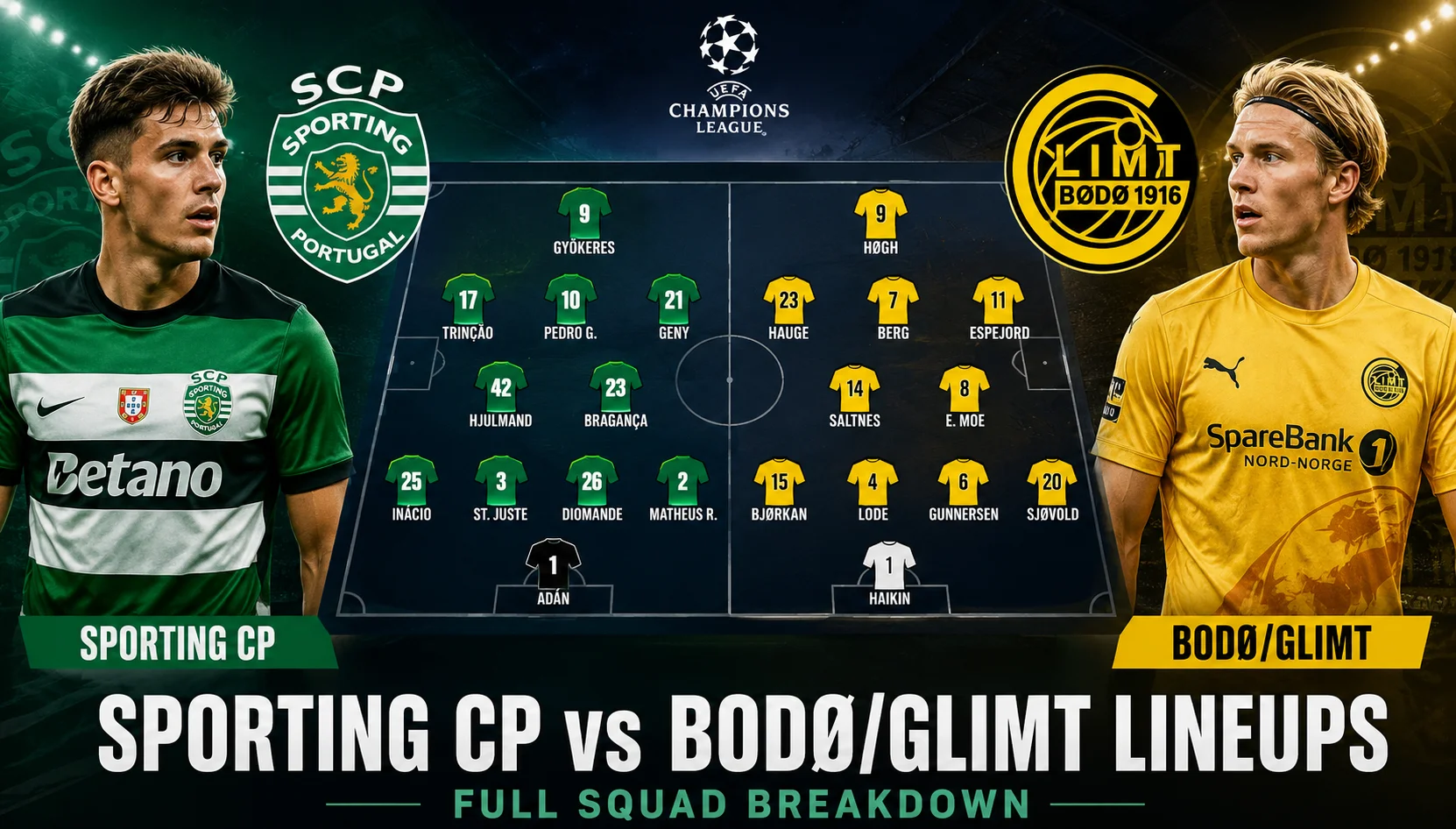
Sporting CP Confirmed Lineup
Rui Borges set Sporting CP up in a 4-2-3-1 shape for the decisive second leg at Estádio José Alvalade. The starting XI featured Rui Silva in goal, with Fresneda, Diomande, Gonçalo Inácio, and Araújo across the back four, Hjulmand and Morita anchoring midfield, and Catamo, Trincão, and Gonçalves supporting Suárez up front.
This selection marked a return to full strength for the hosts. Sporting had gone into the first leg missing both Maximiliano Araújo and Pedro Gonçalves through suspension, alongside injury absences for Ricardo Mangas and Fotis Ioannidis, which had forced a reshuffled attacking line in Bodø. Getting Araújo and Gonçalves back for the home leg gave Borges a far more balanced XI, particularly through the left channel where Sporting had looked short of creativity in Norway.
Bodø/Glimt Confirmed Lineup
Kjetil Knutsen named an unchanged 4-3-3 across both legs, a sign of the squad continuity that has defined Bodø/Glimt’s run. The Norwegian side lined up with Nikita Haikin in goal, Sjøvold, Bjørtuft, Gundersen, and Bjørkan in defense, Evjen, Berg, and Brunstad Fet in midfield, and Blomberg, Høgh, and Hauge leading the attack.
Consistency was central to Knutsen’s approach. Ahead of the second leg, pundits noted it would be a major surprise if Knutsen deviated from the setup that had carried Bodø this far, with the visiting squad free of fresh injuries or suspensions. That said, discipline was a live concern: three Bodø players, Sondre Auklend, Patrick Berg, and Jostein Gundersen, were one yellow card away from a suspension heading into the tie.
Understanding Sporting’s First-Leg Struggles
The story of why Sporting lost 3-0 in Bodø begins with the team sheet. Manager Rui Borges went into that first match without two of his most creative attacking players: Maximiliano Araújo and Pedro Gonçalves, both suspended. That forced a reshuffled lineup that lacked the width and creativity Sporting usually generates down the left flank. Without those two, Sporting looked blunt in attack. Bodø, by contrast, looked ruthless. Goals from Sondre Brunstad Fet in the 32nd minute, Ole Didrik Blomberg in the 57th, and Kasper Høgh in the 81st sent Sporting home with a mountain to climb.
But here’s what people missed while focusing on that 3-0 scoreline: Sporting knew exactly what they were missing, and they knew those two players would be back for the home leg. Getting Araújo and Gonçalves back for Lisbon wasn’t just about adding names to a team sheet—it fundamentally changed how Sporting could operate tactically. Araújo provides width and athleticism down the left. Gonçalves (also known as Pote) is one of Portugal’s most creative midfielders, capable of both scoring and creating from that number 10 role. Without them in Norway, Sporting had tried to compensate with a more defensive setup. With them back, Sporting could return to the attacking football that had gotten them this far.
Bodø/Glimt’s Tactical Consistency and Why It Failed
Kjetil Knutsen, Bodø/Glimt’s manager, made a bold choice for the second leg: he named an unchanged lineup. Same 4-3-3. Same eleven players. Same formation that had worked so brilliantly in the first leg. On the surface, this made sense. Bodø had no fresh injuries or suspensions, and the continuity had clearly worked. Hauge, Blomberg, and Høgh up front had looked dangerous. The midfield three of Evjen, Berg, and Brunstad Fet had controlled the game. The back four of Sjøvold, Bjørtuft, Gundersen, and Bjørkan had kept Sporting at arm’s length.
But there were warning signs Knutsen perhaps underestimated. Three of his players—Sondre Auklend, Patrick Berg, and Jostein Gundersen—were one yellow card away from suspension. That meant they had to play cautiously in a match where Sporting would inevitably come at them hard. More fundamentally, fatigue had likely set in. Bodø had played five consecutive matches before arriving in Lisbon, all at a high intensity. Sporting, by contrast, came in fresh and hungry for redemption.
How Sporting’s Second Half Took Control
The opening thirty minutes of the second leg were tense. Bodø actually had chances early on. But Sporting’s pressing was relentless from the start. In the 34th minute, Gonçalo Inácio rose highest from a corner to head Sporting in front. It was a simple goal, but it represented a shift in momentum. Bodø had come to Lisbon expecting to defend their advantage. Instead, they found themselves chasing the game.
By the 60th minute, Pedro Gonçalves doubled Sporting’s lead with a finish from inside the area. The tie was now level on aggregate at 2-2, and Bodø were visibly rattled. Sporting’s intensity didn’t drop. In the 78th minute, Luis Suárez converted from the penalty spot after a foul in the box, and suddenly Sporting had overturned the deficit entirely. The aggregate score was now 3-3, but Sporting had all the momentum.
The Extra-Time Collapse for Bodø
With the match heading to extra time, Bodø looked broken. Their shape had been disrupted, their confidence had evaporated, and the legs that had carried them to five straight wins were no longer there. Sporting, sensing blood, pressed forward relentlessly. Just two minutes into the additional thirty minutes, Maximiliano Araújo struck to put Sporting ahead in the tie for the first time. Bodø couldn’t respond. Rafael Nel added a fifth goal in stoppage time of extra time, sealing a 5-0 second-leg victory and a 5-3 aggregate progression for Sporting.
What This Means Going Forward
For Sporting, this result is transformative. Reaching the quarter-finals is a genuine achievement, especially after the way they looked in the first leg. It proves that when Rui Borges has his strongest XI available, Sporting can compete with anyone in Europe. They’ve shown resilience, tactical flexibility, and the kind of character that separates good sides from great ones.
For Bodø/Glimt, the exit is disappointing, but their European run this season remains impressive. They won five consecutive games before this tie and proved they belong at this level.
Questions Fans Are Asking
1. How did Sporting overturn a 3-0 deficit in one leg?
The return of Araújo and Gonçalves, combined with home advantage and Bodø’s fatigue, proved decisive.
2. Will Bodø/Glimt be back in the Champions League next season?
Their league form will determine that, but their run this year shows they’re a genuine European threat.
3. Can Sporting win the Champions League?
Reaching the quarters is progress, but they’ll face stronger sides ahead.
4. Why did Knutsen not change his lineup for the second leg?
It’s a tactical decision that backfired, but his consistency approach had worked throughout their run.
5. What’s next for Sporting in the Champions League?
They advance to the quarter-finals, where they’ll face one of the competition’s elite teams.

















Leave a Reply