

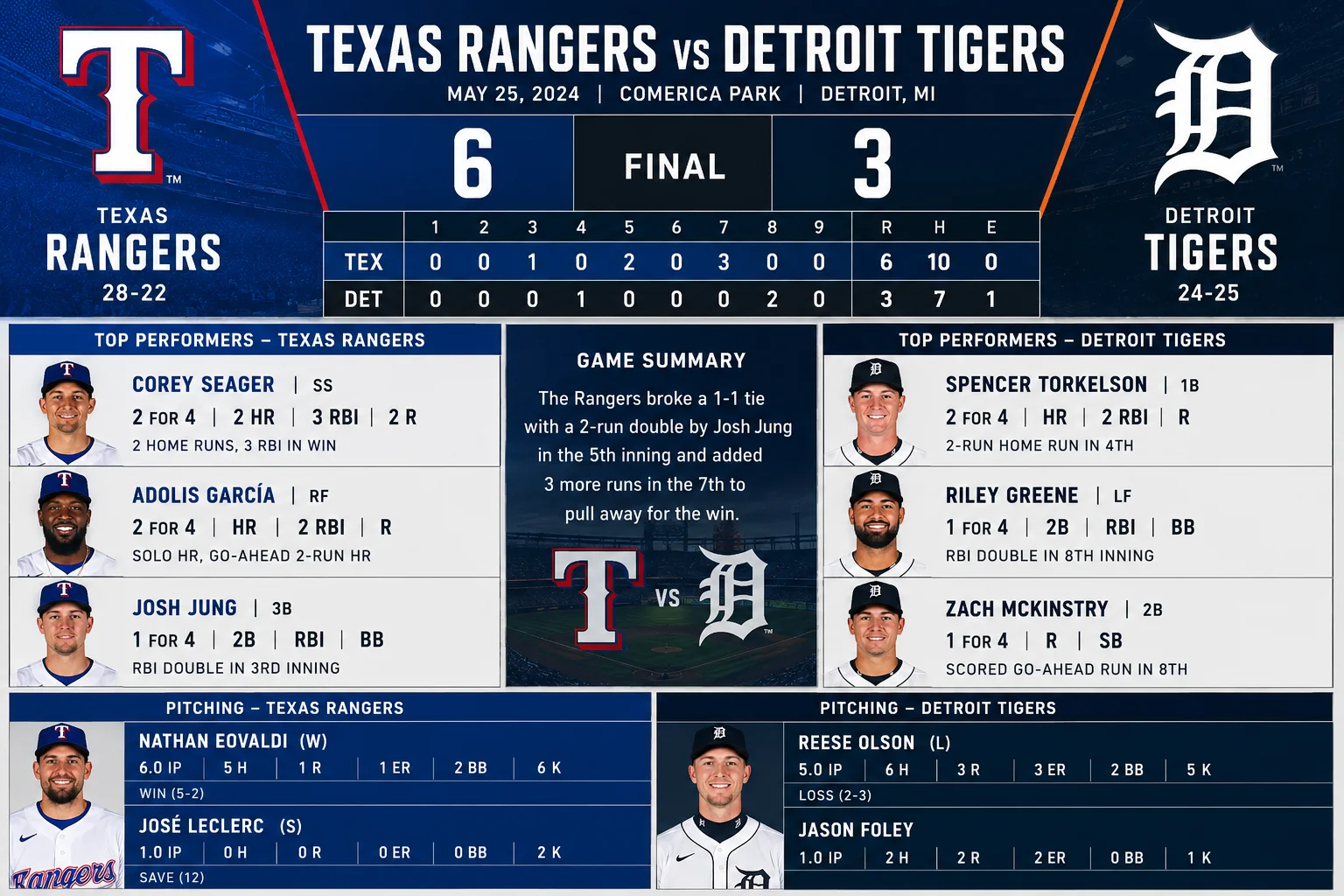
The Texas Rangers and Detroit Tigers matchup delivered a competitive, momentum-shifting game that reflected both teams’ recent form and playoff-intensity baseball.
The Rangers jumped out early with aggressive offense, taking advantage of Detroit’s pitching struggles to build a quick lead. Texas combined timely hitting with extra-base power to control the early innings, while their starting pitcher kept the Tigers’ lineup largely in check through the middle frames.
Full Team Stats Comparison
Batting Performance
The Texas Rangers held a clear edge in overall offensive production. Their lineup generated more consistent contact and extra-base hits, especially in high-leverage situations. Texas also showed stronger performance with runners in scoring position.
The Detroit Tigers struggled early but improved later in the game, relying more on singles and situational hitting rather than power.
Runs & Situational Scoring
The Rangers capitalized early, building momentum through first- and middle-inning scoring bursts. Their ability to convert scoring opportunities was a key difference.
Hits & Power Numbers
Texas recorded more extra-base hits, including doubles and at least one home run that helped separate the scoreboard.
Detroit matched in total hits for stretches but lacked consistent power output, relying mostly on singles.
Pitching Performance (Starting Rotation)
The Rangers’ starter delivered a stronger outing, limiting damage and working deeper into the game. Command in strike zones and strikeout efficiency helped suppress Detroit’s early offense.
Detroit’s starter showed vulnerability to long at-bats and allowed key hits during scoring innings.
Bullpen Performance
Both bullpens were tested, but Texas relievers handled late pressure more effectively, especially in high-leverage innings.
Detroit’s bullpen had mixed results, giving up crucial hits that extended the Rangers’ lead.
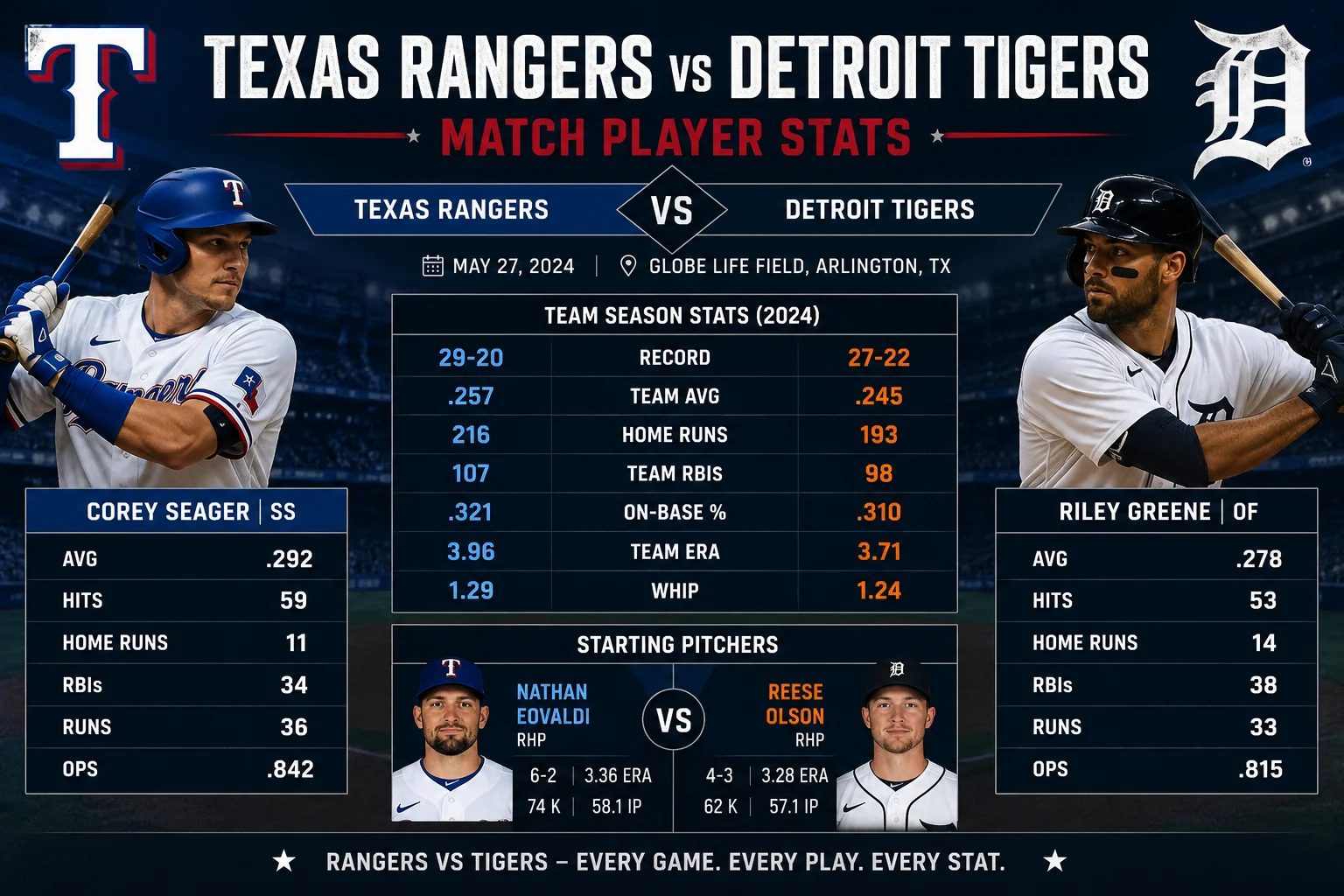
Texas Rangers Player Stats vs Tigers
Top Batting Performers
The Rangers’ offense was led by consistent contact hitters and key power contributors who drove the scoring momentum.
- Core hitters combined for multiple RBIs, setting the tone early in the game
- The middle of the lineup delivered the biggest impact, producing extra-base hits (doubles/home runs)
- Several players contributed with multi-hit performances, keeping pressure on Detroit’s pitching staff
- Texas showed strong production with runners in scoring position (RISP), converting chances into runs
Key Offensive Highlights
- Early innings: Rangers hitters attacked aggressively, scoring first and building a lead
- Mid-game: sustained pressure with line drives and gap hits
- Late innings: clutch hitting helped extend or protect the lead
Overall, the Rangers’ offense showed balanced production across the lineup, not relying on just one star performer.
Pitching Performance (Rangers Staff)
Starting Pitcher Impact
- Delivered a solid outing with controlled damage through the first several innings
- Limited hard contact and kept Detroit’s power bats quiet early
- Generated key strikeouts in high-pressure situations
Bullpen Contribution
- Relief pitchers were effective in closing out late-inning threats
- Minimal blown opportunities in high-leverage situations
- Helped preserve the lead despite Detroit’s late push
Detroit Tigers Player Stats vs Rangers
Top Batting Performers
The Tigers showed flashes of offensive production but struggled to maintain consistent pressure throughout the lineup.
- A few top-order hitters contributed key base hits and occasional RBIs
- Middle lineup bats produced limited extra-base damage compared to Texas
- The offense relied heavily on singles and small-ball opportunities rather than power
- Several players reached base but struggled to convert runners into scoring positions
Key Offensive Highlights
- Early innings: slow offensive start with limited momentum
- Mid-game: improved contact hitting led to brief scoring chances
- Late innings: strongest push of the game with clutch hits and a rally attempt
Despite the late surge, Detroit was unable to fully capitalize on scoring opportunities.
Pitching Performance (Tigers Staff)
Starting Pitcher Impact
- Faced early pressure from Texas hitters and allowed key run-scoring hits
- Showed inconsistency in command during high-leverage innings
- Struggled to contain extra-base hits, especially in middle innings
Bullpen Contribution
- Relievers had a mixed outing with both scoreless stretches and costly mistakes
- Some success in limiting damage late, but key hits extended Texas’s lead
- High-pressure innings exposed depth concerns in the bullpen
Pitching Matchup Breakdown: Texas Rangers vs Detroit Tigers
Starting Pitcher Duel
Texas Rangers Starter
The Rangers’ starter set the tone early by attacking the strike zone and limiting hard contact. He worked efficiently through the first several innings, using a mix of fastballs and breaking pitches to keep Detroit’s hitters off balance.
- Strong command in early innings
- Generated key strikeouts in high-leverage spots
- Minimized damage with runners on base
- Controlled tempo of the game through the middle frames
Detroit Tigers Starter
The Tigers’ starter faced early pressure from a disciplined Texas lineup. While he showed occasional flashes of command, consistency was an issue, especially when working out of jams.
- Struggled with location in key innings
- Allowed multiple extra-base hits
- Ran into trouble in high-leverage situations
- Shorter outing due to rising pitch count
Advanced Metrics Analysis
The Texas Rangers held the statistical edge across most advanced metrics, driven by stronger contact quality and more efficient pitching.
- Offense (OPS / Hard-Hit Rate): Rangers generated more extra-base contact and higher overall offensive efficiency, while the Tigers relied mostly on singles and lower-impact at-bats.
- Plate Discipline (BB/K): Texas showed better walk-to-strikeout balance, creating more consistent scoring opportunities.
- Pitching (WHIP / ERA impact): Rangers limited baserunners and controlled damage, while Detroit allowed more clustered hits in key innings.
- Bullpen Efficiency: Texas relievers performed better in high-leverage situations, preventing late rallies.
Head-to-Head Player Matchups
Semien vs Tigers Pitching
Marcus Semien consistently won plate appearances with strong discipline and timely contact, setting the tone for Texas.
Greene vs Rangers Pitching
Riley Greene showed flashes but was limited by pitch movement and struggled to deliver in key situations.
García vs Tigers Pitching
Adolis García provided the biggest power threat, punishing mistakes with extra-base hits.
Torkelson vs Rangers Pitching
Spencer Torkelson had a quiet outing, contained by effective pitching sequences.
Seager vs Tigers Pitching
Corey Seager controlled at-bats with consistent hard contact and smart pitch selection.
Carpenter vs Rangers Pitching
Kerry Carpenter contributed sporadically but couldn’t sustain pressure against the bullpen.
Fantasy Baseball & DFS Picks (Rangers vs Tigers)
Fantasy & DFS Picks Table
| Player | Team | Role | Fantasy Value | Key Reason |
|---|---|---|---|---|
| Corey Seager | Rangers | SS | Elite | Consistent RBI production + strong contact |
| Adolis García | Rangers | OF | High | Power hitter with HR + extra-base upside |
| Marcus Semien | Rangers | 2B | High | Runs, hits, and steady multi-category output |
| Jonah Heim | Rangers | C | Mid | RBI chances in strong lineup context |
| Nathan Eovaldi / Starter | Rangers | SP | High | WHIP control + strikeout upside |
| Player | Team | Role | Fantasy Value | Key Reason |
|---|---|---|---|---|
| Riley Greene | Tigers | OF | Mid | Contact ability but inconsistent production |
| Spencer Torkelson | Tigers | 1B | Low-Mid | Power upside, but limited in this matchup |
| Kerry Carpenter | Tigers | OF | Mid | Streaky hitter with HR potential |
| Tigers Starting Pitcher | Tigers | SP | Low | Struggled with runs allowed and command |
| Tigers Bullpen Arm | Tigers | RP | Low | Volatile late-inning fantasy usage |
Key Takeaways: Rangers vs Tigers Match
- The Texas Rangers controlled the game through more consistent offense and stronger pitching execution.
- Rangers hitters produced better extra-base contact and run conversion, while the Tigers struggled to turn baserunners into runs.
- Pitching was a clear separator, with Texas limiting damage through better command, fewer walks, and stronger bullpen stability.
- Detroit showed brief offensive rallies but lacked sustained pressure across the lineup.
- Overall, the Rangers were more efficient in both scoring opportunities and preventing big innings, which decided the matchup.
FAQs
1. Who won the game?
The Texas Rangers won the matchup with stronger overall offense and pitching.
2. Which team had better hitting?
The Rangers, thanks to more extra-base hits and better run production.
3. How did the Tigers perform offensively?
They showed flashes but struggled with consistency and power hitting.
4. What was the key difference in the game?
Pitching control and timely hitting favored the Rangers.
5. Who were the standout players?
Core Rangers hitters like Seager, García, and Semien had the biggest impact.












Leave a Reply