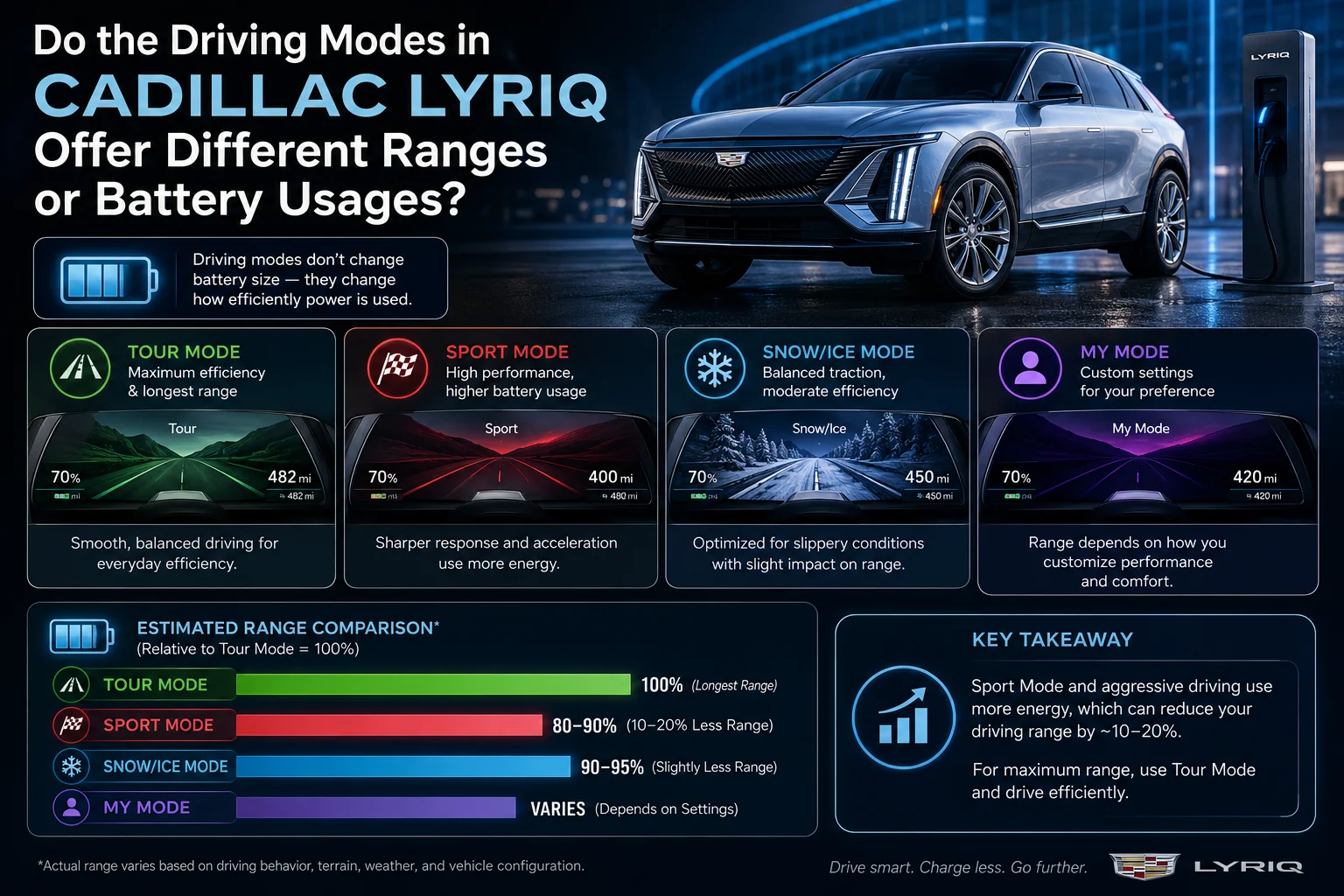
Yes—Cadillac Lyriq driving modes can affect both range and battery usage, but they do not change the battery’s actual capacity. The Lyriq’s battery stays the same; what changes is how efficiently the vehicle uses that energy.
How Cadillac Lyriq Driving Modes Change Battery Usage
Cadillac Lyriq driving modes do not change the battery’s physical size, but they change how quickly energy is used by adjusting vehicle software settings like throttle response, regenerative braking, motor engagement, and climate management. These small system changes can noticeably affect your real-world driving range.
Throttle Response Changes
One of the biggest ways driving modes affect battery usage is through throttle mapping—how aggressively the SUV responds when you press the accelerator.
- Tour Mode: Uses smoother, gradual acceleration to reduce sudden power demand and improve efficiency.
- Sport Mode: Delivers quicker torque and sharper pedal response, which drains battery faster during acceleration.
- Snow/Ice Mode: Softens acceleration to prevent wheel slip, often reducing unnecessary energy spikes on slippery roads.
- My Mode: Lets drivers customize throttle sensitivity, allowing a balance between performance and efficiency.
Since EVs consume the most energy during rapid acceleration, aggressive throttle settings in Sport Mode can reduce range by 10% to 25%, depending on driving habits.
Regenerative Braking Adjustments
Cadillac Lyriq uses regenerative braking to recover energy whenever you slow down, converting motion back into battery power. Driving modes can influence how strong that regenerative braking feels:
- Tour Mode: Balanced regeneration for everyday efficiency.
- Sport Mode: May allow more free-rolling feel but can still use regen.
- One-Pedal Driving: Maximizes energy recovery by slowing the car aggressively when you lift off the accelerator.
- Regen on Demand Paddle: Lets drivers manually increase braking and recover extra energy when needed.
In city driving, strong regenerative braking can improve battery efficiency by 5% to 10%, especially with frequent stop-and-go traffic.
AWD Power Distribution
For all-wheel-drive (AWD) Cadillac Lyriq models, driving modes can also affect how power is distributed between the front and rear motors.
- Tour Mode: Often prioritizes efficiency by minimizing unnecessary dual-motor use.
- Sport Mode: Keeps both motors more active for stronger traction and acceleration.
- Snow/Ice Mode: Continuously adjusts torque between wheels to prevent slipping.
Using both electric motors more frequently improves handling and performance, but it can increase battery consumption compared to rear-wheel-drive efficiency. AWD models typically show slightly lower total range because of this extra energy demand.
Climate Control Energy Impact
Driving modes can also indirectly affect HVAC (heating and air conditioning) energy usage, which can significantly impact EV range.
- Tour Mode: Maintains balanced climate settings for efficiency.
- Sport Mode: May prioritize battery cooling and cabin comfort during high-performance driving.
- Cold Weather: Cabin heating can reduce total range by 15% to 25%, especially in winter.
- Preconditioning: Warming or cooling the cabin while plugged in helps preserve battery range.
Cadillac Lyriq Driving Modes Explained
Tour Mode (Maximum Range)
- Default configuration calibrated for predictable daily travel requirements.
- Engineered specifically to yield maximum performance and battery range conservation.
- Smooth and gradual acceleration mapping reduces severe powertrain demand spikes.
- Balanced regenerative braking calibration systematically reclaims energy.
- Maintains a high standard of steering comfort and traditional ride mechanics.
- Highly effective for city navigation routines and sustained highway corridors.
Sport Mode (Performance First)
- Delivers immediate acceleration capabilities along with direct electric motor torque response.
- Sharpens accelerator pedal data collection for immediate throttle engagement.
- Increases physical steering resistance to support rapid handling procedures.
- Draws heavier electrical loads from the battery pack during performance phases.
- Can predictably degrade actual driving range by 10% to 20%.
- Not recommended when strict battery capacity preservation is essential.
Snow/Ice Mode (Traction & Safety)
- Built strictly to counter slippery road pavements and low-traction weather events.
- Reduces accelerator pedal processing sensitivity to mitigate unintended wheel spin.
- Improves real-time chassis traction calculations and vehicle stability.
- Dynamically shifts AWD torque bias across electric motors for optimal grip.
- Protects overall highway transit safety metrics over baseline energy efficiency.
My Mode (Custom Setup)
- Allows the operator to uniquely isolate and save individualized vehicle performance trends.
- Supports personalized modifications to physical throttle feedback timelines.
- Provides independent options to modify electric power steering weight metrics.
- Features manual adjustment toggles for variable regenerative braking levels.
- Allows drivers to construct their own balance between vehicle energy optimization and power.
V-Mode (Lyriq-V Exclusive)
- Restricted entirely to the dedicated Cadillac Lyriq-V high-performance model variant.
- Unlocks the peak horsepower output threshold and highest possible acceleration rates.
- Switches the active suspension setup to high-response cornering dynamics.
- Generates the highest system energy consumption profile out of all driving modes.
- Reduces total vehicle battery mileage capacity significantly during activation.
Real-World Cadillac Lyriq Range by Driving Mode
Cadillac Lyriq driving modes can noticeably change your real-world range, even though the battery size stays the same. Tour Mode delivers the best efficiency, while Sport Mode can reduce total range by 20 to 70 miles depending on speed, weather, and driving habits.
Cadillac Lyriq Range Comparison by Driving Mode
| Driving Mode | Estimated Range (RWD) | Estimated Range (AWD) | Battery Usage Impact | Best For |
|---|---|---|---|---|
| Tour Mode | 280–310 miles | 250–290 miles | Lowest battery drain | Daily driving, long trips |
| Sport Mode | 240–280 miles | 220–260 miles | Highest battery drain | Fast acceleration, performance |
| Snow/Ice Mode | 260–295 miles | 230–270 miles | Moderate battery drain | Rain, snow, icy roads |
| My Mode (Efficient Setup) | 275–305 miles | 245–285 miles | Depends on settings | Custom balance of comfort and efficiency |
| V-Mode (Lyriq-V only) | N/A | 220–250 miles | Maximum battery usage | High-performance driving |
Does One-Pedal Driving Improve Cadillac Lyriq Battery Efficiency?
Yes—One-Pedal Driving can improve Cadillac Lyriq battery efficiency, especially in city driving and stop-and-go traffic. It increases regenerative braking, allowing the SUV to recover energy every time you lift off the accelerator and send some of that energy back to the battery.
Does Super Cruise Affect Cadillac Lyriq Range?
Yes—Super Cruise can slightly affect Cadillac Lyriq range, but the impact is usually small compared to factors like speed, weather, and driving mode. Since Super Cruise uses Adaptive Cruise Control, cameras, sensors, and mapping systems, it consumes a small amount of extra power—but its smoother driving can also improve efficiency
Read more about :CNLawBlog 2026: Is It Legit, Trustworthy
Factors That Affect Range More Than Driving Mode
While Cadillac Lyriq driving modes can change battery usage, other factors often have a much bigger impact on your real-world range. Things like speed, weather, tire condition, and drivetrain choice can affect efficiency far more than switching between Tour or Sport Mode.
Vehicle Speed Impact
Velocity thresholds function as primary determinants over real-world battery mileage performance parameters.
- Elevated highway speeds exponentially compound aerodynamic drag coefficients.
- Cruising at 75 to 80 mph can decrease your range metric by 20% to 30% versus sustained travel at 60 to 65 mph.
- Aggressive, sudden acceleration sequences rapidly drain high-voltage pack reserves.
- Deploying Super Cruise at moderate limits sustains streamlined powertrain efficiency.
Outside Temperature
Severe environmental baseline climates degrade battery packs from meeting standard estimated milestones.
- Cold ambient conditions can reliably compress maximum estimated range output by 15% to 30%.
- Internal lithium-ion fluid chemistry encounters increased electrical resistance at minimal temperatures.
- High-performance summer heat loads draw additional energy to govern climate systems.
Tire Inflation Metric
Improper tire pressures disrupt contact engineering and force structural efficiency down.
- Underinflated tire profiles create excessive friction coefficients across pavement surfaces.
- Even modest discrepancies below factory specifications systematically decrease EV range performance.
- Freezing climates naturally compress internal gaseous volumes, decreasing PSI.
Cabin Heating & AC
Climate control architecture imposes variable impacts on range based on energy-intensive system configurations.
- Active cabin air heaters consume significantly greater amounts of energy than standard air conditioning compressors.
- Prolonged thermal cabin heating can result in a range reduction penalty of 10% to 20% or more.
- Integrated component heaters (seats and steering wheel) execute targeted thermal warming at highly optimized efficiency metrics.
AWD vs RWD Layouts
Drivetrain motor configurations fundamentally determine default mechanical efficiency performance limits.
- Rear-Wheel Drive variants yield optimal efficiency bounds due to decreased powertrain friction losses.
- All-Wheel Drive packages invoke dual electric motors, generating added electrical operational draws.
- AWD layouts advance physical launch traction, power distribution metrics, and cold weather response variables.
Best Cadillac Lyriq Driving Mode for Long Road Trips
For long-distance travel, the best Cadillac Lyriq driving mode is Tour Mode, combined with efficient driving habits like steady speeds and regenerative braking. Tour Mode is designed to balance comfort, stability, and maximum range efficiency, making it ideal for highway cruising.
When to Use Other Modes on a Road Trip
Sport Mode
Adjusts dynamic steering stiffness and throttle map responsiveness profiles.
- Restrict deployment to short intervals like passing maneuvers.
- Not recommended for steady highway cruising due to accelerated battery draws.
Snow / Ice Mode
Optimizes accelerator pedal sensitivity matrices for low-traction limits.
- Deploy when dealing with adverse weather conditions like snow or rain.
- Bypassed during routine or dry operational infrastructure parameters.
My Mode
Provides user-configured subsystem profiles for tailored operations.
- Highly effective if pre-configured with low throttle response and strong regenerative setups.
- Tour Mode remains the standard benchmark for baseline highway consistency.
V-Mode (Lyriq-V)
Unlocks maximum high-performance torque distribution metrics across the vehicle layout.
- Not recommended for range-stretching road trip scenarios.
- Draws heavy operational power to favor aggressive track performance variables.
Tips to Maximize Cadillac Lyriq Battery Range
Maximizing Cadillac Lyriq range is less about a single driving mode and more about consistent efficient habits. Small changes in speed, climate use, and driving style can add meaningful extra miles on every charge.
1. Drive in Tour Mode
- Serves as the primary default operational setting calibrated for efficiency.
- Delivers highly consistent, smooth power outputs to significantly minimize unnecessary energy waste.
- Optimized perfectly for standard routine daily commuting layouts and sustained highway cruising.
2. Maintain Moderate Speed
- Restricting baseline freeway velocities to 65–70 mph helps control high consumption rates.
- Elevated travel velocities compound aerodynamic friction forces exponentially across the chassis profile.
- Executing a modest reduction in sustained travel speed noticeably improves driving range potential.
3. Use Regenerative Braking Smartly
- Deploy One-Pedal Driving configurations frequently within dense, urban traffic corridors.
- Capture dynamic braking energy to replenish the battery system rather than shedding it as friction heat.
- Anticipate ahead of deceleration sequences to maximize real-time battery energy recovery profiles.
4. Optimize Climate Control Use
- Thermal cabin heating units create a substantially higher energy draw than cooling compressors.
- Prioritize integrated seat and steering wheel heating grids over full-forced air cabin climates.
- Deploy scheduled cabin pre-conditioning commands while the car remains attached to external chargers before driving.
FAQs
Does Sport Mode drain the Cadillac Lyriq battery faster?
Yes. Sport Mode uses more aggressive acceleration profiles and elevated power output thresholds. This increases real-time battery consumption and can reduce your driving range by around 10%–20% compared to standard Tour Mode settings.
Which Lyriq mode gives the best range?
Tour Mode delivers the highest efficiency. It is engineered specifically to provide smooth acceleration mapping and balanced energy usage configurations, making it the most reliable baseline for daily driving routines and long-distance road trips.
Does My Mode save battery?
It depends entirely on your specific configuration. If you isolate your options to lighter throttle responses and strong regenerative braking setups, My Mode can mimic or match the baseline efficiency of Tour Mode. Selecting aggressive performance configurations will reduce total range.
Is one-pedal driving better for efficiency?
Yes. One-Pedal Driving maximizes your energy efficiency within urban traffic layouts and stop-and-go driving conditions by routing maximum kinetic energy back into the battery pack via regenerative deceleration. It offers minimal extra benefits during steady-state highway cruising.
Does cold weather reduce Cadillac Lyriq range?
Yes. Low ambient temperatures can lower total driving range by 15%–30%. This occurs because EV battery chemistries operate less efficiently in cold conditions, and running the cabin heating systems draws extra power. Scheduling a cabin pre-conditioning phase while connected to a charger minimizes this range drop.