

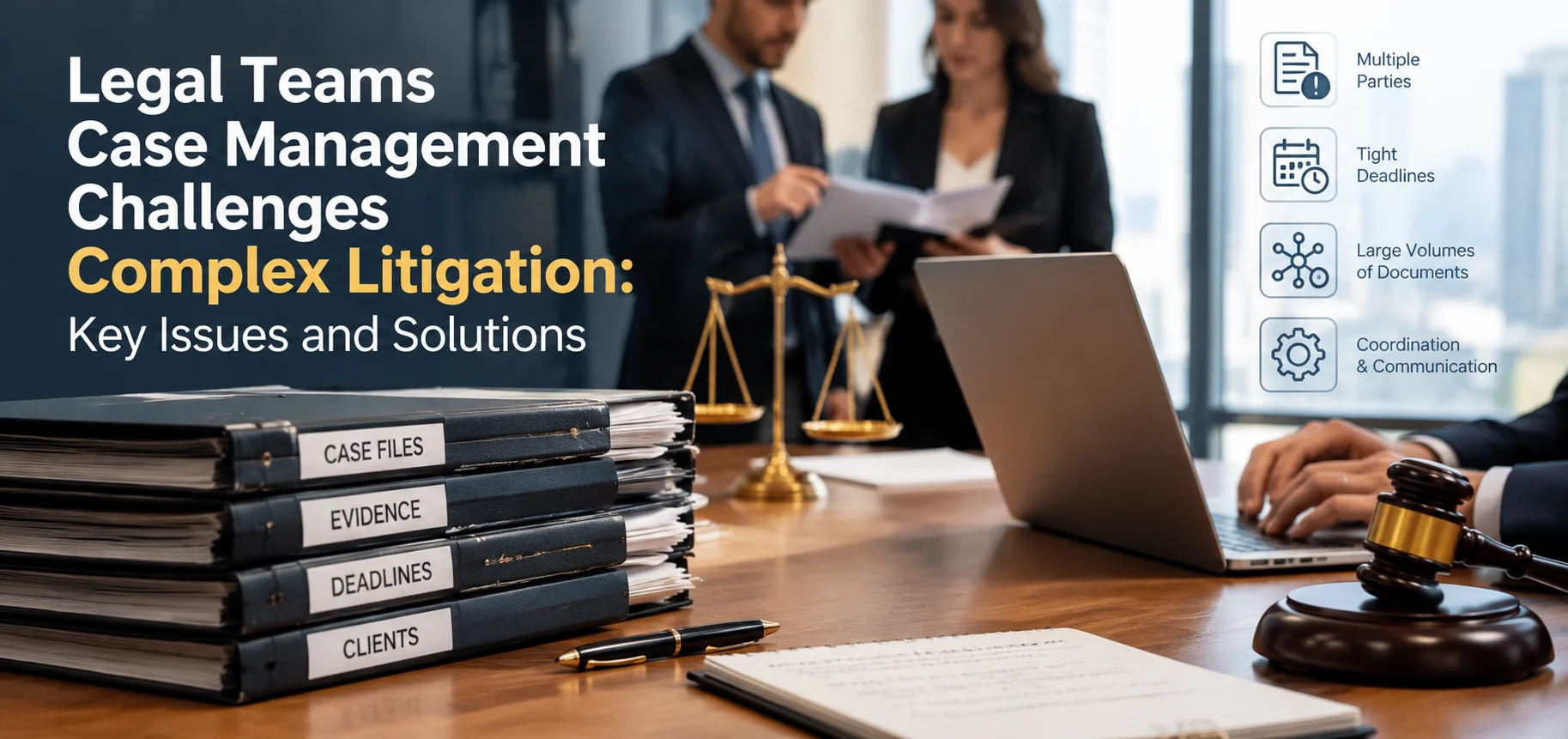
Legal teams case management challenges complex litigation is an important topic for law firms, corporate legal departments, litigation managers, and professionals responsible for handling demanding legal disputes. Complex litigation often involves multiple parties, extensive documentation, strict court deadlines, expert witnesses, and large amounts of information that must be reviewed and organized accurately. When these responsibilities overlap, even experienced legal professionals can struggle to maintain efficiency and consistency.
Effective case management helps legal teams coordinate their work, track important developments, protect confidential information, and prepare stronger legal strategies. However, achieving these goals requires more than hiring experienced attorneys. It also involves reliable communication, organized documentation, appropriate technology, realistic workloads, and clear procedures.
Understanding Complex Litigation and Case Management
Complex litigation refers to legal disputes that require substantial coordination, extensive evidence analysis, multiple legal arguments, or involvement from numerous parties. These cases may include commercial disputes, class actions, corporate litigation, intellectual property conflicts, and regulatory matters.
Case management is the process of organizing and overseeing the activities necessary to move a legal case forward. It includes maintaining records, scheduling deadlines, assigning responsibilities, reviewing evidence, communicating with relevant parties, and preparing for hearings or trials.
When litigation becomes complicated, these activities become more demanding. A single case may involve thousands of documents, several attorneys, external experts, different legal teams, and multiple procedural requirements.
Why Complex Cases Require Specialized Management
Ordinary legal matters may involve a relatively small number of documents and straightforward deadlines. Complex litigation often requires continuous coordination between people working on different aspects of the same dispute.
For example, a commercial lawsuit might involve financial records, employee communications, contractual obligations, technical reports, and testimony from expert witnesses. Each piece of information may influence the legal strategy.
Without a consistent management process, important evidence can be overlooked, deadlines can be missed, and teams may duplicate work unnecessarily.
Successful case management therefore depends on creating a reliable system that connects information, people, responsibilities, and timelines.
Major Legal Teams Case Management Challenges Complex Litigation Creates
Legal professionals encounter several recurring problems when managing complicated disputes. Understanding these challenges is the first step toward developing practical solutions.
1. Managing Large Volumes of Evidence
One of the biggest challenges in complex litigation is handling large quantities of evidence. Documents may include emails, contracts, spreadsheets, meeting records, digital messages, photographs, financial statements, and technical reports.
Reviewing this material requires considerable time and careful attention. Teams must identify relevant evidence, preserve important records, remove unnecessary duplication where appropriate, and maintain accurate document classifications.
Poor organization can make it difficult to locate essential information when preparing motions, questioning witnesses, or responding to opposing counsel.
Practical solutions include:
-
Establishing consistent document naming and classification rules.
-
Using searchable document repositories with appropriate access controls.
-
Maintaining clear records of evidence collection and review.
-
Applying approved technology to identify potentially relevant documents.
-
Conducting quality checks before evidence is used in legal filings.
Technology can accelerate document review, but attorneys must still verify important findings and ensure that evidence is handled according to applicable legal requirements.
2. Tracking Deadlines and Court Requirements
Complex litigation often involves numerous deadlines for filing motions, responding to discovery requests, submitting evidence, and preparing for hearings.
These dates may depend on court orders, procedural rules, agreements between parties, or changes in the litigation schedule. Missing a critical deadline can result in financial penalties, procedural disadvantages, or other serious consequences.
The difficulty increases when multiple attorneys manage different responsibilities within the same case.
A dependable deadline management system should include a central calendar, clearly assigned owners, advance reminders, and procedures for escalating potential delays.
Teams should also distinguish between the official deadline and internal preparation dates. This provides additional time for reviewing documents, obtaining approvals, and correcting errors.
3. Coordinating Multiple Attorneys and Specialists
Complex disputes frequently require collaboration among litigation attorneys, paralegals, investigators, financial analysts, technical experts, and external counsel.
Each professional contributes specialized knowledge, but coordination becomes difficult when responsibilities overlap or information is scattered across different communication channels.
For example, an expert witness may need financial data from one team while another team is preparing related deposition questions. If these groups work independently, inconsistencies can emerge.
Legal managers can improve coordination by establishing responsibility matrices, regular case meetings, shared task lists, and documented decision-making procedures.
Every important task should have an accountable owner, a clear deadline, and a defined completion standard.
4. Controlling Litigation Costs
Complex litigation can become expensive because of attorney hours, expert fees, discovery expenses, document processing, court costs, and external consulting services.
Unexpected developments may also require additional research or new evidence reviews. Without effective monitoring, legal spending can exceed the original budget.
Cost control should not mean reducing necessary legal work. Instead, teams should identify inefficiencies, prioritize high-value activities, and evaluate whether resources are being used appropriately.
Useful measures include reviewing time records, tracking spending against the budget, monitoring external vendor expenses, and identifying repeated administrative tasks.
5. Protecting Confidential and Sensitive Information
Legal teams often handle confidential business records, personal information, trade secrets, financial documents, and privileged communications.
A security incident can expose sensitive material and potentially damage client relationships or compromise a legal position.
Risks may arise from unauthorized access, accidental email disclosure, insecure file sharing, weak passwords, or improper document retention.
Strong information governance should include role-based permissions, secure storage, multifactor authentication, staff training, appropriate retention policies, and documented procedures for responding to incidents.
Legal teams must also understand the rules governing confidentiality, privilege, data protection, and preservation of evidence in the jurisdictions relevant to their cases.
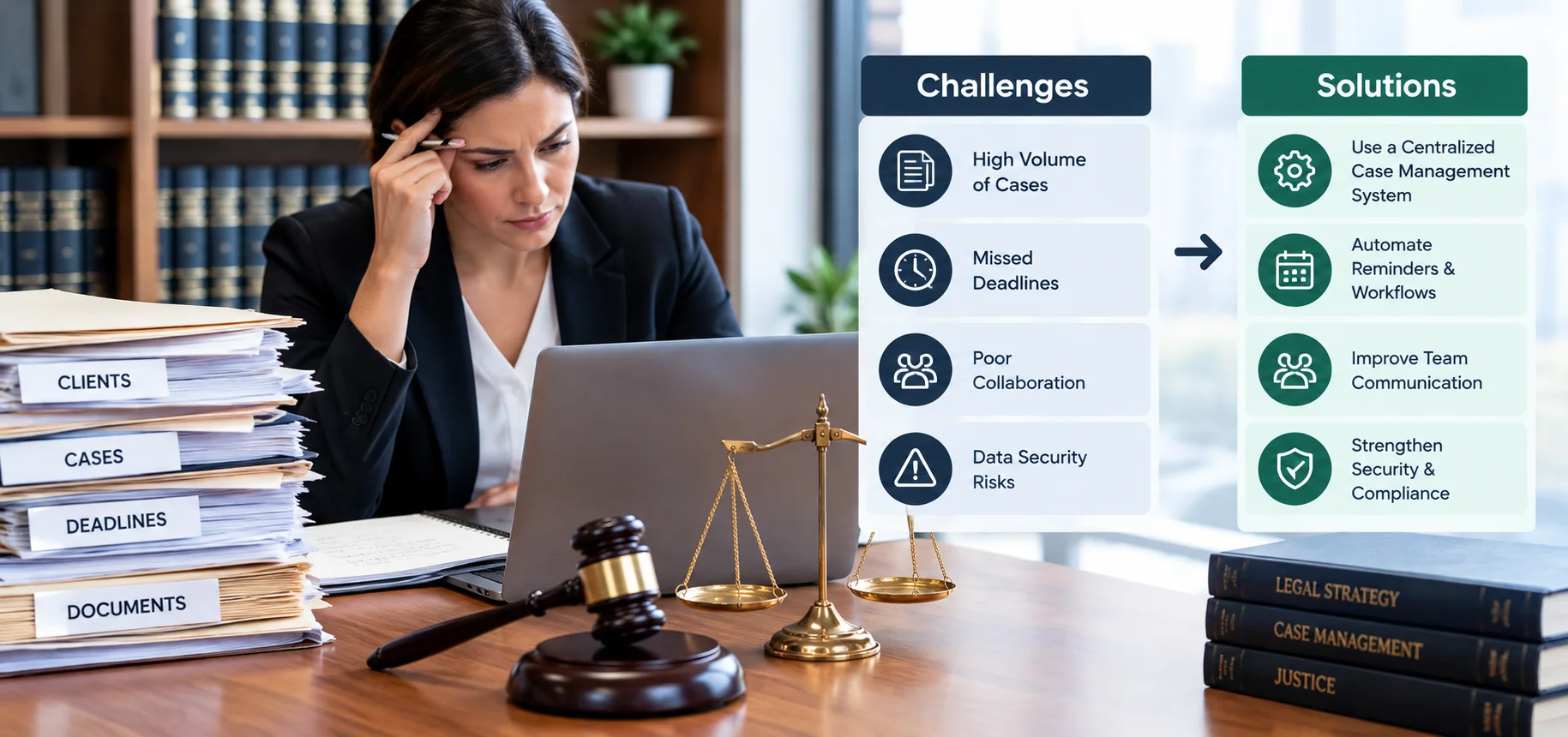
Common Challenges and Their Practical Solutions
The following table summarizes major case management problems and the steps legal teams can take to address them.
| Challenge | Potential impact | Recommended solution |
|---|---|---|
| Large evidence volumes | Delays and overlooked documents | Centralized document management and structured review |
| Missed deadlines | Procedural risks and additional costs | Shared calendars, reminders, and deadline ownership |
| Poor communication | Conflicting instructions and duplicated work | Regular meetings and documented responsibilities |
| Rising legal expenses | Budget overruns | Cost tracking and resource planning |
| Security weaknesses | Unauthorized disclosure | Access controls and secure information handling |
| Inconsistent records | Difficult case preparation | Standardized documentation procedures |
| Limited staff capacity | Delays and excessive workloads | Workload assessment and task prioritization |
| Changing case requirements | Outdated plans and missed actions | Regular case reviews and updated schedules |
These solutions work best when they form part of a consistent management framework rather than being introduced as isolated improvements.
The Role of Technology in Complex Litigation Management
Legal technology can help teams organize evidence, coordinate tasks, monitor deadlines, and maintain visibility across complicated matters. However, software is most effective when it supports clearly defined working procedures.
Document Management Systems
Document management platforms help legal professionals store, classify, search, and retrieve case materials. They can reduce the time spent locating records and improve consistency across large teams.
Useful capabilities may include version control, access permissions, document tagging, audit trails, and full-text search.
Before selecting a platform, legal departments should consider their security requirements, integration needs, case volume, and applicable compliance obligations.
Litigation Management Software
Litigation management systems can provide a centralized overview of case schedules, assigned tasks, legal expenses, important documents, and upcoming procedural requirements.
Instead of relying entirely on individual spreadsheets or personal calendars, teams can maintain a shared view of important activities.
Nevertheless, software should not be treated as a substitute for professional judgment. Court deadlines and procedural requirements should be verified by qualified personnel.
Artificial Intelligence and Legal Research Tools
Artificial intelligence can assist with document classification, summarization, preliminary research, and identifying patterns in large collections of records.
These tools may reduce repetitive work, but they introduce additional risks. Automated systems can produce inaccurate summaries, overlook context, or generate unsupported legal statements.
Legal teams should establish clear rules for using AI, protect confidential information, verify citations and factual claims, and ensure that qualified professionals review consequential outputs.
Building a More Effective Case Management Strategy
Improving complex litigation management requires a coordinated approach that addresses people, processes, information, and technology.
1. Create a Central Case Management Plan
Every major case should have a documented plan describing its objectives, key dates, responsible team members, evidence requirements, expected costs, and major risks.
The plan should be updated when court orders change, new evidence emerges, or the litigation strategy develops.
A central plan helps team members understand how their individual responsibilities contribute to the overall case.
2. Establish Clear Roles and Responsibilities
Unclear ownership creates confusion and delays. A responsibility framework should identify who performs each task, who approves important decisions, and who must receive updates.
For example, a paralegal might manage document organization, while an attorney supervises legal analysis and approves filings. Expert witnesses may provide specialized opinions within their assigned scope.
These arrangements should reflect the actual requirements of the case and the professional responsibilities of each participant.
3. Improve Communication and Reporting
Communication becomes particularly important when teams work across different offices, organizations, or time zones.
Regular progress meetings can help identify obstacles before they become serious problems. Written updates should summarize completed work, outstanding tasks, upcoming deadlines, and decisions requiring attention.
Teams should also establish a reliable location for official case information so that important instructions are not lost in disconnected messages.
4. Prioritize Tasks According to Risk
Not every task has the same urgency or potential impact. Legal managers should prioritize work based on court deadlines, evidentiary significance, procedural requirements, client objectives, and resource constraints.
A risk-based approach helps teams direct attention toward matters that could materially affect the case.
However, lower-priority tasks should still receive appropriate monitoring to prevent them from becoming unexpected problems later.
5. Review Progress and Measure Performance
Regular reviews allow legal teams to identify delays, evaluate spending, and improve their management processes.
Useful performance indicators include:
-
Percentage of deadlines met on time.
-
Average time required to locate important documents.
-
Litigation spending compared with the approved budget.
-
Number of unresolved high-priority tasks.
-
Time required to complete evidence reviews.
-
Frequency of document handling or communication errors.
These measures should be interpreted in context. A complicated case may require more time and resources than a straightforward dispute, so performance comparisons should account for case complexity.
A Practical Workflow for Managing Complex Litigation
A structured workflow helps legal teams maintain consistency from the beginning of a dispute through its resolution.
1. Case assessment
Identify the parties, legal issues, objectives, risks, relevant records, and immediate obligations.
2. Planning and scheduling
Build the case calendar, assign responsibilities, estimate costs, and establish internal review dates.
3. Evidence collection and review
Preserve relevant information, organize records, review documents, and maintain appropriate access controls.
4. Team coordination
Share verified updates, resolve ownership issues, coordinate experts, and track outstanding actions.
5. Monitoring and adjustment
Review deadlines, expenses, risks, and new developments, adjusting the plan when necessary.
6. Resolution and closeout
Complete required follow-up work, preserve or dispose of records according to applicable obligations, and evaluate lessons learned.
The workflow should remain flexible because litigation rarely follows a perfectly predictable schedule. New evidence, procedural decisions, and settlement discussions can change the priorities of a case.
Human Factors That Influence Case Management
Technology and formal procedures cannot solve every problem. The effectiveness of legal case management also depends on the people responsible for carrying out the work.
Workload and Staff Well-Being
Complex litigation may require sustained periods of intense concentration, document review, and deadline-driven work. Excessive workloads can increase the likelihood of mistakes and reduce the quality of decision-making.
Managers should distribute assignments fairly, identify capacity problems early, and ensure that critical tasks have appropriate backup coverage.
Training and Knowledge Sharing
Experienced team members often develop practical knowledge about specific clients, court procedures, and case histories. If this information remains with only one person, the team becomes vulnerable when that individual is unavailable.
Documented procedures, internal training, and structured handovers help preserve institutional knowledge.
Adaptability During Unexpected Developments
A case may change direction when new evidence appears, a witness becomes unavailable, or a court issues an unexpected order.
Teams should periodically reassess their priorities rather than continuing to follow an outdated plan. Adaptability allows legal professionals to respond to developments without losing control of their broader responsibilities.
Five Key Practices for Better Litigation Management
-
Maintain one reliable source of case information. Keep schedules, approved documents, task ownership, and essential updates organized.
-
Verify every critical deadline. Assign responsibility for confirming dates and monitoring changes to court orders.
-
Protect evidence and confidentiality. Apply appropriate security, preservation, access, and review procedures.
-
Monitor costs and workloads. Identify inefficiencies early without compromising necessary legal work.
-
Evaluate and improve processes. Review completed matters to understand what worked, what failed, and what should change.
These practices can help legal teams create a more consistent approach to complex litigation while reducing avoidable administrative problems.
Final Thoughts
Legal teams case management challenges complex litigation presents are rarely limited to one issue. Evidence management, deadline tracking, communication, cost control, information security, and staff capacity often influence one another. A weakness in one area can create additional pressure throughout the entire legal team.
The most effective response combines organized procedures, clear accountability, appropriate technology, and regular performance reviews. Legal professionals should establish reliable systems for managing information, coordinating responsibilities, identifying risks, and adapting to unexpected developments.
Although complex litigation cannot always be made simple or predictable, better case management can make it more manageable. By investing in practical processes and continuous improvement, legal teams can use their time and resources more effectively while maintaining the accuracy, confidentiality, and professional standards their cases require.
Frequently Asked Questions
1. What are the biggest legal teams case management challenges complex litigation involves?
The main challenges include managing extensive evidence, tracking court deadlines, coordinating multiple professionals, controlling legal expenses, protecting confidential information, and adapting to changing case requirements.
2. How can legal teams improve complex litigation management?
They can establish a central case plan, assign clear responsibilities, use reliable document management systems, maintain shared calendars, monitor costs, and conduct regular progress reviews.
3. What role does technology play in litigation case management?
Technology can improve document organization, deadline tracking, collaboration, and evidence review. However, legal professionals must verify important information and ensure that systems meet appropriate security and compliance requirements.
4. Why is deadline tracking important in complex litigation?
Missing a court-imposed deadline can lead to procedural disadvantages, additional expenses, or other legal consequences. Accurate calendars, assigned responsibility, and advance reminders help reduce these risks.
5. How can legal teams control the costs of complex litigation?
Teams can monitor budgets, review time records, prioritize important tasks, reduce duplicated work, evaluate external service expenses, and use appropriate technology to improve administrative efficiency. Cost-saving decisions should not compromise necessary legal work or professional obligations.














Leave a Reply