

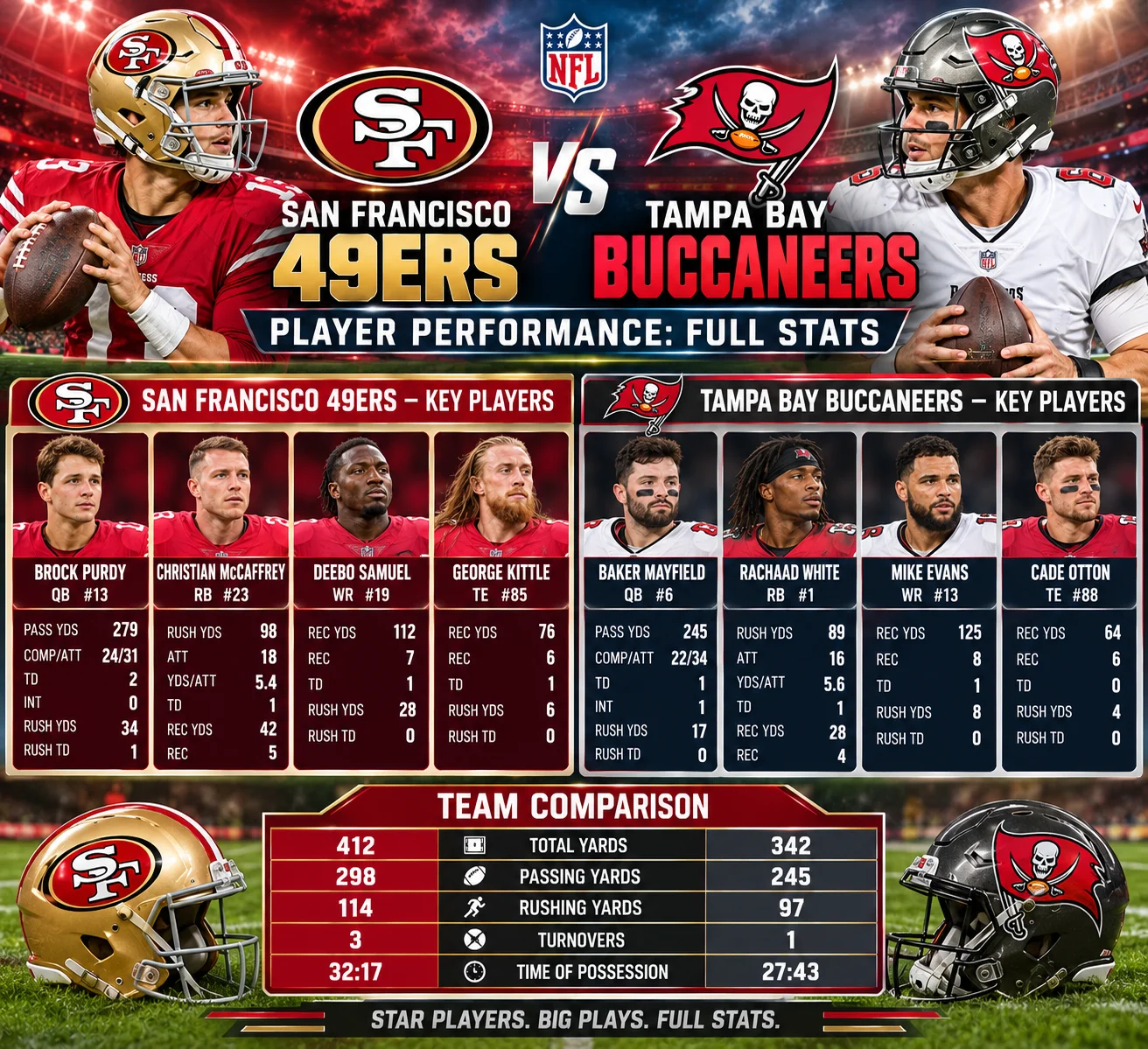
The 49ers vs Tampa Bay Buccaneers Player Performance matchup delivered an entertaining NFL contest filled with important individual performances, explosive plays, and critical moments. Tampa Bay Buccaneers defeated the San Francisco 49ers 30–19 on October 12, 2025, at Raymond James Stadium. The Buccaneers finished with 352 total yards, while the 49ers produced 363 yards, showing that the final score did not tell the entire statistical story.
Both teams moved the football effectively, but Tampa Bay was more efficient in turning key possessions into touchdowns. Baker Mayfield completed 17 of 23 passes for 256 yards and two touchdowns without an interception. Mac Jones responded with 27 completions on 39 attempts for 347 yards, although he threw two interceptions.
49ers vs Tampa Bay Buccaneers Player Performance Breakdown
Mac Jones Leads the 49ers Passing Attack
Mac Jones produced one of the strongest statistical passing totals in the game. He completed 27 of 39 attempts for 347 yards, averaging nearly nine yards per attempt. However, his two interceptions and six sacks affected the overall impact of his performance. His final passer rating was 75.5.
The yardage showed that San Francisco could move the ball through the air. However, Tampa Bay’s defense created enough pressure and turnovers to prevent those passing yards from becoming enough points.
Baker Mayfield Delivers an Efficient Performance
Baker Mayfield had fewer passing yards than Jones, but his efficiency was crucial. He completed 17 of 23 attempts for 256 yards, two touchdowns, and zero interceptions. His accurate decision-making helped Tampa Bay maintain control during important stretches.
Mayfield’s touchdown passes included a 34-yard connection with Kameron Johnson and a 45-yard touchdown pass to Tez Johnson. Those explosive plays gave the Buccaneers a major advantage.
Rushing Performance From Both Teams
Christian McCaffrey Provides a Key Touchdown
Christian McCaffrey remained an important part of San Francisco’s offensive production. He carried the ball 17 times for 54 yards and scored one rushing touchdown. He also caught seven passes for 57 yards, giving him 111 combined yards from scrimmage.
His ability to contribute as both a runner and receiver gave the 49ers a reliable offensive option. Although his rushing average was only 3.2 yards per carry, his receiving contribution added valuable yardage.
Tampa Bay Gets Important Contributions on the Ground
Rachaad White led Tampa Bay’s rushing attack with 17 carries for 65 yards and one touchdown. Sean Tucker added 25 yards and a touchdown on six carries, while Mayfield contributed 14 rushing yards.
Those rushing scores helped Tampa Bay establish an early advantage and maintain pressure on the 49ers defense.
Receiving Leaders and Explosive Plays
Kendrick Bourne Has a Huge Day
Kendrick Bourne was the standout receiver for San Francisco. He caught five passes for an impressive 142 yards, including a long reception of 56 yards. Despite the strong individual performance, he did not record a touchdown.
Jake Tonges also contributed six receptions for 58 yards, while McCaffrey added seven receptions for 57 yards. Together, these players helped San Francisco accumulate substantial passing production.
Tampa Bay’s Receivers Make Big Plays
The Buccaneers received valuable contributions from several targets. Kameron Johnson caught four passes for 64 yards and a touchdown. Cade Otton recorded five receptions for 51 yards, while Shepard also produced 51 receiving yards. Tez Johnson made a particularly memorable impact with a 45-yard touchdown reception.
These explosive receptions were important because Tampa Bay converted passing opportunities into touchdowns rather than relying only on field goals.
Full Player Performance Table
| Player | Team | Key Statistics | Impact |
|---|---|---|---|
| Mac Jones | 49ers | 27/39, 347 yards, 0 TD, 2 INT | High passing volume |
| Christian McCaffrey | 49ers | 54 rush yards, 57 receiving yards, 1 TD | Two-way production |
| Kendrick Bourne | 49ers | 5 receptions, 142 yards | Top receiving performance |
| Jake Tonges | 49ers | 6 receptions, 58 yards | Reliable target |
| Baker Mayfield | Buccaneers | 17/23, 256 yards, 2 TD, 0 INT | Efficient passing |
| Rachaad White | Buccaneers | 17 carries, 65 yards, 1 TD | Strong rushing contribution |
| Kameron Johnson | Buccaneers | 4 receptions, 64 yards, 1 TD | Key touchdown catch |
| Tez Johnson | Buccaneers | 1 reception, 45 yards, 1 TD | Explosive scoring play |
The statistical comparison highlights an interesting contrast. San Francisco produced more passing yardage, while Tampa Bay made better use of its scoring opportunities.
Five Key Takeaways From the Game
- Baker Mayfield protected the football, throwing two touchdowns without an interception.
- Mac Jones generated 347 passing yards, but two interceptions limited his overall effectiveness.
- Kendrick Bourne produced 142 receiving yards, giving San Francisco a major offensive highlight.
- Christian McCaffrey contributed 111 total yards and one rushing touchdown.
- Tampa Bay’s explosive touchdown plays helped decide the contest, particularly through the passing game.
Why Tampa Bay Won
The final result was shaped by execution rather than simply total yardage. San Francisco actually finished with 363 net yards compared with Tampa Bay’s 352. The 49ers also controlled the ball for 32:35, compared with 27:25 for Tampa Bay.
However, Tampa Bay produced the more valuable scoring plays. Mayfield’s two touchdown passes and the Buccaneers’ two rushing touchdowns created a stronger scoring profile. San Francisco, meanwhile, relied heavily on field goals after several productive drives.
Turnovers were another decisive factor. Jones threw two interceptions, while Mayfield avoided an interception entirely. That difference gave Tampa Bay a significant advantage in possession efficiency.
Defensive and Game-Management Impact
Although the headline numbers focus on quarterbacks and offensive players, defensive pressure also influenced the result. Jones was sacked six times for a loss of 51 yards, which reduced the effectiveness of San Francisco’s passing attack despite his 347 passing yards.
The 49ers also committed nine penalties for 65 yards, while Tampa Bay had five penalties for 31 yards. Those extra yards helped the Buccaneers maintain better overall discipline during important sequences.
Frequently Asked Questions
Who led the 49ers in passing?
Mac Jones led San Francisco with 347 passing yards on 27 completions from 39 attempts.
Who led the Buccaneers in passing?
Baker Mayfield completed 17 of 23 passes for 256 yards and two touchdowns.
Who was the 49ers’ leading receiver?
Kendrick Bourne led San Francisco with five receptions for 142 yards.
How did Christian McCaffrey perform?
McCaffrey rushed for 54 yards and one touchdown while adding 57 receiving yards on seven catches.
Who won the game?
The Tampa Bay Buccaneers defeated the San Francisco 49ers 30–19.
Final Thoughts
The 49ers vs Tampa Bay Buccaneers Player Performance matchup demonstrated how efficiency, turnovers, explosive plays, and red-zone execution can outweigh raw yardage. Mac Jones and Kendrick Bourne produced impressive numbers for San Francisco, while Christian McCaffrey delivered valuable all-around production.
For Tampa Bay, Baker Mayfield’s accurate passing and zero-interception performance provided a strong foundation. Rachaad White contributed a touchdown on the ground, while the Buccaneers’ receivers created decisive big plays.
Ultimately, Tampa Bay’s ability to convert important opportunities into touchdowns proved critical in the 30–19 victory. The game remains a useful example of why complete player statistics require more than simply looking at passing or total-yard numbers.







Leave a Reply