

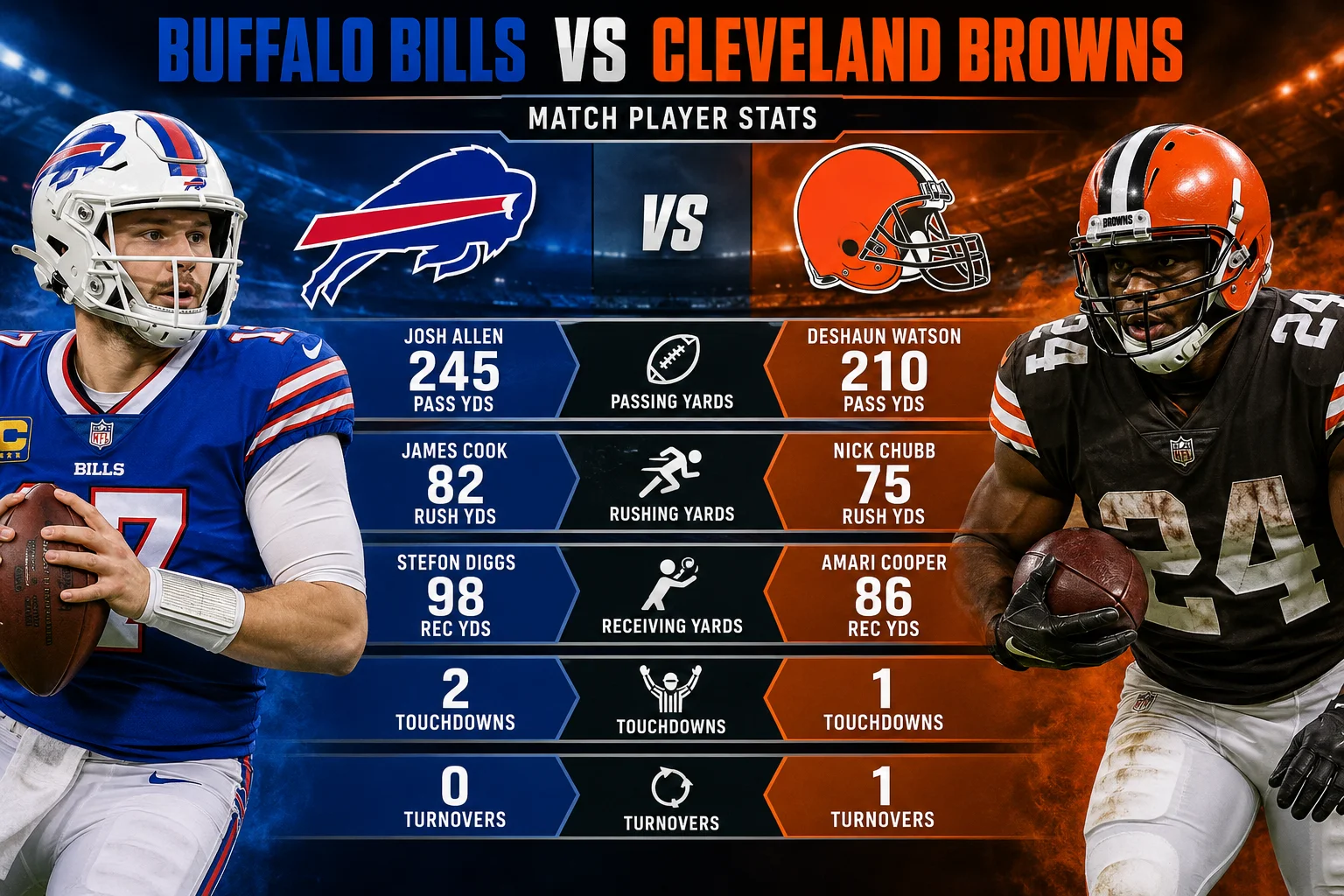
When two historic franchises like the Buffalo Bills and the Cleveland Browns cross paths on the gridiron, fans expect a gritty, intense matchup defining cold weather football. Their recent clash featured a battle of offensive execution, high impact defensive plays, and key statistical performances that tipped the scales.
Understanding the flow of this matchup requires diving into the numerical production across both sidelines. Below is a comprehensive analysis of the offensive and defensive performances, individual player statistics, key turning points, and tactical takeaways from this contest.
Quarterback Performance and Passing Efficiency
The passing game dictated the cadence of the contest, with both coaching staffs attempting to push the ball downfield while maintaining a structured short-to-intermediate standard.
For the Buffalo Bills, the passing distribution showed remarkable efficiency. Signal-callers Kyle Allen and Shane Buechele effectively spread the ball among primary targets, making dynamic plays down the field when protection held up in the pocket. Kyle Allen’s early precision allowed Buffalo to establish rhythmic drives, whereas Shane Buechele took advantage of second-half defensive coverages to land game breaking explosive plays.
On the Cleveland Browns’ side, young quarterback Shedeur Sanders shared duties under center alongside veteran Deshaun Watson. Sanders showed early poise, orchestrating an impressive first-quarter touchdown drive that converted key late down situations. However, constant pressure from the Bills’ defensive front disrupted Cleveland’s long-developing pass concepts, forcing critical interceptions that altered momentum.
Passing Box Score
| Player | Team | Cmp/Att | Yds | YPA | TD | INT | Rating |
| Kyle Allen | BUF | 24/28 | 236 | 8.4 | 1 | 0 | 114.3 |
| Shane Buechele | BUF | 6/9 | 102 | 11.3 | 1 | 0 | 144.4 |
| Shedeur Sanders | CLE | 8/14 | 74 | 5.3 | 1 | 1 | 65.8 |
| Deshaun Watson | CLE | 5/11 | 36 | 3.3 | 0 | 1 | 23.3 |
Rushing Attack and Front Seven Battle
Ground play remains a centerpiece for both schemes. Success in establishing the run allowed the Bills to manage third-down distance effectively, avoiding forced throwing situations against Cleveland’s pass rushers.
Buffalo relied heavily on a committee backfield. Tailback Frank Gore Jr. spearheaded the second-half ground push, breaking arm tackles and churning out tough yardage between the tackles. Rookie back Ray Davis provided effective short-yardage running, capping off early drives near the goal line. Complementing them, Ian Wheeler provided burst on perimeter sweeps.
Cleveland struggled to generate sustained explosive runs. The Buffalo interior defense clogged primary operational gaps, preventing Cleveland running backs like Davon Booth and Raheim Sanders from reaching the second level uninterrupted.
Rushing Box Score
| Player | Team | Carries | Yds | Avg | Long | TD |
| Ian Wheeler | BUF | 21 | 97 | 4.6 | 18 | 1 |
| Frank Gore Jr. | BUF | 12 | 52 | 4.3 | 16 | 0 |
| Ray Davis | BUF | 8 | 28 | 3.5 | 9 | 1 |
| Shane Buechele | BUF | 2 | 8 | 4.0 | 5 | 1 |
| Davon Booth | CLE | 7 | 24 | 3.4 | 8 | 0 |
| Raheim Sanders | CLE | 5 | 18 | 3.6 | 7 | 0 |
Receiving Production and Playmaking Yards After Catch
The difference in air yards and runs after the catch (YAC) defined the separation on the scoreboard. The Bills capitalized on missed tackle opportunities in the secondary, converting short catches into major continuous gains.
Ja’Mori Maclin emerged as the premier big-play threat of the game. Catching multiple passes downfield, including a stunning 71-yard touchdown reception in the second half, Maclin exploited single coverage against Cleveland’s secondary. Mecole Hardman Jr. provided reliability in short receiver-screen situations, converting inside the red zone.
For Cleveland, wide receiver Luke Floriea proved to be a reliable security blanket. Floriea secured a difficult touchdown catch in the back of the end zone during the first quarter to pull the Browns level. Tight end Blake Whiteheart added key intermediate receptions on fourth-down conversions, but overall vertical consistency was lacking across four quarters.
Receiving Box Score
| Player | Team | Rec | Yds | Avg | Long | TD |
| Ja’Mori Maclin | BUF | 3 | 117 | 39.0 | 71 | 1 |
| Trent Sherfield Sr. | BUF | 4 | 48 | 12.0 | 22 | 0 |
| Mecole Hardman Jr. | BUF | 3 | 24 | 8.0 | 9 | 1 |
| Luke Floriea | CLE | 3 | 35 | 11.7 | 23 | 1 |
| Blake Whiteheart | CLE | 2 | 22 | 11.0 | 16 | 0 |
| Gage Larvadain | CLE | 2 | 14 | 7.0 | 9 | 0 |
Defensive Impact, Turnovers, and Special Teams
A team’s box score rarely tells the whole story without looking at the defensive disruptions and kicking units that dictated field position throughout the afternoon.
The Buffalo Bills defense dominated critical high-pressure moments. Safety Damar Hamlin produced a major highlight by picking off an end-zone pass midway through the second quarter, denying Cleveland valuable points. Later in the second half, defensive back Te’Cory Couch intercepted a pass over the middle, setting up an immediate single-play scoring strike for the Bills’ offense. Up front, edge rusher Mike Danna recorded 2.0 sacks, disrupting Cleveland’s passing timing.
Cleveland’s defense had isolated moments of success, featuring linebackers Nathaniel Watson and Michael Hall Jr. clogging inside gaps early on. However, secondary coverage breakdowns late in key drives allowed Buffalo to pull away on the scoreboard.
Defensive & Special Teams Leaderboard
| Player | Team | Total Tackles | Sacks | INT | Field Goals |
| Jordan Dunbar | BUF | 8 | 0.0 | 0 | – |
| Mike Danna | BUF | 4 | 2.0 | 0 | – |
| Damar Hamlin | BUF | 3 | 0.0 | 1 | – |
| Te’Cory Couch | BUF | 3 | 0.0 | 1 | – |
| Tyler Bass | BUF | – | – | – | 1/1 (Long 52) |
| Michael Hall Jr. | CLE | 6 | 1.0 | 0 | – |
| Nathaniel Watson | CLE | 5 | 0.0 | 0 | – |
Key Game Takeaways and Strategic Future Outlook
Analyzing the raw data highlights distinct paths for both organizations moving forward across the remainder of the schedule.
Bills Depth and Execution: Buffalo showed significant prowess in using dynamic playmakers across multiple depth chart tiers. The execution of vertical routes off play action passes remains a potent element of their identity.
Browns Red-Zone Efficiency: Turnovers in the scoring zone proved disastrous for Cleveland. Ending multiple drives without points despite penetrating inside the opponent’s 20-yard line created an uphill battle they could not overcome.
Defensive Pressure Packages: The Bills demonstrated how creating pressure with four rushers allows safety coverage to undercut intermediate passing lanes effectively.
Both teams leave this matchup with clear game tape to study. Buffalo’s tactical versatility and turnover generation proved decisive, while Cleveland must address key errors.
Team Stat Comparison
| Metric | Buffalo Bills | Cleveland Browns | Differential |
| Passing Yards | 230 | 110 | +120 (BUF) |
| Rushing Yards | 138 | 84 | +54 (BUF) |
| Total Offensive Yards | 368 | 194 | +174 (BUF) |
| Time of Possession | 31:16 | 28:44 | +2:32 (BUF) |
| Yards Per Play | 6.5 | 3.7 | +2.8 (BUF) |
Key Statistical Highlights
Passing Yardage Dominance: Buffalo outgained Cleveland through the air by 120 yards. The Bills averaged 10.5 yards per pass attempt compared to Cleveland’s 4.6 yards per pass attempt, heavily aided by explosive downfield plays like Ja’Mori Maclin’s 71-yard touchdown catch.
Rushing Efficiency: Buffalo racked up 138 yards on the ground at a 4.1 yards-per-carry clip, led by Ian Wheeler and Frank Gore Jr. Cleveland struggled to generate consistent displacement, averaging just 3.1 yards per carry for 84 total rushing yards.
Time of Possession Control: The Bills controlled the clock for 31:16, sustaining long scoring drives in both halves and capitalizing on defensive stops to keep Cleveland’s offense off the field








atlanta braves vs phillies match player stats - Football club menu
[…] early. Ace lefty Chris Sale took the mound for Atlanta, demonstrating sharpness across his slider fastball mix. Facing a formidable Phillies lineup featuring Trea Turner, Kyle Schwarber, and Bryce Harper, […]