

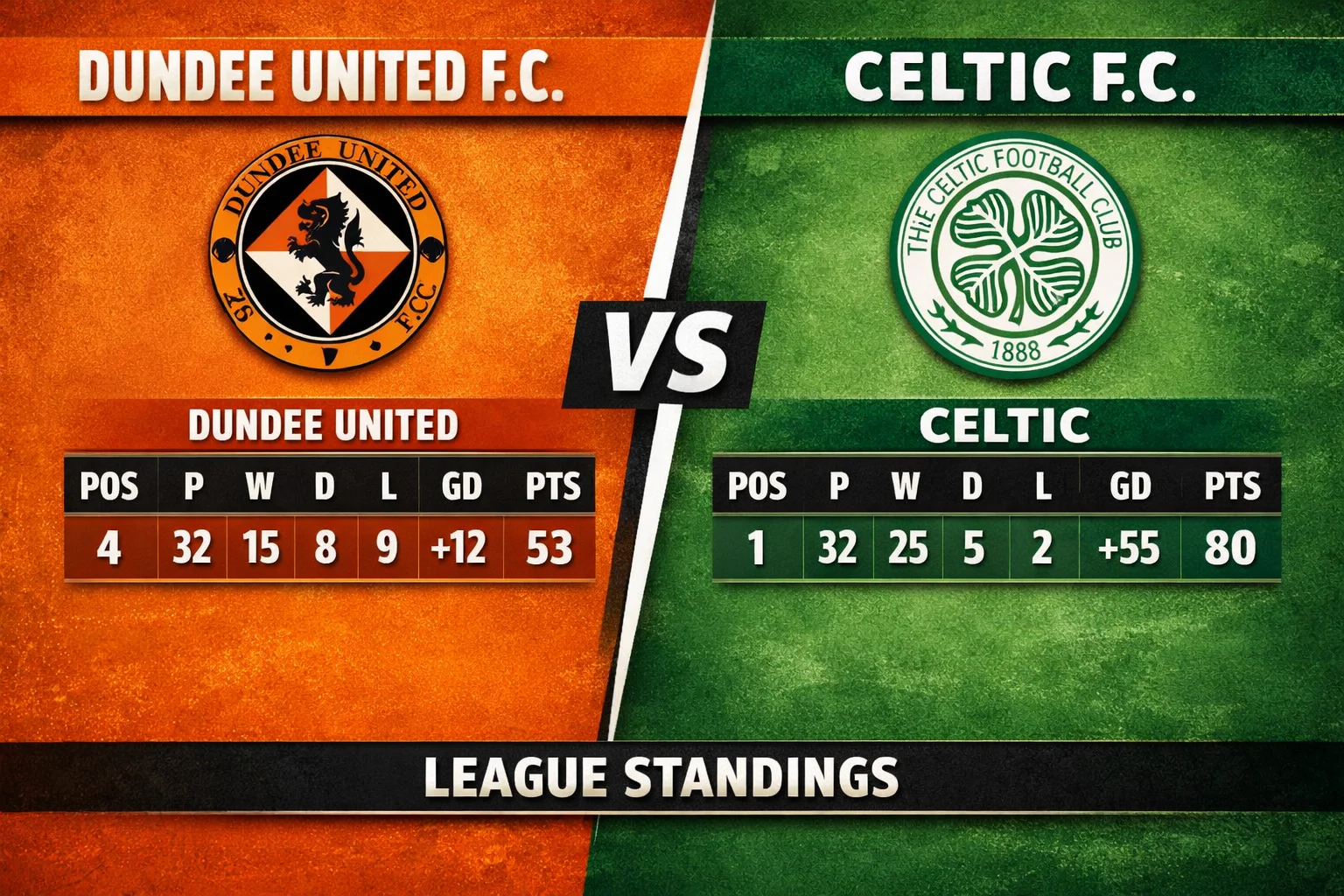
2025–26 Scottish Premiership Standings (after 31 games)
William Hill Premiership Standings 2025/26
League table as of March 30, 2026. Hearts lead the title race heading into the final pre-split fixtures.
Top 6: Championship Group Contenders
| Pos | Team | Pld | GD | Pts |
|---|---|---|---|---|
| 1 | Hearts | 31 | +28 | 66 |
| 2 | Rangers | 31 | +30 | 63 |
| 3 | Celtic | 31 | +22 | 61 |
| 4 | Motherwell | 31 | +26 | 54 |
| 5 | Hibernian | 31 | +13 | 48 |
| 6 | Falkirk | 31 | -1 | 43 |
Bottom 6: Relegation Survival
| Pos | Team | Pld | GD | Pts |
|---|---|---|---|---|
| 7 | Dundee United | 31 | -8 | 37 |
| 8 | Dundee | 31 | -18 | 32 |
| 9 | Aberdeen | 31 | -15 | 30 |
| 10 | St. Mirren | 31 | -22 | 27 |
| 11 | Kilmarnock | 31 | -25 | 27 |
| 12 | Livingston | 31 | -30 | 15 |
Technical Summary
Hearts remain in the driver’s seat for the title, though Rangers hold a superior goal difference (+30). At the bottom, Livingston’s survival chances are statistically slim, as they trail 11th-placed Kilmarnock by 12 points with only two games remaining before the league split.
Key Comparison: Celtic vs Dundee United
League Position
Celtic are currently 3rd in the Scottish Premiership, competing in the title race.
Dundee United sit 7th, outside the European qualification spots.
Points
Celtic: ~61 points from 31 matches.
Dundee United: ~37 points from 31 matches.
Goal Difference (GD)
Celtic: +22 goal difference.
Dundee United: –8 goal difference.
Form Insights
Celtic have been locked in a close title battle with Hearts and Rangers, with recent losses impacting their title hopes.
- Dundee United have shown mixed results. Recent league matches include notable wins over Celtic (e.g., 2‑0 in March 2026).
Head‑to‑Head (H2H) Notes (2025–26)
Celtic and Dundee United have met multiple times this season. Most recent league encounters saw Dundee United beating Celtic, reflecting competitive matchups despite the overall league gap.
Head‑to‑Head Record Explained
All‑Time Meetings Between the Clubs
Across competitive matches between Celtic and Dundee United:
They’ve met over ~85 times in competitive fixtures.
Celtic have dominated historically with around 64 wins (≈75 %).
Dundee United have a small number of wins (around 4–5 wins, ~5 %).
Draws account for roughly 17–20 % of meetings.
Celtic have scored hundreds more goals overall (over 200 for Celtic vs ~55 for Dundee United).
Recent and Notable H2H Results
Recent head‑to‑head results reflect this trend but also show occasional upsets:
Celtic 4–0 Dundee United at Celtic Park (January 2026).
Dundee United 2–1 Celtic (Dec 2025) — a rare United win.
Dundee United 2–0 Celtic (Mar 2026) — notable shock result.
Older fixtures (e.g., Celtic 3–0, 2–0) also underline Celtic’s strong record.
Standings vs Match Results Correlation
The overall head‑to‑head balance reflects the relative stature of the teams in Scottish football:
Celtic are traditionally one of the country’s strongest sides, consistently competing for league titles and European qualification.
Dundee United historically sit mid‑table, with fewer resources and lower league finishes.
This status difference explains why Celtic win a large majority of matches in their history. However, recent seasons have seen Dundee United occasionally upset this pattern, with notable wins that have affected Celtic’s title hopes and league momentum.
Winning Percentages & Draw Stats
From the head‑to‑head data:
| Result Type | Approx. % | Notes |
|---|---|---|
| Celtic Wins | ~75 % | Dominant performance across all meetings. |
| Dundee United Wins | ~5 % | Far less frequent; fewer overall wins. |
| Draws | ~20 % | A significant minority of fixtures |
Season-Specific Breakdown (2025–26)
Technical analysis of league standings, the impending split, and comparative home/away performance metrics.
Standings After the Split
Upon reaching Matchweek 33, the league separates into the Championship and Relegation groups. Points carry forward into the final five fixtures. Currently, at Matchweek 31, the dividing line is clearly defined.
Top Six (Championship Group)
- Hearts – 66 pts
- Rangers – 63 pts
- Celtic – 61 pts
- Motherwell – 54 pts
- Hibernian – 48 pts
- Falkirk – 43 pts
Bottom Six (Relegation Group)
- 7. Dundee United – 37 pts
- 8. Dundee – 32 pts
- 9. Aberdeen – 30 pts
- 10. St. Mirren – 27 pts
- 11. Kilmarnock – 27 pts
- 12. Livingston – 15 pts
Home Form Standings
| Pos | Team | Pld | W-D-L | Pts |
|---|---|---|---|---|
| 1 | Hearts | 16 | 12-4-0 | 40 |
| 2 | Motherwell | 16 | 10-5-1 | 35 |
| 3 | Rangers | 16 | 10-5-1 | 35 |
| 8 | Dundee United | 16 | 5-6-5 | 21 |
Away Form Standings
| Pos | Team | Pld | W-D-L | Pts |
|---|---|---|---|---|
| 1 | Rangers | 15 | 7-7-1 | 28 |
| 2 | Celtic | 16 | 8-3-5 | 27 |
| 7 | Dundee United | 15 | 3-7-5 | 16 |
Technical Summary
Hearts’ unbeaten home record is the statistical driver of their 1st-place standing. Conversely, Dundee United’s modest home efficiency (21 pts from 16 games) explains their 7th-place position, despite a formidable recent win over Celtic.
Explore the Latest Club Rankings
Statistical Standings Insights (Advanced Metrics)
Expected Points Relative to Position
Expected Points (xP) — a metric derived from expected goals (xG) and expected goals conceded (xGA) — estimates how many points a team should have earned based on the quality of chances created and conceded across all matches. It’s a way to assess whether a team’s actual points tally aligns with underlying performance.
Analyses typically convert the xG values in each match to a simulated scoreline (rounding expected goals to nearest integers) and then derive an “expected result” from those simulated outcomes (win/draw/loss).
Over a near‑complete season, the expected points table often mirrors the actual league table, with teams that generate higher quality chances frequently occupying higher positions.
However, there are always deviations: teams that overperform their xP are often clinical finishers or have excellent goalkeeping, while teams that underperform their xP may waste chances or concede soft goals.
For the 2025–26 Scottish Premiership:
Celtic rank near the top both in actual table and in expected metrics: they generate some of the highest xG per match (~1.97 overall) and — barring finishing anomalies — should be near the top of the expected points table too.
Dundee United have a much lower xG (~1.41 per match) and relatively high xGA (~1.74 conceded per match) compared with top teams, suggesting their “expected points” tally would also be on the lower side, which aligns with them being in the mid‑to‑lower part of the actual table.
Goal Expectations vs Actual Standings
Expected Goals (xG) quantifies the quality of chances created and conceded — essentially, how many goals a team “should” score and concede based on shot opportunities, regardless of what actually happened on the scoreboard. Comparing xG with actual goals scored helps identify efficiencies or inefficiencies in finishing and defence.
Key Expected Goals Insights (2025–26 SPFL)
Celtic:
Overall xG per match ~1.97; xGA ~1.04 → xGD (expected goal difference) of ~+0.93.
This high expected goal differential aligns with Celtic’s strong actual performance (high league position), showing they consistently create better quality chances than they concede.
Dundee United:
Overall xG ~1.41 with xGA ~1.74 → xGD of about –0.33.
This suggests they create significantly fewer quality chances and concede more than they generate, which correlates with their lower actual standings.
Where xG Helps Explain Standings:
Teams with a positive xGD are more likely to occupy top‑half positions because they consistently create more quality scoring opportunities than they concede.
Negative xGD teams are lower in the standings, reflecting that their underlying play generates fewer scoring chances and more defensive vulnerability — a trend seen with Dundee United this season.
Comparisons of xG vs actual goals can reveal if a team’s position is “deserved” by its underlying performance:
Over‑achievers in the standings might have actual goals exceeding xG (indicative of clinical finishing or good luck).
Under‑achievers might be scoring fewer goals than their xG suggests (missing chances that good teams usually convert).
Why Celtic Usually Tops the Table vs Dundee United
Seasonal Dominance Patterns
Celtic’s repeated success in the Scottish Premiership — often finishing first and collecting titles year after year — isn’t by accident. A few key patterns explain this sustained dominance:
1. Established Winning Culture and Club Structure
Celtic are one of the historically strongest clubs in Scotland, with a culture built around winning and a professional hierarchy geared toward sustained success. For much of the last decade they’ve been either Scottish champions or close challengers, and they’ve regularly lifted domestic trophies.
This long‑term success creates feedback effects:
Expectation of winning attracts better players
Sponsors and revenue streams improve
Stability reduces volatility in performance
All of these help Celtic consistently accumulate more points than most rivals.
2. Superior Match Control and Playing Style
Celtic’s tactical approach tends to dominate games: higher possession rates, better pass accuracy, and greater territorial control. In advanced match stats, they often outnumber and out‑create teams like Dundee United across key metrics (possession, shot volume, set plays).
That consistency in applying pressure translates into more goals and league points over a long season, even if occasional matches — like recent losses to Dundee United — buck the general trend.
3. Historical Head‑to‑Head Trends
Head‑to‑head history shows Celtic winning a large majority of meetings. According to detailed records, Celtic have around 51 wins vs just 4 for Dundee United in 72 total meetings, with the rest draws — reflecting a historical gulf in levels.
That dominance in direct fixtures often feeds into league momentum: beating teams like Dundee United gives Celtic comfortable points and goal advantage across the season.
Squad Strength vs Standings Correlation
A big part of why Celtic frequently finish at the top revolves around player quality and depth compared with clubs like Dundee United.
1. Transfer and Recruitment Advantage
Celtic generally have greater financial resources, broader scouting networks, and higher wage budgets than Dundee United. This allows them to bring in higher‑profile players (both domestically and internationally) and maintain stronger depth across positions — crucial during congested fixtures and injury periods.
Higher squad quality tends to correlate strongly with:
More goals scored
Better defensive stability
More consistent results across home and away matches
All of these boost league points tallies over a full season.
2. Tactical and Managerial Experience
Celtic’s coaching staff tends to have more experience managing top‑level football both domestically and in Europe. That tactical depth helps them handle a wide range of opponents — including compact defensive sides like Dundee United — and extract points even in challenging situations.
For example, even in seasons where Celtic dropped unexpected points, their overall tactical consistency helped keep them in the title fight.
3. Squad Depth Buffers Against Variance
Unlike many mid‑table clubs, Celtic usually have squad options in multiple key positions. When injuries or suspensions occur, they can still field high‑quality lineups. Dundee United, by contrast, have a smaller squad pool, which means injuries or dips in form tend to affect them more severely.
DUNDEE UTD VS CELTIC FAQS
1. Who won the last match between Dundee United and Celtic?
The last meeting took place on March 22, 2026, where Dundee United won 2–0 at Tannadice Park with goals from Will Ferry and Emmanuel Agyei.
2. What is Celtic’s biggest-ever win against Dundee United?
Celtic’s record victory over the Terrors was a 9–0 win away at Tannadice on August 28, 2022. It remains one of the largest away wins in Scottish Premiership history.
3. How many times has Dundee United beaten Celtic recently?
Dundee United has been a tough opponent at home this season, securing two wins at Tannadice against Celtic in the 2025–26 campaign (2–1 in December and 2–0 in March).
4. Where do Celtic and Dundee United currently sit in the table?
As of late March 2026, Celtic is in 3rd place with 61 points, trailing Hearts and Rangers. Dundee United sits in 7th with 37 points.
5. Which players were key in the recent Dundee United victory?
Will Ferry and Emmanuel Agyei were the standout performers, scoring the decisive goals to help Dundee United to their 2–0 clean sheet victory.

















Leave a Reply