

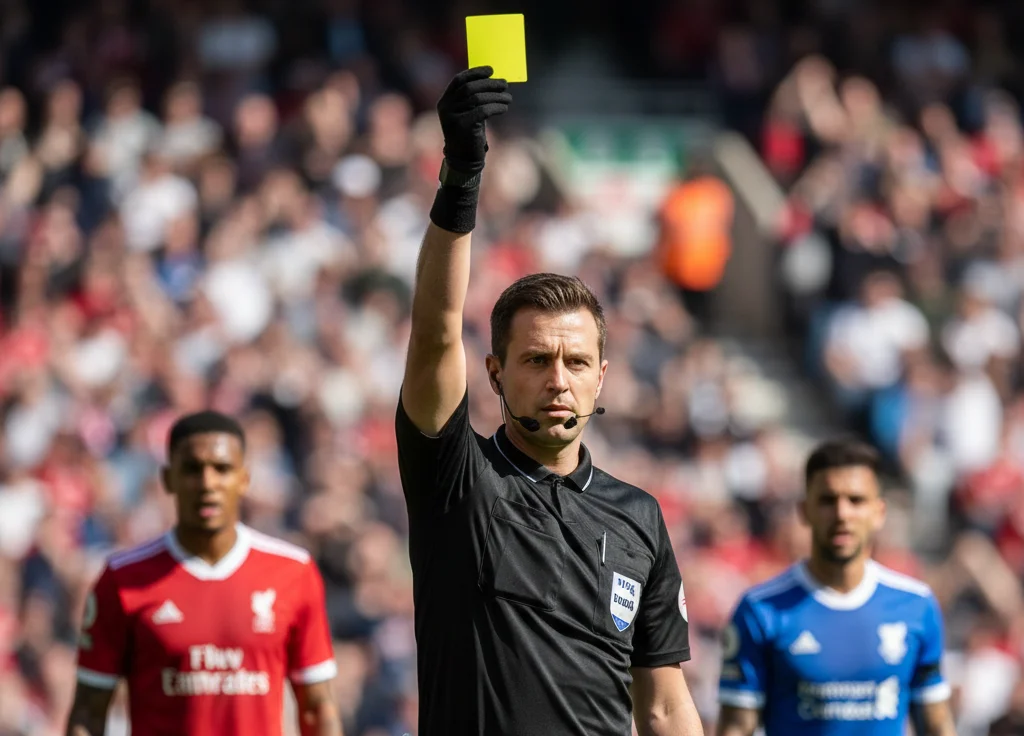
A yellow card in soccer is a formal caution given by the referee for rule violations. It warns players for misconduct such as unsporting behavior, dissent, or time-wasting, and two yellow cards in one match lead to a red card and dismissal. Yellow cards help maintain fair play and control on the field.
What a Yellow Card Means in Soccer
A yellow card in soccer is an official caution issued by the referee to a player for misconduct. It serves as a formal warning that the player has violated the rules and is now at risk of further disciplinary action.
If a player receives two yellow cards in the same match, it results in a red card and immediate dismissal from the game.
Official Definition Under the Laws of the Game
A player must be cautioned for:
Reasons a Yellow Card Is Issued
Unsporting Behavior
Reckless tackles, deliberate fouls to stop promising attacks, handling the ball unfairly, or attempting to deceive the referee.
Dissent
Arguing with the referee, protesting decisions, sarcastic clapping, shouting, or aggressive body language.
Time-Wasting
Deliberately delaying restarts by kicking the ball away, slowing substitutions, or taking excessive time on set pieces.
Tactical Fouls
Intentionally stopping a counterattack or promising move to gain a strategic advantage.
Simulation (Diving)
Exaggerating contact or pretending to be fouled to win a free kick or penalty through deception.
Consequences in Different Competitions
Yellow cards carry different implications depending on the competition, with rules designed to manage player discipline over multiple matches.
World Cup
In the FIFA World Cup, a player who accumulates two yellow cards in separate matches during the group stage or knockout rounds is suspended for the next match. Yellow card counts reset after the quarterfinals, so players entering the semifinals start with a clean slate, reducing the risk of missing the final due to accumulation.
League Play
In domestic leagues, such as the English Premier League or La Liga, yellow cards accumulate over the season. Players may face automatic suspensions after reaching a set threshold (e.g., 5 yellow cards = 1-match ban, 10 cards = 2-match ban). This system encourages consistent discipline and discourages repeated fouls.
Cup Tournaments
Cup competitions, like the FA Cup or Copa del Rey, often have their own yellow card rules. Accumulation may carry over only within the tournament, and suspensions usually apply to the next cup match, not league games. Some knockout tournaments may reset all cautions at the start of a new round to ensure fair play in decisive matches.
How Two Yellow Cards Turn Into a Red Card
In soccer, receiving two yellow cards in a single match automatically results in a red card, meaning the player is sent off and cannot continue playing. This rule enforces discipline by penalizing repeated cautionable behavior.
First Yellow Card
The referee cautions the player for a cautionable offense (unsporting behavior, dissent, tactical foul, etc.). The player is allowed to continue playing but is officially warned.
Second Yellow Card
If the same player commits another cautionable offense later in the match, the referee issues a second yellow card.
Automatic Red Card
The second yellow converts into a red card. The player must leave the field immediately, and their team plays with one fewer player for the remainder of the match.
Match & Post-Match Consequences
In addition to leaving the field, the player is usually suspended for the next match, with the length of suspension depending on competition rules.
Yellow vs Red Card
A direct comparison between yellow and red cards in soccer, highlighting their purpose, effects on players and teams, and the types of offenses that lead to each. Presenting these side-by-side makes it easier to understand how referees maintain fair play and control over the match.
Yellow Card
- Purpose: Caution for minor or moderate misconduct
- Effect on Player: Player remains on the field but is warned
- Accumulation: Two yellow cards in one match = red card
- Common Offenses: Unsporting behavior, dissent, time-wasting, tactical fouls, simulation
- Team Impact: Team continues with full squad unless second yellow occurs
- Official Reference: Law 12 – Fouls and Misconduct (IFAB)
Red Card
- Purpose: Punishment for serious or repeated offenses
- Effect on Player: Player is immediately sent off and cannot continue playing
- Accumulation: Single red card results in dismissal
- Common Offenses: Serious foul play, violent conduct, spitting, denying a goal-scoring opportunity deliberately, offensive language
- Team Impact: Team must play with one fewer player for the remainder of the match
- Official Reference: Law 12 – Fouls and Misconduct (IFAB)
Accumulation & Suspension Rules by League
Yellow card accumulation varies across domestic leagues and may lead to player suspensions. Each league sets thresholds to maintain discipline throughout the season.
English Premier League (EPL)
Suspension thresholds:
Accumulation resets after ~19 matches.
La Liga (Spain)
Suspension thresholds:
Cards may reset at certain stages or after specific games.
Serie A (Italy)
Suspension thresholds:
Suspensions escalate for further accumulation.
Yellow and Red Cards FAQs
What is the difference between a yellow card and a red card?
A yellow card is a caution for minor or moderate misconduct, while a red card results in a player being sent off for serious or repeated offenses. Two yellow cards in one match automatically convert to a red card.
How many yellow cards lead to a suspension?
In many domestic leagues, 5 yellow cards in a season trigger a one-match suspension, with longer suspensions for higher totals. In tournaments like the World Cup, two yellow cards in separate matches may result in a suspension for the next game.
Can yellow cards reset during a competition?
Yes. In tournaments such as the FIFA World Cup, yellow cards reset after the quarterfinals. Some leagues may reset counts mid-season or after a certain number of matches to prevent players from missing critical games due to accumulation.
What offenses typically result in a yellow card?
Common cautionable offenses include unsporting behavior, dissent, time-wasting, tactical fouls, and simulation (diving). These are outlined in Law 12 of the IFAB Laws of the Game.
What happens if a player receives two yellow cards in one match?
Receiving a second yellow card automatically converts to a red card. The player is sent off, cannot continue playing, and their team must continue with one fewer player. The player usually faces a suspension for the next match.
Conclusion
Yellow and red cards are essential tools in soccer for maintaining fair play and discipline. A yellow card warns players for cautionable offenses, while a red card removes them for serious or repeated misconduct. Understanding the rules, accumulation systems, and competition-specific consequences helps players, teams, how referees manage the game and ensure safety on the field.
Anti – OffsideAston VillaBallon d’OrBarcelonaBright Football ClubCareer Football CoachCenter-BackChampions LeagueChampions League Predictionsconcacaf champions cup 2026Cristiano Ronaldofootball bros unblockedFootball Club MenuFootball FormationFootball Netball ClubFootball's Most Talked-AboutGo Ahead EaglesInter MilanNorway national football teamOffsidePrediction of serie aPreviewred card soccerRomaSerie ASoccer Rulessoccer throw in rulesStriker Soccertransfer marktYellow Card Soccer

Admin
Website: https://footballclubmenu.com/













Leave a Reply