

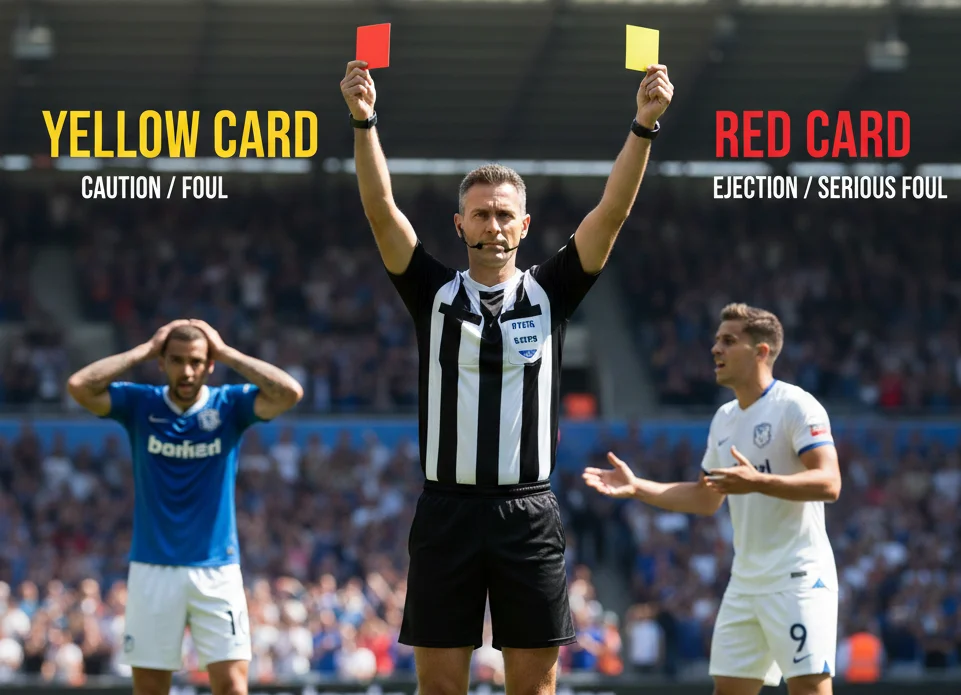
In soccer, What Do the Cards Mean in Soccer? (Complete Guide) cards are a fundamental tool used by referees to maintain discipline, enforce the rules, and protect player safety. From yellow warnings to red dismissals, and even experimental blue or green cards, these visual signals influence not only individual player behavior but also team tactics, strategy, and the overall flow of the game. Understanding how cards work is essential for players, coaches, officials, and fans alike.
What Are Cards in Soccer?
In soccer (football), cards are disciplinary tools used by referees to control player behavior during a match. There are two main types:
🟨 Yellow Card
A warning for misconduct
🟥 Red Card
Immediate dismissal from the game
These cards are part of the official Laws of the Game, governed globally by FIFA and written by the International Football Association Board (IFAB).
History & Purpose of Yellow/Red Cards
The card system was introduced after confusion during the 1966 FIFA World Cup, when language barriers made it difficult for players to understand referee decisions.
The idea was created by English referee Ken Aston. Inspired by traffic lights:
- Yellow = Caution
- Red = Stop / Dismissal
The system was first officially used at the 1970 FIFA World Cup in Mexico.
Why Referees Use Them
1. Control the Game
Cards help prevent matches from becoming aggressive or chaotic.
2. Enforce the Rules
Referees issue cards for unsporting behavior, dissent, repeated fouls, serious foul play, or violent conduct.
3. Protect Player Safety
Dangerous tackles or violent behavior often result in a red card to reduce risk of injury.
4. Maintain Fair Play
Cards discourage time-wasting, simulation (diving), and tactical fouls.
Yellow Card Meaning in Soccer
A yellow card in soccer is an official caution given by the referee to warn a player for breaking the Laws of the Game. It is a disciplinary action short of dismissal (red card), but it signals that further misconduct could result in the player being sent off.
Yellow cards are governed by the Laws of the Game written by the International Football Association Board and enforced globally in competitions organized by FIFA.
Key Point: A yellow card is a formal warning — not a dismissal — but it puts the player at risk of being sent off if misconduct continues.
What a Caution Is
A caution is a formal warning issued during a match.
When a referee shows a yellow card:
- The player’s name is recorded.
- The offense is documented.
- The player is warned that another serious offense could lead to dismissal.
- The team continues with 11 players (unless a red card is later shown).
Official List of Cautionable Offenses
According to IFAB’s Laws of the Game, a player must be cautioned (yellow card) for:
- Unsporting behavior
- Dissent by word or action (arguing with the referee)
- Persistent infringement of the Laws (repeated fouls)
- Delaying the restart of play (time-wasting)
- Failure to respect the required distance (free kicks or corners)
- Entering or re-entering the field without permission
- Deliberately leaving the field without permission
Modern interpretations of unsporting behavior often include:
- Simulation (diving)
- Tactical fouls to stop counterattacks
- Reckless tackles
- Handball to stop a promising attack
Example Match Situations
A defender pulls an attacker’s shirt to stop a counterattack.
A midfielder repeatedly commits small fouls throughout the match.
A player aggressively argues after a referee decision.
A player stands too close during a free kick to block a quick restart.
A forward dives inside the penalty area to try to win a penalty.
What Happens After a Yellow Card
- The player remains in the game.
- The caution is officially recorded.
- A second yellow card in the same match results in an automatic red card (dismissal).
- The team plays at full strength unless a red card follows.
If a player receives two yellow cards in the same match, they receive a second yellow + automatic red card, and the team must continue with 10 players.
Accumulation & Seasonal Suspensions
Yellow cards also carry consequences beyond a single match.
- Players who collect a certain number of yellow cards (e.g., 5 in domestic leagues) may receive a one-match suspension.
- International tournaments often apply accumulation thresholds during group stages.
- Some competitions reset yellow card counts at later stages (quarterfinals or semifinals).
- Specific suspension rules vary by competition.
Accumulation systems are a standard disciplinary structure used worldwide.
VAR & Card Decisions
VAR (Video Assistant Referee) is a system used in professional football to review certain match-changing decisions. It was officially introduced into the Laws of the Game by the International Football Association Board and first used at a FIFA World Cup during the 2018 FIFA World Cup.
While VAR does not review every decision, it can impact card decisions in specific situations.
How VAR Can Review or Overturn Cards
VAR can only intervene in four types of “clear and obvious” situations:
- Goals and build-up incidents
- Penalty decisions
- Direct red card incidents
- Mistaken identity
Direct Red Cards: VAR can review incidents involving a straight red card (serious foul play, violent conduct, denial of an obvious goal-scoring opportunity, etc.).
Upgrading Yellow to Red: If a referee initially gives a yellow card for a challenge, VAR can intervene only if the foul clearly meets the criteria for a direct red card. The referee can review footage and upgrade the decision.
High-Profile VAR Card Moments
Cristiano Ronaldo – 2018 Champions League
Sent off for Juventus against Valencia after VAR review of an off-the-ball incident.
Son Heung-min – 2019 Premier League
Initially yellow carded for a tackle on André Gomes, upgraded to red after VAR review.
2018 World Cup – France vs Australia
VAR reviewed major fouls and penalties, influencing card-related decisions.
Why VAR Card Decisions Are Controversial
Even with technology, debates continue because:
- “Clear and obvious error” is subjective.
- Slow-motion replays can make challenges look worse.
- VAR does not cover second yellow cards.
- Different leagues apply interpretations slightly differently.
Cards for Players, Coaches & Team Officials
In soccer, cards are not limited to players on the field. Referees have the authority to caution or dismiss coaches, team officials, and substitutes for misconduct. This ensures discipline and fair play throughout the entire team area.
Who Can Be Carded
According to the Laws of the Game (IFAB, FIFA):
- Players on the field: Receive yellow or red cards for fouls, violent conduct, dissent, and other offenses.
- Substitute players: Can be cautioned (yellow card) or sent off (red card) for unsporting behavior, entering the field without permission, or dissent.
- Team officials (coaches, assistants, medical staff): Can be shown a yellow card (caution) or red card (dismissal from the technical area) for misconduct such as:
- Arguing with the referee
- Throwing objects onto the field
- Unsporting behavior toward opponents or officials
- Entering the field without permission
Referees can record these incidents in the match report and enforce suspensions if necessary.
Examples of Non-Player Card Incidents
Coach Cautions:
A coach gesturing aggressively toward the referee after a disputed goal may receive a yellow card.
Team Official Ejections:
Coaches or bench staff who refuse to control their players, argue excessively, or enter the pitch illegally can be shown a red card and must leave the technical area.
Substitute Misconduct:
A substitute verbally abusing the referee or physically confronting another player can be cautioned or sent off.
High-Profile Cases
Managers in top leagues like the Premier League and La Liga have been dismissed for dissent or entering the field, showing that cards are enforced at all levels.
Other Card Colors & Experiments
While yellow and red cards are the standard disciplinary tools in soccer, some leagues and competitions have experimented with other card colors to encourage fair play or implement temporary suspensions. These variations are not part of the official Laws of the Game but have been tested in various contexts.
Blue Cards and Sin-Bins
Purpose:
Penalize players for minor offenses without permanently reducing team numbers and give them a chance to reflect while keeping the game flowing.
Mechanics:
A player shown a blue card must leave the field for a set period (e.g., 5–10 minutes). The team plays with one fewer player during that time, and the player may return after the suspension.
Examples of Blue Card Use
Youth competitions and futsal leagues use blue cards to teach discipline.
Some lower-tier professional leagues trialed blue cards to reduce persistent fouling.
Green / Fair Play Cards
Purpose:
Encourage sportsmanship, honesty, and respect for opponents and officials. Reward players who admit fouls, help injured opponents, or demonstrate exceptional fair play.
Mechanics:
A green card acknowledges positive behavior rather than penalizing the player. Some competitions also use green cards for statistics or minor advantages like additional substitutions in youth tournaments.
Examples of Green Card Use
Italian Serie B trialed green cards to reward fair play.
Youth and amateur leagues globally use green cards to teach sportsmanship.
Tactical & Game Impact of Cards
Cards in soccer have a major influence on tactics and player behavior. A yellow or red card can force teams to adjust their strategy and requires players to manage their actions carefully to avoid further punishment.
How Teams Adjust After a Red Card
Defensive Adjustments:
Teams often switch to more defensive formations (e.g., 4-4-1 or 5-3-1) to cover space and protect the goal. Midfielders may drop back, reducing attacking opportunities.
Attacking Strategy Changes:
Teams may rely on counter-attacks, long balls, or set-piece plays when down a player.
Substitution Tactics:
Managers may substitute an attacking player for a defender, or instruct players to focus on key defensive zones or mark specific opponents.
Psychological Effects:
Remaining players increase concentration to compensate for the numerical disadvantage, while opponents may exploit extra space.
Player Discipline Strategies
- Controlled Aggression: Players focus on timing tackles and avoid reckless challenges. Aggression is directed strategically.
- Situational Awareness: Players with yellow cards avoid unnecessary fouls; defenders play conservatively in critical moments.
- Communication & Leadership: Captains and experienced players guide teammates; coaches give instructions on fouls, positioning, and composure.
- Tactical Fouling: Minor fouls may be committed deliberately to disrupt attacks without risking a red card, balancing risk vs. reward.
FAQ’s
1. Can Goalkeepers Get Cards?
Yes. Goalkeepers are treated like any other player under the Laws of the Game. They can receive yellow or red cards for fouls, dissent, time-wasting, or unsporting behavior. A red card for a goalkeeper usually requires a substitute goalkeeper to enter the match.
2. Do Card Accumulations Carry Across Competitions?
No. Yellow card accumulations are typically competition-specific. Domestic league yellow cards do not usually carry into cup competitions. Similarly, international tournament yellow cards do not carry into domestic league matches. However, red cards can sometimes carry over if a governing body rules it as a serious offense.
3. How Many Matches Do Red Cards Suspend?
The suspension depends on the severity of the offense: Straight red card for violent conduct usually leads to 3 matches; serious foul play or extreme misconduct can result in longer bans. Two yellow cards in one match (resulting in a red) typically leads to a 1-match suspension. Leagues and tournaments set their own rules.
4. What Happens If a Player Gets Two Yellow Cards in One Match?
Two yellow cards in a single game automatically convert into a red card, resulting in the player being sent off, the team continuing with one fewer player, and a suspension for the next match according to competition rules.
5. Can Coaches or Substitutes Be Carded?
Yes. Referees can show yellow or red cards to substitute players, coaches, team officials, or medical staff for misconduct such as dissent, unsporting behavior, entering the field without permission, or interfering with play.
Conclusion
Cards in soccer serve a dual purpose: they enforce the Laws of the Game and shape how matches are played. Yellow cards warn, red cards punish, and experimental cards encourage fair play or temporary discipline. Beyond penalties, they influence tactics, player discipline, and team strategy, highlighting the critical role of referees in controlling the game and ensuring fairness on the pitch.












Leave a Reply