

A Real-Time vs Official Clock Chart shows the difference between a game’s actual elapsed time and the referee’s official match clock. It highlights stoppages, added time, and interruptions, helping fans and analysts understand how events like injuries, substitutions, and VAR affect the flow and duration of the game.
Real-Time vs Official Clock Chart
A Real-Time vs Official Clock Chart compares the actual elapsed match time (real-time clock) with the referee’s official match clock. This comparison highlights stoppages, added time, VAR checks, injuries, substitutions, and other interruptions that influence the rhythm of the game.
In modern football analytics, this visualization provides deeper insight into how match flow changes during key moments.
Stoppage impact on total playing time
First & second-half added time trends
VAR or injury-related delays
Late-game time management strategies
Effective vs official match duration differences
Typically, the X-axis represents real-time minutes, while the Y-axis displays the official match clock. When the two lines diverge, it signals stoppages or delays — the greater the gap, the longer the interruption.
Quarter Length – NFHS Football Rules (Official)
Standard Game Time
A high school football game consists of four quarters of 12 minutes each (total game clock time = 48 minutes). This is the standard length under NFHS rules.
Intermissions
- One-minute intermission between 1st & 2nd quarters.
- One-minute intermission between 3rd & 4th quarters.
- Halftime is 10 minutes (may be altered by mutual agreement).
Variations
Non-varsity or younger divisions (e.g., below 9th grade) may use shorter quarters such as 6- or 8-minute periods. State associations may also adopt timing adaptations like continuous running clocks in lopsided games.
Timeout Rules – NFHS Football
Charged Timeouts
- Each team is permitted three (3) charged timeouts per half.
- Unused timeouts do not carry over between halves or into overtime.
- A timeout is charged only when requested and granted by officials.
Official Timeouts
- Injuries or medical treatment
- Equipment issues
- Measurement for first downs
- Penalties or administrative reasons
These are not charged to teams.
Overtime Timeouts
Each team is allowed one timeout per overtime period.
Additional Timing Considerations
- Incomplete passes
- Ball carrier out of bounds
- Change of possession
- First downs (clock restarts on ready-for-play)
- Scoring plays
- Penalties
- End of quarter/half
These stoppages impact total game duration beyond the nominal 48 minutes.
Running Clock / Mercy Rule
Many state associations implement a running clock when a team leads by a specified margin (commonly 35 points). The clock continues running except for injuries and charged timeouts.
📑 Official Rulebook Citations
- Rule 5 – Length of Game Periods
- Rule 3 – Game Timing Procedures
- NFHS Timeout Provisions
Real-World Game Duration
Understanding how official time interacts with real-world events in high school football.
Official Clock vs Real Duration
While the official game clock defines play length, actual game time is usually longer due to timeouts, penalties, scoring plays, injuries, reviews, and other delays. Spectators often spend more time watching than the official 48 minutes.
Typical Game Length
- 2 – 2.5 hours under normal conditions
- Up to 2.75+ hours if many stoppages occur
Key factors: incomplete passes, out-of-bounds plays, scoring frequency, team timeouts, halftime, and overtime periods.
Running Clock / Mercy Rule
When a team leads by a large margin, a running clock reduces stoppages by keeping the clock running. This can shorten the game duration significantly.
Without a running clock, the game often takes longer due to clock stops for incomplete passes, out-of-bounds plays, penalties, timeouts, halftime, and overtime periods.
Factors Affecting Duration
- Number of incomplete passes
- Ball carrier going out-of-bounds
- Scoring frequency & extra points
- Team timeouts (3 per half)
- Halftime & quarter breaks
- Overtime periods
Even though the official playing time is fixed, the interaction between clock rules and game events determines the actual duration for players, coaches, and fans.
State & Level Variations in High School Football Timing
NFHS provides baseline rules, but states and levels adopt their own timing and running clock policies.
Varsity
Typically uses 12-minute quarters under NFHS timing rules.
Junior Varsity (JV)
Many states/schools shorten quarters slightly (e.g., 10–11 minutes) to reduce game duration and fit multiple games.
Freshman
Often have 8–10 minute quarters to accommodate younger players.
Running Clock / Mercy Rule Triggers
There is no single national mercy rule — each state sets its own threshold and specifics. Common patterns include:
- Point Differential Threshold: Typically 30–45 points (most commonly ~35 points) triggers a running clock.
- Timing of Activation: Some states allow activation anytime after threshold, others require halftime or specific quarter.
- Clock Behavior Post-Trigger: Clock usually runs continuously, stopping only for timeouts, major injuries, or sometimes scoring plays.
- Reversion Rules: Lead narrowing may resume normal timing in some states; others keep running clock active.
Example Table of State Mercy Rule Variations
| State | Point Threshold | Activation Timing | Running Clock Behavior |
|---|---|---|---|
| Texas | ~35 pts | After Q2 (midpoint) | Yes — continuous |
| California | ~32–35 pts | After Q1 or any time | Yes — continuous |
| Florida | ~28–30 pts | 4th quarter only | Yes — continuous |
| New York | ~40 pts | After Q3 | Yes — continuous |
| Pennsylvania | ~45 pts | After Q3 | Discretionary |
| Ohio | ~30 pts | After Q2 | Yes — continuous |
Overtime Explained – High School Football (NFHS)
How overtime works, state variations, and estimated extra time added to games.
Standard NFHS Overtime
Each team starts at the 10-yard line and alternates possessions. After the 2nd OT, mandatory two-point conversions may apply (NFHS Rule 8-3).
Modified Formats by State
Starting yard line may differ (e.g., 5-yard line for freshman games). Shootout style may be used after multiple OTs. Reset time between possessions is ~1–2 minutes.
Tiebreaker Rules
From 3rd/4th OT onward, many states require alternating two-point conversions instead of full drives, mostly applied at varsity level to manage long-duration games.
Estimated Extra Time by Number of Overtimes
Factors Affecting Duration
- Number of plays per possession
- Scoring outcomes (TDs vs FGs)
- Officials’ ball reset and penalties
- Broadcast adjustments or halftime resets
HS vs College vs NFL Football Rules & Duration
Compare game duration, timing rules, timeouts, and overtime procedures across all levels of football.
High School (NFHS)
- Quarter Length: 12 min (varsity), 10–8 min (JV/freshman)
- Halftime: 10–15 min
- Timeouts: 3 per half, no carryover, 1 per OT
- Clock Stoppages: incomplete passes, out-of-bounds, penalties, scores, injuries
- Overtime: Alternating possessions from 10-yard line; two-point attempts after 2nd OT
- Typical Game Duration: 2–2.5 hours (regulation), 2.5–3+ with OT
College (NCAA)
- Quarter Length: 15 min
- Halftime: 20 min
- Timeouts: 3 per half, additional for OT, clock stops on first downs
- Clock Stoppages: same as HS + targeting review, TV breaks, first down adjustments
- Overtime: Alternating possessions from 25-yard line; two-point attempts mandatory after 2nd OT
- Typical Game Duration: 3–3.5 hours (regulation), longer with OT or TV breaks
NFL
- Quarter Length: 15 min
- Halftime: 12 min
- Timeouts: 3 per half, 2 per OT, 2-minute warning stops clock
- Clock Stoppages: TV timeouts, 2-minute warning, incomplete passes, out-of-bounds, penalties
- Overtime: Sudden-death style (10 min regular season, 15 min playoffs; first score wins unless tied after initial possession)
- Typical Game Duration: 3–3.5 hours (regulation), 3.5–4+ with OT and commercials
Football Game Timeline: HS vs College vs NFL
Approximate real-world duration of games with key events and differences at each level.
Key Differences: HS vs College vs NFL
| Feature | High School | College | NFL |
|---|---|---|---|
| Quarter Length | 12 min (Varsity) | 15 min | 15 min |
| Halftime | 10–15 min | 20 min | 12 min |
| Timeouts | 3 per half, 1 OT | 3 per half, extra OT | 3 per half, 2 OT |
| Clock Stops | Incomplete, out-of-bounds, penalties, injuries | Same + TV/first down clock | Same + 2-min warning, TV stops |
| Overtime Format | 10-yard line series | 25-yard line series | Sudden-death / modified |
| Extra Time (OT) | 5–25+ min | 10–30+ min | 10–30+ min |
| Typical Duration | 2–2.5 hr (reg), 2.5–3+ hr OT | 3–3.5 hr | 3–3.5 hr (reg), 3.5–4+ hr OT |
High School Football Game FAQs
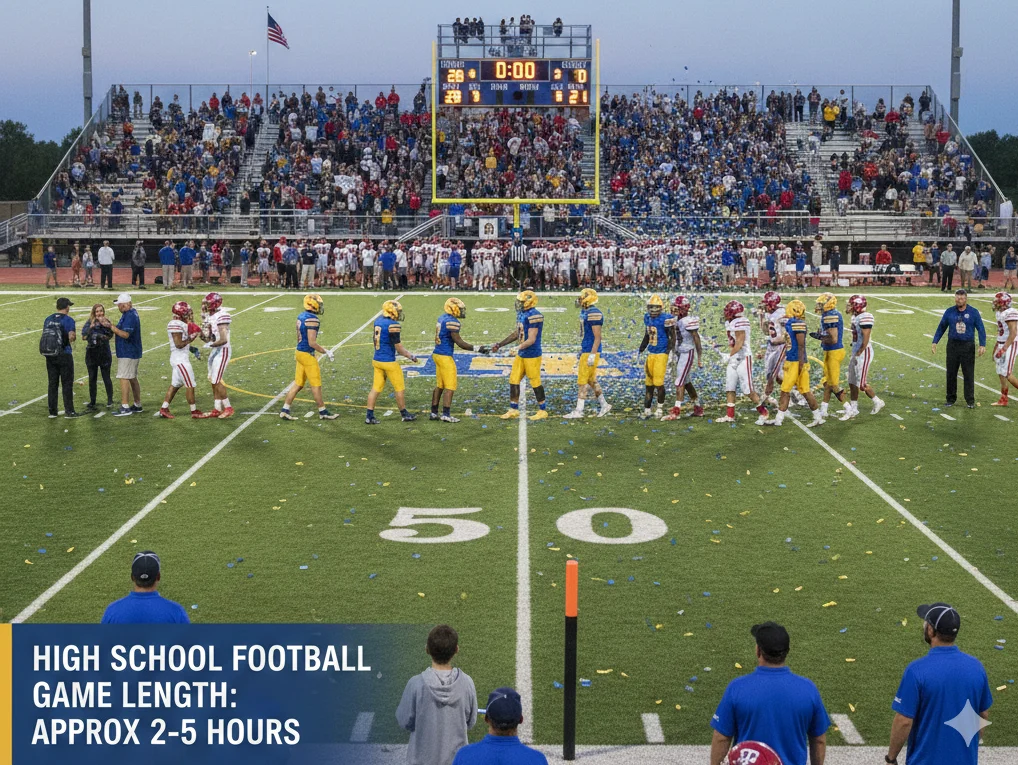
A typical high school football game runs about 2 to 2.5 hours from kickoff to the final whistle, including the four 12‑minute quarters, halftime, timeouts, and clock stoppages.
While the official clock totals 48 minutes, the real‑world duration is longer because of timeouts, injuries, penalties, clock stoppages for incomplete passes or out-of-bounds plays, and halftime breaks.
Yes — at the varsity level, quarters are usually 12 minutes each under NFHS rules. Some states or lower levels (JV/freshman) may use shorter quarters.
Yes — overtime, weather delays, penalties, injuries, and extended halftime events (e.g., band performances in playoffs) can push games toward 3 hours or more.
Many states implement a running clock (“mercy rule”) when one team leads by a large margin, which keeps the clock running and shortens the total game time.
Conclusion
A high school football game has 48 minutes of official playing time (four 12‑minute quarters), but due to clock stoppages, timeouts, halftime, and other breaks, the real‑world duration is much longer. Most varsity games take about 2 to 2½ hours from kickoff to the final whistle, and can approach or exceed 3 hours in cases of many stoppages or overtime play.












Leave a Reply