

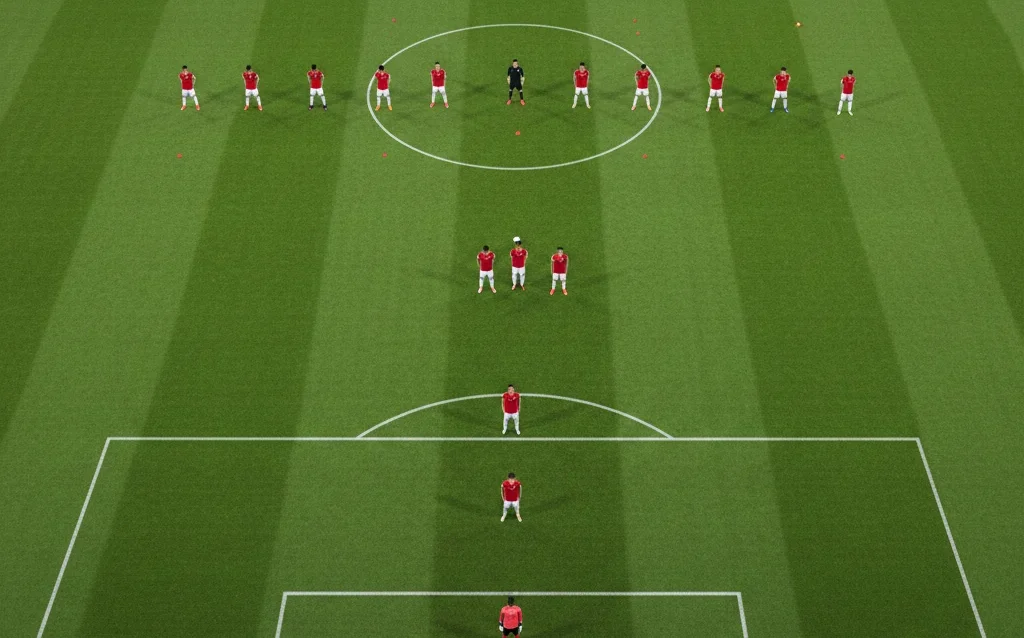
The Football Formations 4-2-3-1 is one of the most widely used tactical systems in modern football. It features four defenders, two defensive midfielders, three attacking midfielders, and a central striker, providing a balanced approach that combines defensive solidity with attacking flexibility. This formation allows teams to control the midfield, create width through wingers and full-backs, and maintain a compact defensive structure when out of possession.
What Is the 4-2-3-1 Formation?
The 4-2-3-1 formation is a popular football tactical system consisting of four defenders, two defensive midfielders, three attacking midfielders, and one central striker. It provides defensive stability while maintaining attacking flexibility.
Back Four
- 2 Centre-backs
- 2 Full-backs
- Defensive foundation of the team
Double Pivot
- 2 Defensive/Central Midfielders
- Shield the defense
- Control transitions
Attacking Midfield Trio
- Left Winger
- Central Attacking Midfielder
- Right Winger
Lone Striker
- Central Forward
- Finishes attacks
- Links play
Formation Diagram & Roles
The 4-2-3-1 formation is structured in four clear horizontal lines that provide balance between defense and attack.
Shape in Defense
- Often shifts into a 4-4-1-1 or 4-5-1
- Wingers drop back to support full-backs
- CAM stays close to midfield
- Striker presses or blocks passing lanes
Centre-Backs (CBs)
- Maintain defensive line
- Mark opposition striker
- Win aerial duels
Full-Backs (LB/RB)
- Close down wide attackers
- Prevent crosses
- Stay disciplined in positioning
Double Pivot (CDMs)
- Screen the defense
- Break up attacks
- Control central spaces
Wide Players & Striker
- Wingers track back to form midfield four
- Block wide passing channels
- Striker initiates pressing
- Forces play into wide areas
Shape in Build-Up
- One CDM drops between centre-backs
- Full-backs push slightly higher
- CAM finds space between lines
Goalkeeper & Centre-Backs
- GK acts as sweeper-keeper
- Distributes short
- CBs spread wide for passing angles
- Start ball progression
Double Pivot
- Offer safe passing options
- Switch play
- Resist pressing
Full-Backs & CAM
- Provide width
- Advance carefully
- CAM receives between lines
- Operates on the half-turn
Shape in Attack
- Full-backs push high
- Wingers stretch the pitch
- CAM supports striker
- One CDM protects transitions
Striker
- Finishes chances
- Holds up play
- Makes runs behind defense
Wingers
- Cut inside or stay wide
- Create crossing opportunities
- Attack half-spaces
CAM & Holding Midfielder
- Primary playmaker
- Links midfield and attack
- Arrives late into the box
- Holding midfielder prevents counter-attacks
Strengths & Weaknesses of the 4-2-3-1 Formation
The 4-2-3-1 is one of the most balanced systems in modern football. It offers defensive solidity, structured build-up, and attacking versatility. However, like any formation, it has tactical trade-offs depending on player profiles and match context.
Strengths
1. Strong Defensive Stability
- Double pivot screens central spaces
- Breaks up counter-attacks
- Provides cover when full-backs push forward
2. Excellent Transitional Play
- Ball recovery by CDMs
- Immediate progression to CAM
- Fast release to wingers or striker
3. Central Midfield Control
- Outnumbers opponents in central zones
- CAM operates between defensive and midfield lines
- Passing triangles enhance possession retention
4. Tactical Flexibility
- Can morph into 4-4-1-1 (defensive block)
- Can shift to 4-3-3 (if CDM pushes forward)
- Can adopt 4-5-1 (deep defensive phase)
5. Balanced Width and Creativity
- Wingers stretch defenses horizontally
- Full-backs overlap
- CAM provides vertical penetration
Weaknesses
1. Lone Striker Isolation
- Striker may become isolated
- Opposing center-backs can double-mark
- Attacks may lose momentum
2. Heavy Dependence on the CAM
- Tightly marked CAM reduces chance creation
- Without a quality playmaker, attacks become predictable
3. Vulnerability on the Wings
- Space opens when full-backs push high
- Quick wide transitions can exploit defensive gaps
4. Physical Demands on the Double Pivot
- Cover large spaces
- Defend and distribute efficiently
- Maintain positional discipline
5. Can Become Too Defensive
- Double pivot may limit attacking numbers
- Ball circulation may become slow
- Breaking low blocks becomes challenging
Tactics in Practice (with Manager Case Studies)
The 4-2-3-1 formation blends defensive stability with attacking flexibility. Its application varies depending on the manager’s philosophy and player selection. Here’s a look at how top managers use it.
Jose Mourinho – Counter-Attacking 4-2-3-1
- Style: Defensive solidity, fast transitions
- Teams: Inter Milan (2009–10), Manchester United (2016–17)
- Tactical Approach:
- Double Pivot: One holds deeper, one supports counters
- Striker: Lone forward holds ball, runs behind defense
- Wingers: Stay wide, exploit spaces on counters
- Full-backs: Limited forward runs for defensive balance
Weakness: Limited attacking overload in opponent’s half.
Pep Guardiola – Possession-Based 4-2-3-1
- Style: High-possession, positional play
- Teams: Bayern Munich, Manchester City
- Tactical Approach:
- Double Pivot: Both midfielders capable passers forming central hub
- CAM: Links midfield and attack centrally
- Full-backs: Inverted or overlapping to create numerical superiority
- Pressing: High press after losing possession
Weakness: Vulnerable to fast counter-attacks if ball lost high.
Diego Simeone – Defensive, Compact 4-2-3-1
- Style: Highly disciplined, low block, counter-attack
- Team: Atletico Madrid
- Tactical Approach:
- Double Pivot: Extremely disciplined; shields defense
- Wingers: Track back, support full-backs
- Striker: Physical, holds up play
- Pressing: Selective; energy focused on key moments
Weakness: Limited creativity; requires disciplined players.
Jurgen Klopp – High-Intensity 4-2-3-1 Variant
- Style: Gegenpressing, vertical play
- Team: Liverpool (early 2010s)
- Tactical Approach:
- Double Pivot: One presses aggressively, one slightly behind
- CAM: Links directly to striker; involved in pressing triggers
- Wingers: High-speed, inverted runs to overload flanks
- Full-backs: Push high for attack and width
Weakness: Demands extreme fitness; gaps appear if press bypassed.
Lessons from Manager Case Studies
- Flexibility is key: Can be defensive, possession-based, or counter-attacking.
- Player roles matter: Depends on abilities of CDMs, CAM, full-backs.
- Tactical discipline: Simeone & Mourinho rely on strict positioning; Guardiola on movement.
- Transition phases define outcomes: Quick recovery and build-up are crucial.
4-2-3-1 vs Other Formations
Comparison of the 4-2-3-1 formation against other popular formations in terms of defense, midfield control, attacking width, and flexibility.
| Formation | Defensive Stability | Midfield Control | Attacking Width | Flexibility | Best Use Case |
|---|---|---|---|---|---|
| 4-2-3-1 | High (double pivot shields defense) | Strong (numerical superiority in midfield) | Good (wingers + full-backs) | Very flexible (can shift to 4-4-1-1, 4-3-3, 4-5-1) | Balanced teams; possession or counter-attack |
| 4-4-2 | Medium | Medium | Medium (depends on wide midfielders) | Moderate | Direct play; wingers on the flank |
| 4-3-3 | Medium | Strong (three central midfielders) | High (wide wingers) | High | Attacking teams; pressing style |
| 3-5-2 | High (three center-backs) | Strong (midfield overload) | Medium (wing-backs provide width) | Moderate | Control midfield; counter defensive teams |
| 5-3-2 | Very High | Medium | Low | Low | Defensive teams; absorb pressure |
| 4-1-4-1 | High | Medium | Medium | Moderate | Defensive solidity with midfield support |
Frequently Asked Questions
1. What is the main advantage of the 4-2-3-1 formation?
The 4-2-3-1 formation provides defensive stability with a double pivot while maintaining attacking flexibility. It allows teams to control midfield and create multiple attacking channels through wingers, CAM, and overlapping full-backs.
2. Which players are key in the 4-2-3-1 system?
The most crucial players are the two CDMs (double pivot) for defensive cover, the CAM (No. 10) for creative playmaking, and the lone striker for finishing attacks. Full-backs and wingers also play vital roles in width and transitions.
3. How does the 4-2-3-1 differ from a 4-3-3 formation?
While 4-3-3 uses three central midfielders for control and pressing, the 4-2-3-1 uses two holding midfielders with a central playmaker (CAM). This allows better defensive balance while maintaining attacking creativity behind a lone striker.
4. What are the weaknesses of the 4-2-3-1 formation?
Weaknesses include potential isolation of the lone striker, dependence on the CAM for creativity, vulnerability on the wings when full-backs push high, and high physical demands on the double pivot.
5. Which top managers use the 4-2-3-1 formation?
Famous managers who have used this formation include Jose Mourinho (counter-attacking), Pep Guardiola (possession-based), Diego Simeone (defensive compact), and Jurgen Klopp (high-intensity pressing variant).











Leave a Reply