

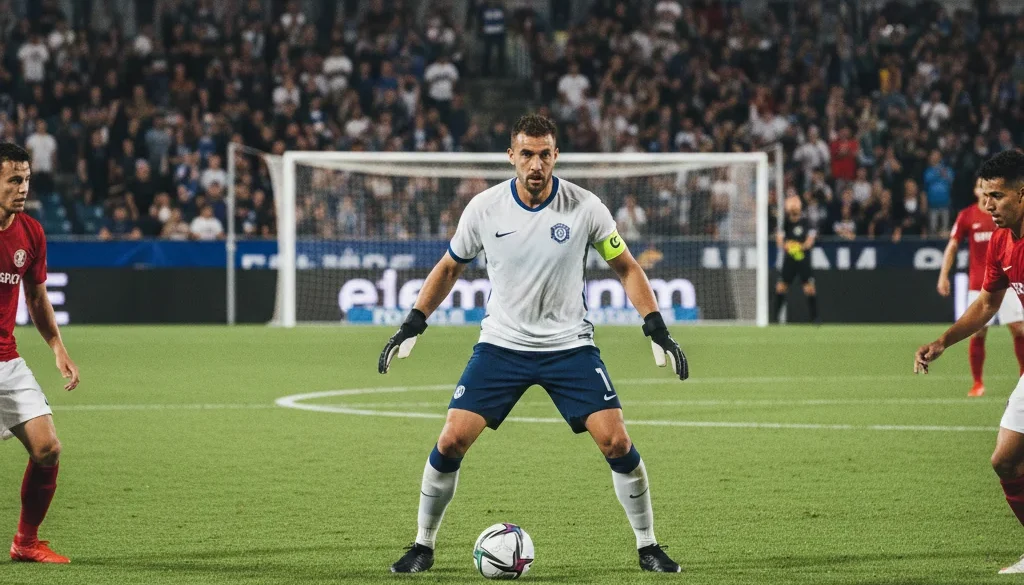
Sweeper Center-Back Is the Most Crucial Element in a Back-Three System
A sweeper center-back is the central defender in a back-three system who sits slightly behind the other two center-backs, reading the game, intercepting threats, and covering gaps.
Relevance Today:
In modern football, where teams press high and wing-backs push forward, the sweeper is crucial for:
Defensive security: Cleans up balls behind the line.
Transition play: Initiates attacks from the back.
Tactical flexibility: Allows the team to maintain width and control space centrally.
In short: the sweeper turns a back-three from vulnerable into structured and attack-ready.
History & Evolution of the Sweeper
1. Origins: Catenaccio and the Libero (1950s–1970s)
Catenaccio, an Italian defensive system, popularized the libero (Italian for “free”) as a sweeper behind the defensive line.
- Role: Clean up balls past the man-marking defenders, organize defense, and start counter-attacks.
- Famous Practitioners:
- Franco Baresi (AC Milan) – excellent reading of the game, technical ability.
- Gaetano Scirea (Juventus) – elegant ball-playing sweeper, initiated attacks.
- Characteristics: Defensive-first mindset; man-marking teammates handled immediate threats, libero provided cover. Minimal involvement in buildup play compared to modern standards.
2. Evolution Through the 1980s–1990s
Teams valued ball-playing defenders; sweepers became more proactive:
- Dribbling out of defense.
- Passing to midfielders or wingers to launch attacks.
- Tactical systems like 3-5-2 and 4-4-2 integrated sweepers with possession responsibilities.
- Example: Franz Beckenbauer (Germany) – “The Kaiser” blended defensive security with elegant playmaking.
3. Modern Back-Three Systems (2000s–Today)
Pure sweepers are rare; teams now use central ball-playing defenders as sweeper-like pivots.
- Role Shift: Orchestrating defense and starting attacks.
- Often drops behind teammates during build-up, forming a temporary back-four.
- Tactical Examples:
- Pep Guardiola’s teams – CBs split wide or drop between midfielders to control possession.
- Antonio Conte’s back-three at Chelsea/Inter – central CB acts as sweeper, wing-backs provide width, midline pressing enabled.
- Key Qualities Today: Vision, passing range, speed, and anticipation—less focus on last-ditch tackles.
Sweeper vs Center Back — Role Differences
Compare the roles and responsibilities of a Sweeper (Libero / Modern Back-Three CB) versus a Traditional Center-Back.
| Feature / Role | Sweeper (Libero / Modern Back-Three CB) | Traditional Center-Back |
|---|---|---|
| Positioning | Sits slightly behind the other CBs; covers gaps and reads the game | Marks opposing forwards; holds the defensive line |
| Primary Role | Sweeps up loose balls, intercepts through passes, provides defensive cover | Stops attackers, blocks shots, wins aerial duels |
| Ball Distribution | Often initiates attacks with passes or dribbles; can act as pivot | Mainly short passes to midfielders or wide players; less involved in buildup |
| Game Reading | High emphasis on anticipation and positioning | Focused on marking and responding to immediate threats |
| Mobility | Must be quick to cover spaces left by teammates; can step into midfield | Less required to roam; stays in line with fellow defenders |
| In Modern Systems | Key in back-three or fluid defensive setups; links defense and attack | Usually part of a back-four or static defensive line |
| Famous Examples | Franz Beckenbauer, Franco Baresi, Virgil van Dijk (modern sweeper-like) | Sergio Ramos, Gerard Piqué, Kalidou Koulibaly |
Tactical Responsibilities (With Diagrams)
The sweeper’s influence changes across game phases. Below is a visual breakdown of
defensive positioning, build-up involvement, and transition responsibilities.
Defensive Phase
The sweeper positions deeper than the main defensive line, reading danger early and
covering space behind pressing defenders.
CB
CB
SW
Covering space behind the defensive line
Build-Up Phase
During possession, the sweeper steps forward to create numerical superiority and
progress the ball under pressure.
CB
CB
SW
Stepping into midfield to start attacks
Transition Phase
When possession changes, the sweeper must react instantly—either dropping to delay
counters or distributing quickly after regaining the ball.
SW
Recovery runs or fast ball circulation
Modern Usage in Back Three / Back Five
The modern sweeper role survives through positional responsibility rather than fixed position.
Back-three and back-five systems adapt this role differently depending on pressing intensity,
build-up structure, and transition control.
—–Manchester City — Positional Back Three
DEFENSE
High line protected by anticipation and counter-pressing
BUILD-UP
Central CB drops as a sweeper-pivot while wide CBs stretch play
TRANSITION
Immediate counter-press prevents exposure behind the line
—–Atalanta — Aggressive Sweeper System
DEFENSE
Man-oriented marking with central cover behind duels
BUILD-UP
Central defender steps into midfield to overload zones
TRANSITION
Sweeper recovers space aggressively after turnovers
—- Back Five — Defensive Stability Model
DEFENSE
Central CB holds deepest position to protect wide channels
BUILD-UP
Longer circulation before progression, safety-first passing
TRANSITION
Sweeper delays counters while wing-backs recover
Player Profile Snapshot (Indicative)
Typical performance benchmarks that define the modern sweeper role in
elite tactical systems.
| Metric | Modern Sweeper Profile |
|---|---|
| Interceptions / 90 | 1.6 – 2.0 |
| Progressive Passes / 90 | 7 – 9 |
| Progressive Carries / 90 | 1.5 – 2.3 |
| Pass Accuracy | 89 – 92% |
| Aerial Duel Win % | 65 – 75% |
| Errors Leading to Shots | Very Low |
These profiles align with players such as Virgil van Dijk,
Alessandro Bastoni, and prime-era Franco Baresi
when evaluated within role-adjusted tactical contexts.
Training & Skill Drills
Developing an Elite Sweeper Center-Back
Sweepers must train anticipation, scanning, recovery speed, and progressive play —
often while operating under pressure and numerical disadvantage.
Interception & Reading Drill
Purpose
Improve anticipation, lane-blocking, and reading passing cues.
Setup
- Area: 20×20 meters
- 3 attackers positioned on the outside
- 1 sweeper in the central zone
- 1 mini-goal behind the sweeper
Action
Attackers circulate the ball and attempt a threaded pass into the mini-goal.
The sweeper must read body shape, passing angles, and intercept early.
Coaching Points
- Side-on defensive stance
- Scan every 2–3 seconds
- Intercept before sprinting
Match Transfer: Simulates through-balls played behind a high defensive line.
Recovery & Cover Drill
Purpose
Train covering space behind advancing center-backs and wing-backs.
Setup
- Area: 30×40 meters
- 2 wide defenders step high
- 1 sweeper starts deeper
- 2 attackers counter toward goal
Action
Ball is released to attackers. Sweeper must delay, angle the recovery run,
and block central passing lanes.
Coaching Points
- Don’t dive in
- Curve recovery runs
- Force play wide and buy time
Key Skill: Covering space, not chasing the ball.
Progressive Passing Circuit
Purpose
Develop line-breaking distribution from deep areas.
Setup
- Back three + 2 midfield targets
- Mannequins or cones simulate pressing opponents
Action
Ball flows GK → sweeper. The sweeper must decide between a vertical pass,
switch of play, or stepping in before releasing.
Constraints
- Two-touch maximum
- One vertical option blocked
Coaching Points
- Scan before receiving
- Play on the half-turn
- Weight and timing of pass
Step-In & Carry Drill
Purpose
Encourage confident but controlled ball carrying.
Setup
- Central channel marked (15–20m)
- Sweeper receives under light pressure
Action
Sweeper drives forward into space and must release a pass before pressure arrives.
Progression
- Add pressing midfielder
- Decision between forward pass or recycle
Key Focus: Breaking lines without over-dribbling.
Communication & Line Control Drill
Purpose
Develop defensive leadership and collective movement.
Setup
- Back three + wing-backs
- Coach calls triggers: “STEP”, “DROP”, “SHIFT”
Action
Sweeper issues commands while the defensive line moves in sync.
Coaching Points
- Clear, early communication
- Constant scanning
- Correct body shape while organizing
Frequently Asked Questions
1. What is the main role of a sweeper center-back?
A sweeper center-back provides cover behind the defensive line, intercepts
through-balls, organizes defensive shape, and initiates progressive build-up play.
The role blends defensive intelligence with composure on the ball.
2. How is a modern sweeper different from a traditional center-back?
Unlike traditional stoppers who focus on duels and clearances, modern sweepers
are proactive defenders. They step into midfield, carry the ball forward,
break lines with passing, and manage space behind high defensive lines.
3. Which formations use a sweeper center-back?
Sweepers are most common in back-three or back-five systems such as 3-2-4-1,
3-4-3, and 5-2-3. The central defender operates deeper, providing balance
when wide center-backs and wing-backs push forward.
4. What key skills should a sweeper center-back train?
Core skills include anticipation, scanning, recovery speed, progressive passing,
controlled ball carrying, aerial ability, and constant communication with the
defensive line.
5. Can young defenders be trained as sweepers?
Yes. Young defenders can be developed as sweepers by emphasizing game reading,
comfort on the ball, decision-making under pressure, and leadership skills
rather than focusing only on physical defending.











Leave a Reply