

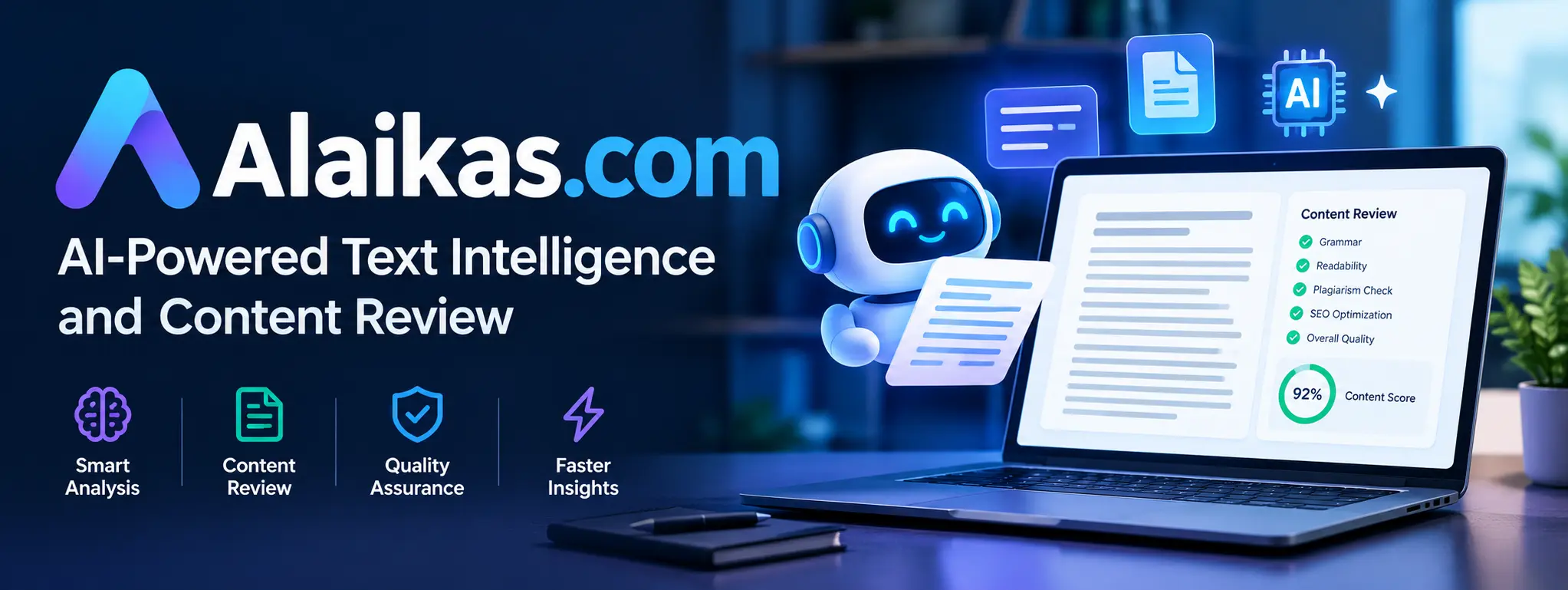
In the fast-changing world of digital publishing, creating useful content is only the first step. Writers must also review clarity, structure, keyword placement, readability, and the quality of their ideas before publishing. Alaikas.com is presented in recent online coverage as a platform focused on AI-powered text intelligence and content review, helping users examine written material and identify areas that may need improvement.
For bloggers, students, marketers, website owners, and professional writers, text analysis can make editing more organized and efficient. Instead of relying entirely on manual proofreading, users can explore how their content is structured, which terms appear frequently, and whether certain sections deserve another look.
However, an important distinction remains: a platform’s advertised capabilities do not automatically prove that every feature performs accurately. Understanding what Alaikas.com offers, how text-analysis tools can support a writing workflow, and which details require verification can help users make better decisions.
Understanding Alaikas.com and AI-Powered Text Intelligence
Alaikas.com is described in recent third-party articles as an AI-assisted text-analysis and informational content platform. Its reported purpose centers on reviewing existing writing rather than simply generating new paragraphs.
Text intelligence involves examining written material to identify patterns, repeated expressions, prominent topics, structural issues, and other characteristics. Depending on the tool, analysis may also include readability indicators and basic text statistics.
For example, a blogger preparing a detailed guide might discover that several sections repeat the same explanation. A marketing professional could notice that a landing page uses vague language instead of explaining a product’s actual benefits. Text analysis can help make these issues easier to identify.
The main value of this approach is practical: writers can make informed revisions before their work reaches readers.
Nevertheless, the precise capabilities, pricing, and performance of Alaikas.com’s full analysis tools should be confirmed through the live website rather than assumed from descriptions published elsewhere.
How Alaikas.com May Support the Content Review Process
AI-assisted content review generally works by examining text and presenting information that helps users evaluate their writing. The exact process depends on the available tool and its underlying technology.
1. Text Structure and Organization
A well-organized article guides readers from one idea to another. Long paragraphs, unrelated sections, and repeated explanations can make even valuable information difficult to follow.
A text-analysis workflow can help writers inspect paragraph lengths, sentence patterns, and the overall organization of their material. These observations are particularly useful when reviewing long articles, reports, educational resources, and website pages.
Writers should still evaluate the logical flow of their arguments themselves. A sentence can be grammatically correct while appearing in the wrong section.
2. Keyword and Topic Analysis
Keyword analysis can help website owners understand how a topic is represented throughout an article. It may reveal frequently used phrases, related concepts, or sections where a subject receives limited attention.
For SEO professionals, this information can support a more balanced content review. For instance, an article about website security should address practical security concerns rather than repeat its primary keyword in every paragraph.
There is an important difference between identifying repeated terms and understanding search intent. A tool may count a phrase accurately without knowing whether the article answers the reader’s underlying question.
3. Readability and Sentence Review
Clear writing helps readers understand information without unnecessary effort. Excessively long sentences, unexplained technical expressions, and complicated paragraphs can make content harder to consume.
Readability analysis can highlight sections that deserve closer inspection. A writer may then shorten a sentence, replace an unfamiliar expression, or explain a technical concept with a relevant example.
However, readability scores are indicators, not universal standards. Technical documentation, academic research, and general-interest blog posts have different audiences and language requirements.
4. Identifying Repetition and Content Gaps
Repetition is one of the most common problems in lengthy online articles. Writers sometimes explain the same benefit in the introduction, several body sections, and the conclusion without adding new information.
Text intelligence can help identify recurring words and overlapping passages. Editors can use these observations to remove unnecessary material and improve the article’s overall value.
A more advanced editorial review should also examine missing information. For example, a guide discussing an online service might explain its purpose but omit pricing, privacy practices, limitations, or the steps required to use it.
These missing details can be more important to readers than minor wording improvements.
Who Can Benefit From Alaikas.com?
The usefulness of an AI text-analysis platform depends on its actual features and the user’s needs. The following groups may benefit from this type of technology.
Bloggers and Website Owners
Bloggers regularly update articles, publish new guides, and maintain existing website pages. Reviewing content structure and repeated ideas can help them produce more useful resources.
Website owners can also use a consistent review checklist to maintain a recognizable editorial style across multiple articles.
SEO Specialists and Digital Marketers
SEO specialists need content that addresses search intent while remaining natural and informative. Text-analysis tools can help identify keyword patterns, repetitive passages, and areas that require editorial attention.
However, text analysis alone cannot guarantee higher rankings. Search visibility depends on numerous factors, including relevance, content quality, competition, technical accessibility, and the usefulness of the page.
Students and Researchers
Students may use text-analysis tools to review essays, reports, and research summaries. Such tools can help identify awkward sentences or repeated explanations before submission.
Users should verify factual claims, preserve proper citations, and follow their institution’s rules regarding AI assistance. An automated review should not replace independent research or critical thinking.
Businesses and Content Teams
Businesses often publish product descriptions, customer communications, internal reports, and marketing materials. A structured review process can improve consistency across these different formats.
Teams should establish clear editorial standards so that automated suggestions support their communication goals rather than making every document sound identical.
Alaikas.com Compared With Other Content Review Approaches
Different tools solve different writing problems. Before choosing a platform, users should distinguish basic text measurement from grammar correction, readability editing, and comprehensive content analysis.
| Review approach | Main purpose | Best use |
|---|---|---|
| AI text intelligence | Examine patterns and content characteristics | Initial content review |
| Grammar checker | Identify grammar, spelling, and punctuation issues | Proofreading |
| Readability editor | Highlight difficult sentences and wording | Improving clarity |
| SEO content analyzer | Examine keyword coverage and related topics | Search-focused editing |
| Human editorial review | Evaluate accuracy, relevance, originality, and reasoning | Final quality control |
Alaikas.com is associated with AI-powered text analysis in recent online descriptions, but its exact capabilities should be checked before treating it as a complete alternative to these other approaches.
The most effective choice is not necessarily the tool with the longest feature list. It is the one that reliably addresses the user’s actual editing needs.
A Practical Workflow for Reviewing Content With AI
Writers can get more value from text-analysis technology by following a consistent process. These steps are useful whether a user chooses Alaikas.com or another writing tool.
- Prepare the draft: Remove obvious formatting problems and ensure the article has a clear purpose.
- Review the structure: Check whether headings and paragraphs follow a logical sequence.
- Inspect repeated terms: Identify unnecessary keyword repetition and overlapping explanations.
- Check readability: Review long sentences, vague expressions, and unexplained technical language.
- Verify the final version: Confirm facts, sources, examples, privacy considerations, and the accuracy of the revised content.
This workflow keeps the writer in control. AI-generated suggestions become evidence for editorial decisions rather than instructions that must always be followed.
For SEO articles, add one further step: compare the finished draft with the questions readers are likely to ask. A technically polished article can still disappoint if it fails to provide the information people came to find.
Important Limitations and Safety Considerations
AI-powered text intelligence can be useful, but users should understand its limitations before relying on any platform for important work.
Automated Analysis Does Not Guarantee Accuracy
A tool may identify repeated phrases correctly but misunderstand their purpose. Repetition can be necessary when defining a technical term, explaining a process, or maintaining consistency.
Likewise, a readability score cannot fully measure whether an explanation is accurate, persuasive, or suitable for its intended audience.
Privacy Deserves Careful Attention
Before submitting unpublished articles, business documents, research, or client material, review the platform’s privacy policy and terms of service.
Look for information about data retention, access, deletion, and whether submitted text may be used to improve services. If these details are unclear, avoid uploading confidential or personally identifiable information.
Verify Access, Pricing, and Available Features
The existence of an advertised tool does not establish that every feature is currently available or free. Users should verify whether registration is required, whether usage limits apply, and whether paid services are offered.
A short test using non-sensitive text can help determine whether the tool provides useful results for a particular task.
Five Practical Tips for Getting Better Results
- Start with a clear goal: Decide whether you need structural feedback, readability improvements, or keyword analysis.
- Use relevant examples: Compare the tool’s suggestions with your intended audience and writing style.
- Avoid keyword stuffing: Use important phrases naturally and prioritize the reader’s needs.
- Check factual claims separately: Text analysis cannot replace reliable sources and careful fact-checking.
- Keep editorial control: Accept only suggestions that improve meaning, accuracy, or clarity.
These practices make AI-assisted editing more effective without sacrificing the originality and personality of the writer’s work.
Final Thoughts
Alaikas.com is described in recent third-party coverage as a website focused on AI-powered text intelligence and content review. This category of technology can help writers examine structure, repeated language, topic coverage, and potential readability problems before publishing their work.
For bloggers, students, marketers, and businesses, the greatest opportunity lies in combining automated analysis with thoughtful human editing. A useful review process should improve the reader’s experience, preserve factual accuracy, and remove unnecessary repetition without stripping away the writer’s individual voice.
At the same time, users should verify Alaikas.com’s current features, pricing, and privacy practices rather than relying solely on promotional claims or third-party descriptions. Testing a small, non-sensitive sample is a sensible starting point.
Ultimately, strong content requires more than a polished appearance. It needs accurate information, meaningful explanations, clear organization, and a genuine understanding of the audience. AI-powered text intelligence can support that process, but careful research and sound editorial judgment remain essential.
Frequently Asked Questions
1. What is Alaikas.com used for?
Alaikas.com is described in recent online coverage as an AI-assisted text-analysis platform intended to help users review written content.
2. Who may benefit from Alaikas.com?
Bloggers, website owners, students, marketers, and businesses may find text-analysis tools useful for reviewing and improving their writing.
3. Can Alaikas.com help with SEO content?
Text analysis may support keyword and structure reviews, but it cannot guarantee search rankings or replace comprehensive SEO research.
4. Is Alaikas.com free to use?
Its current pricing and access conditions should be verified on the live website. Do not assume that every advertised feature is free.
5. Should I upload confidential documents to Alaikas.com?
Avoid uploading confidential material until you have reviewed the platform’s privacy policy, data-handling practices, and relevant terms of service.






Leave a Reply