

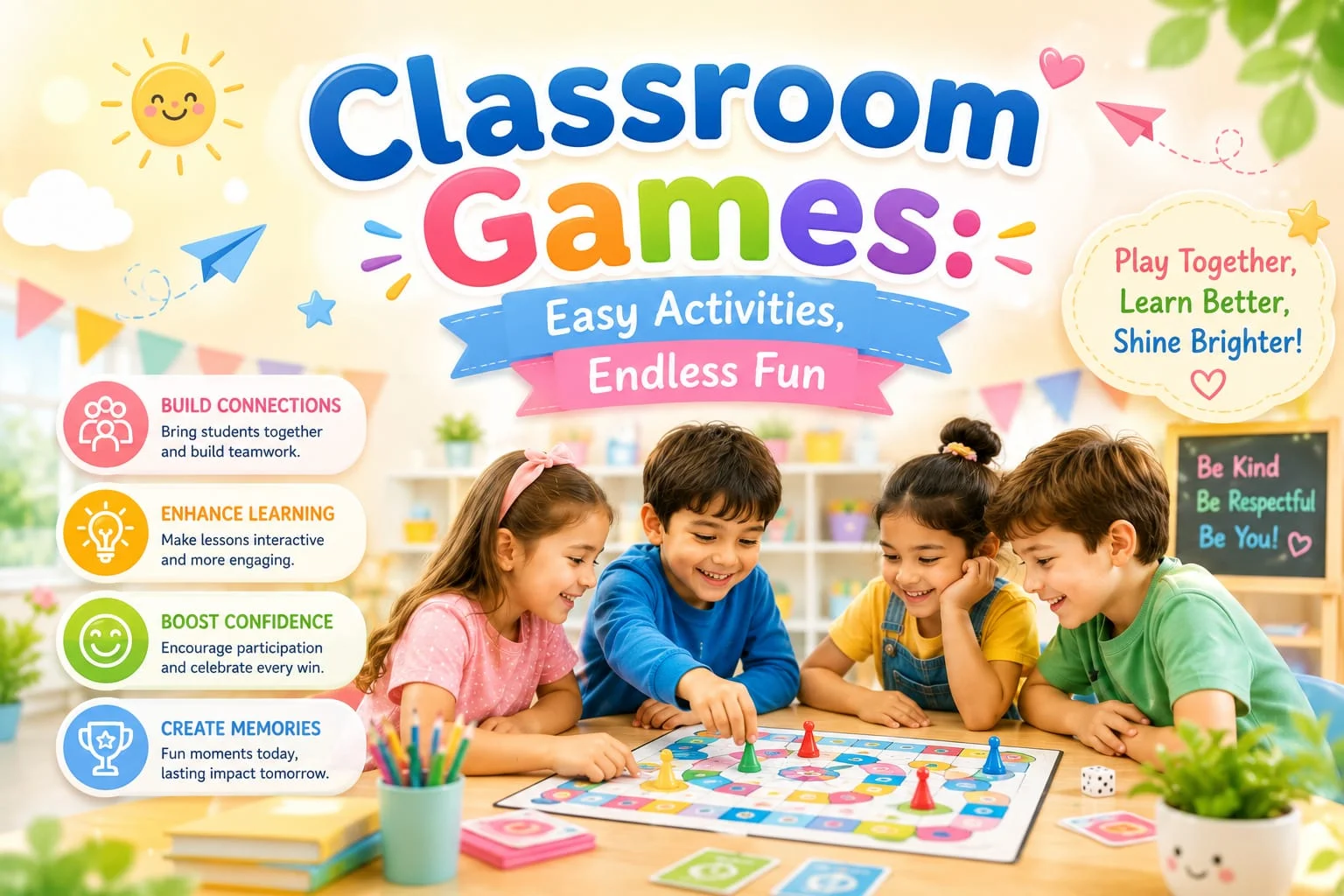
Classroom games can turn an ordinary lesson into an exciting learning experience. Whether students need a quick break, a review activity, or a creative way to practice new skills, games can make the classroom more interactive and enjoyable. The best part is that many classroom games require little preparation and can be adapted for different ages, subjects, and class sizes.
Why Classroom Games Are Valuable
Games are more than just entertainment. A well-designed classroom activity can support learning while giving students an opportunity to participate in a different way.
Make Learning More Engaging
Students may lose interest when a lesson relies only on lectures, worksheets, or textbook exercises. Games introduce variety and give students something active to focus on. Even a five-minute activity can refresh attention and make a lesson feel more enjoyable.
Encourage Teamwork
Many classroom games involve pairs or small groups. Students learn to communicate, listen to others, share ideas, and work toward a common goal. These skills are useful both inside and outside the classroom.
Support Different Learning Styles
Not every student learns in exactly the same way. Some enjoy speaking activities, while others prefer writing, solving problems, drawing, or moving around. Classroom games can provide different ways for students to interact with the material.
Easy Classroom Games to Try
You do not need complicated equipment or hours of preparation to create a fun classroom activity. Here are several simple ideas that can work in many subjects.
1. Quick Quiz Challenge
Divide the class into small teams and prepare several questions related to the current lesson. Ask one question at a time and allow teams to discuss their answers before responding.
Questions can cover vocabulary, mathematics, science, history, or general knowledge. Keep the pace quick so students remain involved.
2. Word Chain
Choose a starting word and ask students to create another word beginning with the final letter of the previous word.
For example, one student might say “book,” followed by “kite,” then “elephant.” Teachers can make the activity more educational by limiting words to a specific topic, such as animals, countries, or science terms.
3. Charades
Write vocabulary words, concepts, or topics on small pieces of paper. One student chooses a word and acts it out without speaking while classmates try to guess it.
Charades can be particularly useful for language learning because students connect words with actions and meanings.
4. Classroom Scavenger Hunt
Create a list of clues or questions connected to the lesson. Students work individually or in teams to find answers around the classroom or within provided learning materials.
A scavenger hunt can turn a review session into an active challenge while encouraging students to explore information carefully.
5. Pictionary
Give a student a word or concept and ask them to draw it on the board. Other students try to identify what is being represented.
Pictionary works well for vocabulary, science concepts, geography, and many other subjects. It also gives creative students a chance to participate.
Classroom Games for Different Subjects
One advantage of classroom games is that they can be adapted to almost any subject.
Language and Vocabulary Games
For language classes, try vocabulary bingo, word matching, scrambled words, or sentence-building competitions. These activities can help students practice spelling, grammar, definitions, and communication.
Teachers can also give students a group of words and challenge them to create a sentence using as many words as possible.
Math Games
Math games can make practice feel less repetitive. Number challenges, mental-math races, logic puzzles, and problem-solving competitions can help students practice calculations and reasoning.
For younger learners, teachers can use cards, dice, or simple classroom objects to create number-based activities.
Science Games
Science lessons offer plenty of opportunities for interactive games. Students can play identification games, science trivia, vocabulary challenges, or classification activities.
For example, a teacher can describe an animal, plant, material, or scientific process and let teams identify the answer.
History and Geography Games
History and geography can become more memorable through quizzes, map challenges, timeline activities, and mystery clues. Students might match historical events with dates or identify locations from clues.
These activities encourage students to recall information while making the review process more dynamic.
How to Make Classroom Games Successful
A good classroom game should be fun, but it should also have a clear purpose. A few simple strategies can make activities work better.
Keep the Rules Simple
Students should understand what they need to do before the game begins. Explain the rules clearly and demonstrate an example if necessary. Complicated instructions can take attention away from the learning goal.
Set a Reasonable Time Limit
Short activities are often easier to manage. A five- or ten-minute game can provide energy without taking over the entire lesson. For longer activities, divide the game into clear stages.
Include Everyone
Try to design games where every student has a chance to participate. Avoid activities where the same few students always answer questions or take the lead.
Small teams, rotating roles, and turn-based activities can help create more balanced participation.
Focus on Learning, Not Just Winning
Competition can make games exciting, but winning should not become the only goal. Give students opportunities to explain answers, learn from mistakes, and work together.
Teachers can also use cooperative games where the entire class works toward a shared target.
Classroom Games With Little or No Preparation
When time is limited, teachers can still introduce games without preparing special materials.
Twenty Questions
Think of a person, place, object, or concept connected to the lesson. Students ask questions that can be answered with yes or no until they identify the answer.
True or False
Read statements related to the topic and ask students to decide whether each one is true or false. Afterward, discuss the answers and explain any misconceptions.
One-Minute Challenge
Give students one minute to complete a focused task, such as listing vocabulary words, solving problems, naming examples, or recalling key facts.
These quick activities are useful at the beginning or end of a lesson.
Final Thoughts
Classroom games are a simple way to bring energy and interaction into everyday learning. They can help students review important concepts, practice useful skills, communicate with classmates, and approach lessons with greater enthusiasm.
The most effective activities do not need expensive materials or complicated rules. A quick quiz, word game, drawing challenge, or team activity can be enough to change the atmosphere of a classroom.
By choosing games that match the lesson objective and giving every student a chance to participate, teachers can create learning experiences that are both productive and enjoyable. With a little creativity, classroom games can turn everyday lessons into opportunities for easy activities and endless fun.















Leave a Reply